
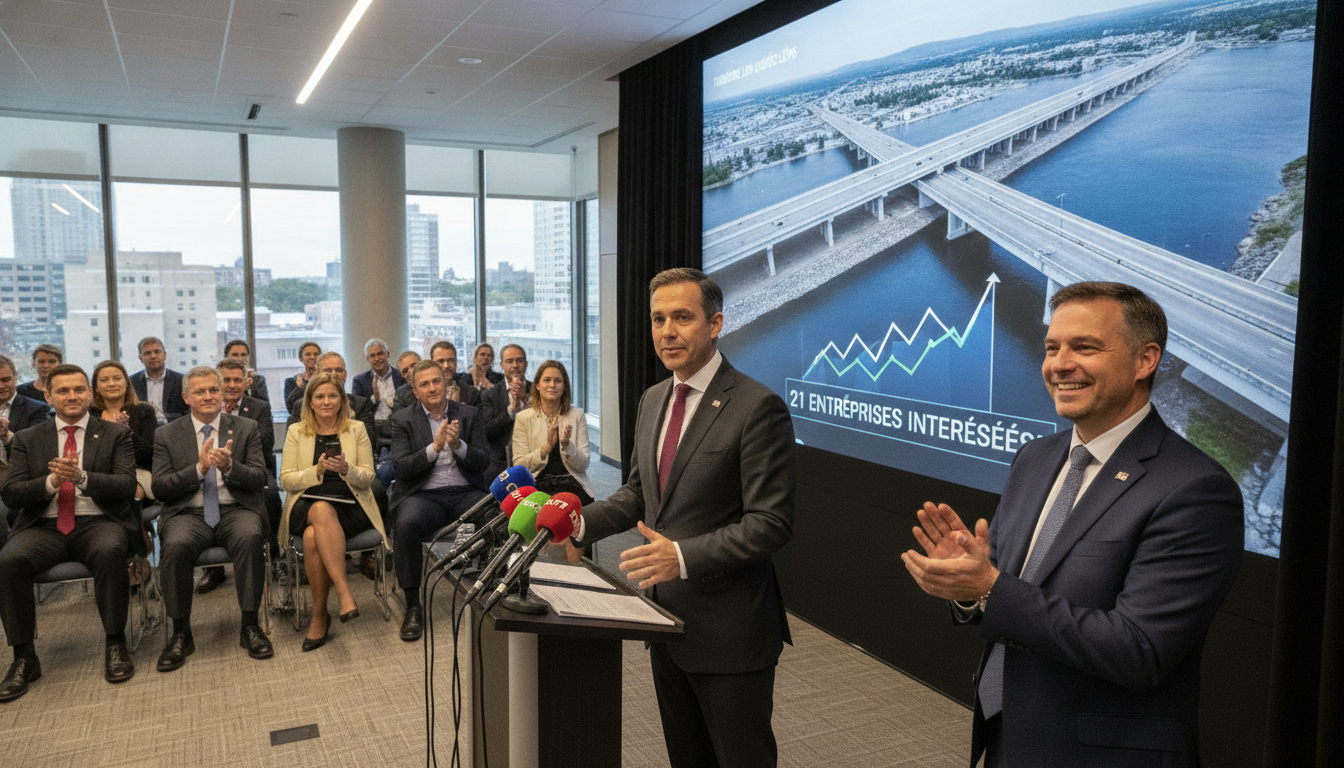
Quebec government says 21 firms expressed interest in third link between Québec and Lévis
Quebec reports 21 firms expressed interest in the third link between Québec and Lévis; MTMD will release findings in November and begin procurement in 2028.
Premier frames response as validation of public–private model and says third link has attracted robust private-sector attention.
Quebec’s government announced Tuesday that 21 companies formally signalled interest in the proposed third link highway between Québec City and Lévis, a development the premier called “encouraging” and substantive. The Ministry of Transport and Sustainable Mobility (MTMD) said a total of 36 organizations requested more information on project plans, underscoring notable industry appetite for the file.
The disclosure came after the formal deadline for the expression of interest and ahead of a planned review of submissions that government officials say will determine the seriousness of each respondent. The administration reiterated that the list of firms would not be made public at this stage while internal teams evaluate conformity with strict criteria.
Interest from 21 firms
The MTMD reported that 21 entities have gone beyond information requests to officially indicate interest, a figure Premier Christine Fréchette presented as a sign the project can attract private capital. Officials said the responses include Quebec-based companies among the respondents, though specific names were not released.
The ministry also noted that 36 organizations asked for additional documentation and clarifications, a measure authorities interpret as broader market engagement that will inform later procurement choices. The government has committed to scrutinizing submissions to ensure only credible, qualified teams advance.
Government argues public–private approach reduces fiscal pressure
Premier Fréchette defended the government’s shift toward a public–private partnership model for the third link, saying it would help “reduce pressure on public spending” while enabling project delivery. She framed the market response as evidence the approach “holds up,” arguing private involvement can mobilize cost and schedule discipline.
Officials emphasized that the PPP model does not amount to abandoning public oversight; rather, they said it is intended to balance public interest with private-sector efficiency. The government’s communication stressed that rigorous evaluation and contractual safeguards will guide any future selection.
Timeline and next procedural steps
According to the MTMD, teams evaluating the expressions of interest will prepare a report of findings to be tabled in November. The ministry said that once assessments are complete, a more formal procurement sequence will follow with a call for qualifications slated for the first half of 2028, to be followed by a call for proposals.
Transport Minister Benoit Charette told reporters the teams will develop the infrastructure concept further and define the mode of realization before asking proponents to qualify. The ministry did not provide specifics on technical or environmental criteria but stressed that those details will shape the subsequent rounds.
Financing changes and the toll debate
The current iteration of the project moves away from the previous central-corridor design and increases the role of private financing, including provisions for a toll, a proposal that has drawn criticism from experts and parts of the public. The government says tolling is one mechanism to secure private capital without transferring unsustainable costs to the provincial balance sheet.
Opponents and some analysts have warned that tolls could create inequities and shift long-term maintenance and revenue risk onto users. The government has indicated those concerns will factor into contract design and risk allocation in later procurement documents.
Political and regional responses to project redesign
Fréchette’s administration has been explicit that it discarded the earlier corridor concept adopted under the previous plan and is pursuing a different configuration and funding model. She also rejected a proposal from the Parti Québécois to prioritize a transit-only crossing, describing that alternative as insufficiently aligned with local needs.
Municipal leaders and regional stakeholders have advocated for solutions that consider traffic flows, economic development and community impact, while some transit advocates continue to press for a stronger focus on public transportation components. The government says community consultation and technical analysis will remain part of the process.
Independent evaluation and a scheduled report in November will be key moments for scrutiny.
With the MTMD due to table its findings next month, analysts expect closer examination of who expressed interest, how the government plans to allocate risk, and what the procurement documents will require. The first formal procurement event, a call for qualifications, is planned for the first half of 2028, setting a timeline that will extend the project’s public profile for several more years.
The government’s decision to withhold the identities of interested parties until evaluations are complete keeps the focus on process, even as debate continues over tolls, design choices and the balance between transit and highway capacity.
