
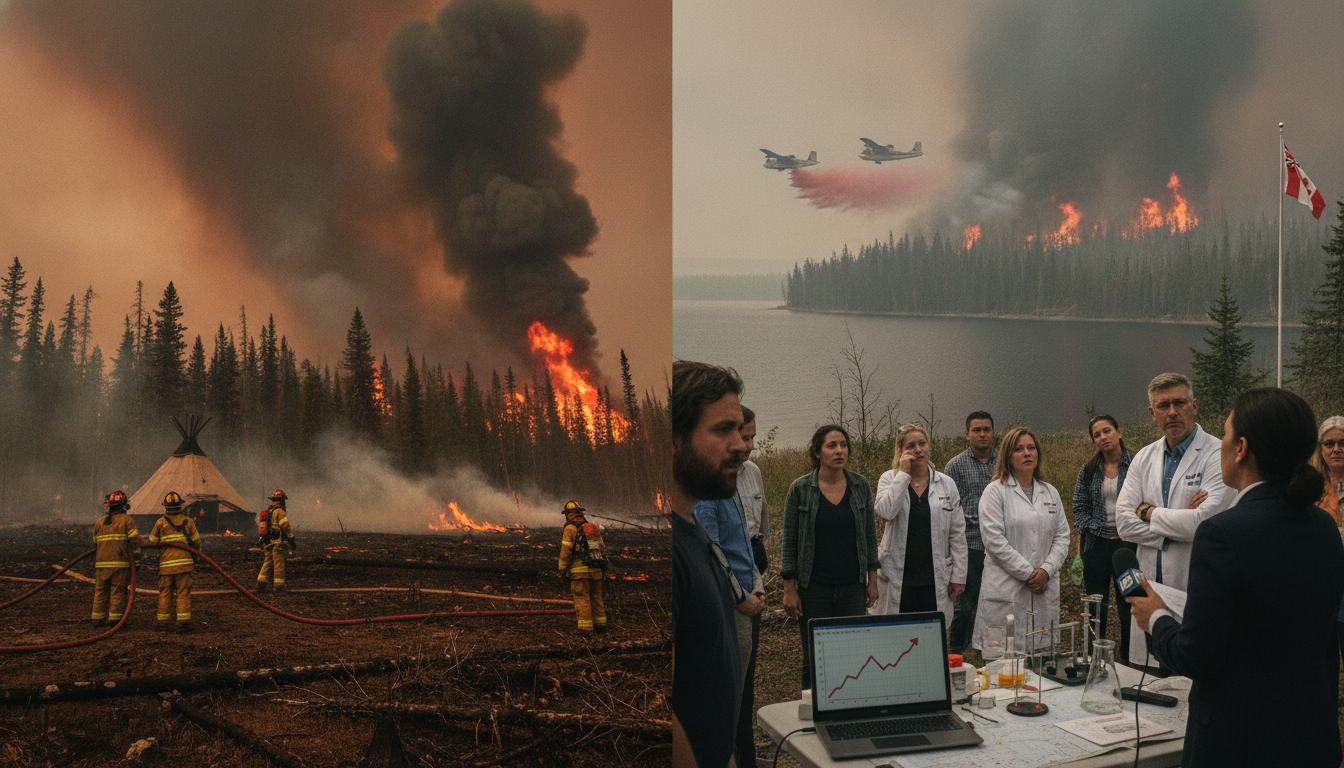
Study: Wildfires in the Northwest Territories and Ontario Twice as Likely Due to Human-Driven Climate Change
Study finds wildfires in the Northwest Territories and Ontario twice likelier due to human-driven climate change, raising frequency, health and evacuation risks.
The World Weather Attribution network, working with researchers linked to Imperial College London, reports that wildfires in the Northwest Territories and Ontario are now about twice as likely because of human-caused climate change. The analysis used climate models and observed weather data to compare today’s conditions with a preindustrial baseline, finding a sharp jump in the probability and frequency of extreme fire-weather. The study also warns that these changes are already altering how often communities must confront large, fast-moving fires and extended smoke exposure.
How scientists measured changing fire risk
The research team combined climate simulations with fire-weather indices to quantify shifting risk. They used the Forest Fire Weather Index to estimate potential fire intensity and the Daily Severity Rating to assess how difficult fires would be to control. To capture moisture deficits, the study also examined cumulative precipitation over the previous 24 months, linking multi-year drought to heightened ignition and spread.
The modelling compared present-day conditions with a hypothetical world without the extra greenhouse gases emitted since the industrial era. That approach allowed researchers to estimate how much more likely extreme fire-weather is because of human emissions, rather than natural variability. The analysis found that the recent patterns of extreme dryness and heat are unlikely under preindustrial conditions.
Changing return periods for the Northwest Territories and Ontario
The study translates those probability shifts into expected recurrence intervals for extreme fire-weather events. In the Northwest Territories, the conditions that produced this year’s massive blazes are now likely to recur every two to six years. For Ontario, similar extremes are expected every six to fifteen years under current climate conditions. By contrast, those same conditions would have been expected less than once every forty years in the preindustrial baseline.
Researchers say the shorter return periods mean communities will face these high-risk seasons within the span of a single generation. That intensification increases the chance of repeated evacuations, greater economic loss, and sustained pressure on firefighting resources across regions that previously experienced such extremes only rarely.
On-the-ground impacts and evacuation challenges
This year’s wildfire season has already overwhelmed parts of Canada, the study notes, with thousands of blazes and millions of hectares burned. Canadian tallies for 2026 cited by the researchers indicate roughly 4,000 fires that have consumed about 3.8 million hectares, with around 800 fires still active at the time of the analysis. More than 200 of the active incidents were in the Northwest Territories and roughly 160 were in Ontario, stretching response capacity.
Communities such as Wrigley and Fort Simpson in the Northwest Territories were forced to evacuate as multi-year drought left forests primed to burn. In northern Ontario, rapid escalation of extreme conditions sent crews into intense suppression work and prompted calls from Indigenous nations for a public inquiry into evacuation planning and fire management. The study highlights that remote communities with limited transport options face particular difficulty during evacuations.
Health threats from smoke and prolonged exposure
Beyond flame-front destruction, the paper underscores growing public-health threats from wildfire smoke that travels far beyond burn areas. Emergency physicians and public-health officials have linked dense smoke to spikes in emergency-department visits for asthma exacerbations, chronic lung disease flare-ups, and cardiovascular events. Health experts warn that even communities well away from the fire line can experience hazardous air quality for extended periods, straining clinics and hospitals.
The researchers emphasized that smoke is becoming one of Canada’s most significant health hazards linked to climate change. They called attention to the need for enhanced air-quality monitoring, clearer public advisories, and expanded supports for hospitals and community health services during prolonged smoke episodes.
Regional drivers: prolonged drought versus rapid heat spikes
The report identifies different drivers in each region this season. In the Northwest Territories, a sustained multi-year drought drained fuels and created conditions for long-burning, persistent fires that undermined local infrastructure and community safety. In Ontario, the shift was more abrupt: a short period of unusually high temperatures and low humidity created explosive conditions that allowed fires to grow quickly.
Environment Canada’s analysis for mid-July showed temperatures in parts of Ontario running markedly above seasonal norms, contributing to rapid fire development. Those contrasts illustrate how climate change can amplify both slow-building and sudden-onset fire risks across diverse landscapes.
Calls for emissions cuts and better preparedness
Scientists who authored the paper urged immediate action on both mitigation and adaptation. They recommended rapid reductions in fossil-fuel emissions to limit further increases in extreme fire-weather, and they stressed the importance of strengthening community preparedness. Researchers and officials alike called for clearer evacuation messaging, improved logistics for remote community movement, and more robust support for Indigenous communities that are disproportionately affected.
International figures also weighed in, with leaders at the UN climate convention endorsing the study’s conclusions and warning that continued reliance on coal, oil and gas will make large-fire seasons more common. At the same time, domestic fire scientists advocated for investments in prevention, firefighting capacity, and public-health readiness to reduce harm as the climate shifts.
The study makes a stark point: unless emissions fall and communities adapt quickly, the scenes witnessed this year in the Northwest Territories and Ontario are likely to repeat within the lifetimes of people now living there. Emergency planners, health systems and policymakers face the dual tasks of cutting emissions and preparing for more frequent, more intense wildfire seasons.
