
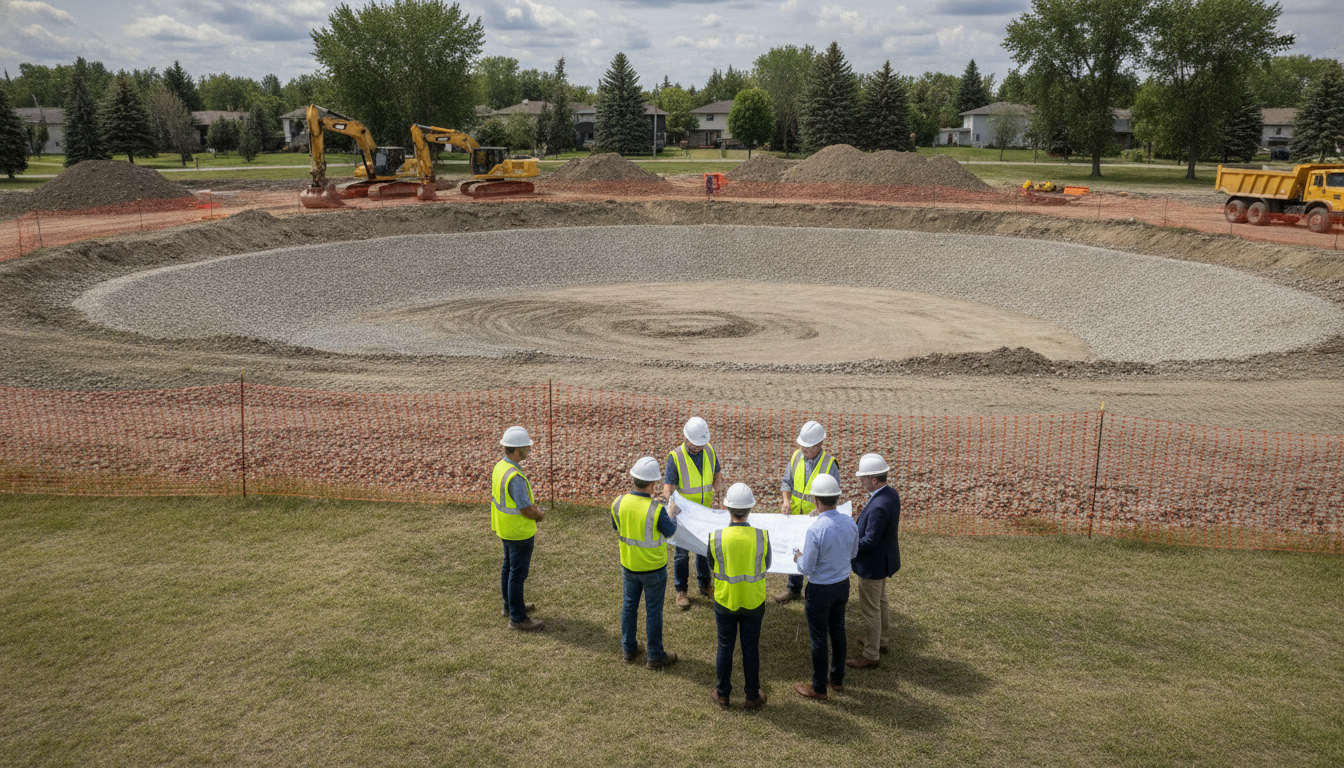
Lauderdale Flood Mitigation Project: Epcor builds dry pond at Grand Trunk Off‑Leash Park
Epcor has begun installing a dry pond at the Grand Trunk Off‑Leash Dog Park in Edmonton’s Lauderdale as part of the Lauderdale Flood Mitigation Project to reduce neighbourhood flood risk.
Work started this week in the greenspace at 127 Avenue and 113 Street as the utility moves to upgrade storm infrastructure across Lauderdale under its wider Stormwater Integrated Resource Plan. The dry pond will remain accessible for dog walkers except during large storm events, when the facility is designed to store surge flows and protect nearby properties. Epcor says the project is one element of a city‑wide, council‑approved, multi‑decade strategy to strengthen urban drainage and reduce flood impacts.
Epcor begins construction in Grand Trunk park
Epcor crews are building the dry pond within the existing park footprint so the space can still be used by the public during normal conditions. The company has communicated that closures will be limited to times when the pond is intentionally filling during heavy storms, and signage will be used to warn visitors when water levels rise. Residents in Lauderdale were informed this week of the work as crews installed new inlets, pipes and grading to increase short‑term storage capacity.
Craig Bonneville, group vice‑president of planning, projects and engineering for Epcor Water Services, said the upgrades respond to recent weather patterns that overwhelmed parts of the storm system. He explained the dry pond functions as temporary storage when underground pipes and outfalls reach capacity, then drains back to the system once levels fall. Epcor framed the work as proactive risk reduction rather than a permanent wet amenity.
Project tied to 20‑year, $1.6‑billion storm plan
The Lauderdale work is being carried out under the Stormwater Integrated Resource Plan, a council‑approved program launched in 2019 that schedules upgrades across Edmonton over 20 years. The plan, with an estimated budget of $1.6 billion, targets pipe capacity, pond construction and "green infrastructure" retrofits in mature neighbourhoods. Epcor has said it will continue to evaluate drainage corridors and pipe sizing as part of the multi‑phase program.
Recent dry pond projects in the city have ranged in capacity and footprint, with some new basins holding tens of thousands of cubic metres of stormwater. Epcor noted that in some locations dry ponds are integrated with recreational spaces — for example, soccer fields constructed in basins — to make efficient use of municipal land while adding stormwater capacity.
How a dry pond protects homes during storms
A dry pond is a landscape depression designed to accept overflow from stormwater pipes during high‑volume events and release it slowly back into the system. When pipe levels rise, excess water spills into the basin rather than backing up into yards, basements or streets, lowering immediate flood risk for surrounding properties. Once the peak has passed and pipe levels decline, the pond drains back through engineered outlets.
Bonneville said Edmonton’s network of about 100 dry ponds has been activated in recent summer storms, protecting communities by temporarily storing runoff. He emphasized that these facilities are part of a layered approach that combines pond storage, pipe upgrades and low‑impact development methods such as permeable surfaces and rain gardens.
Access, safety and signage for park users
Epcor is advising park users to heed warning signs and vacate dry pond areas when water levels begin to rise, because inflows and currents can form quickly and unexpectedly. Even when water appears calm, outflow currents at engineered outlets can create hazards for people and pets, so the utility is stressing public awareness. The company also plans to leave most park amenities accessible during normal conditions while maintaining a safe exclusion zone during storm events.
The municipality and utility will coordinate messaging to ensure dog walkers and other park users understand when temporary closures are required. Officials said that keeping the park usable outside of storms preserves community amenity value while delivering essential flood protection.
Recent extreme weather and infrastructure failures amplify urgency
Edmonton and nearby municipalities experienced an intense series of rainfall events this summer that exposed vulnerabilities in storm systems built for different climate patterns. Short, high‑intensity storms and long soaker events saturated soils and pushed pipes to their limits, leading to widespread activation of dry ponds across the city. In some places, storm drainage failures caused serious damage; prior projects such as a culvert upgrade on 137 Avenue were paused in 2024 due to changes in road plans, and erosion events have previously severed key connections into newer developments.
Those incidents influenced the urgency of the current upgrades, municipal officials say, and reinforced the need for both large‑scale investments and neighbourhood‑level solutions. Epcor and the city continue to assess where additional capacity or green infrastructure could reduce future damages.
Water quality worries and public health guidance
The temporary lakes that form in dry ponds during storms are not intended for recreation and can contain urban runoff pollutants including fertilizer, oils and other contaminants. St. Albert officials noted a recent pop‑up pond that attracted residents but warned against swimming or boating because of outfalls and potential contaminants. Municipal managers also flagged the remote possibility of sanitary backups in extreme circumstances, which would prompt emergency measures to protect public health.
Epcor and neighbouring municipalities are recommending that people, particularly children and pets, avoid contact with standing water in storm basins and report any unexpected flooding or hazards. The utility says it will monitor water levels and coordinate clean‑up as needed after storm events.
The Lauderdale Flood Mitigation Project work at Grand Trunk Off‑Leash Park is part of a longer program of upgrades across Edmonton aimed at reducing flood risk and protecting neighbourhoods. Residents with questions or safety concerns are being asked to watch for posted signage during construction and to follow guidance from Epcor and city crews when storms approach.
