
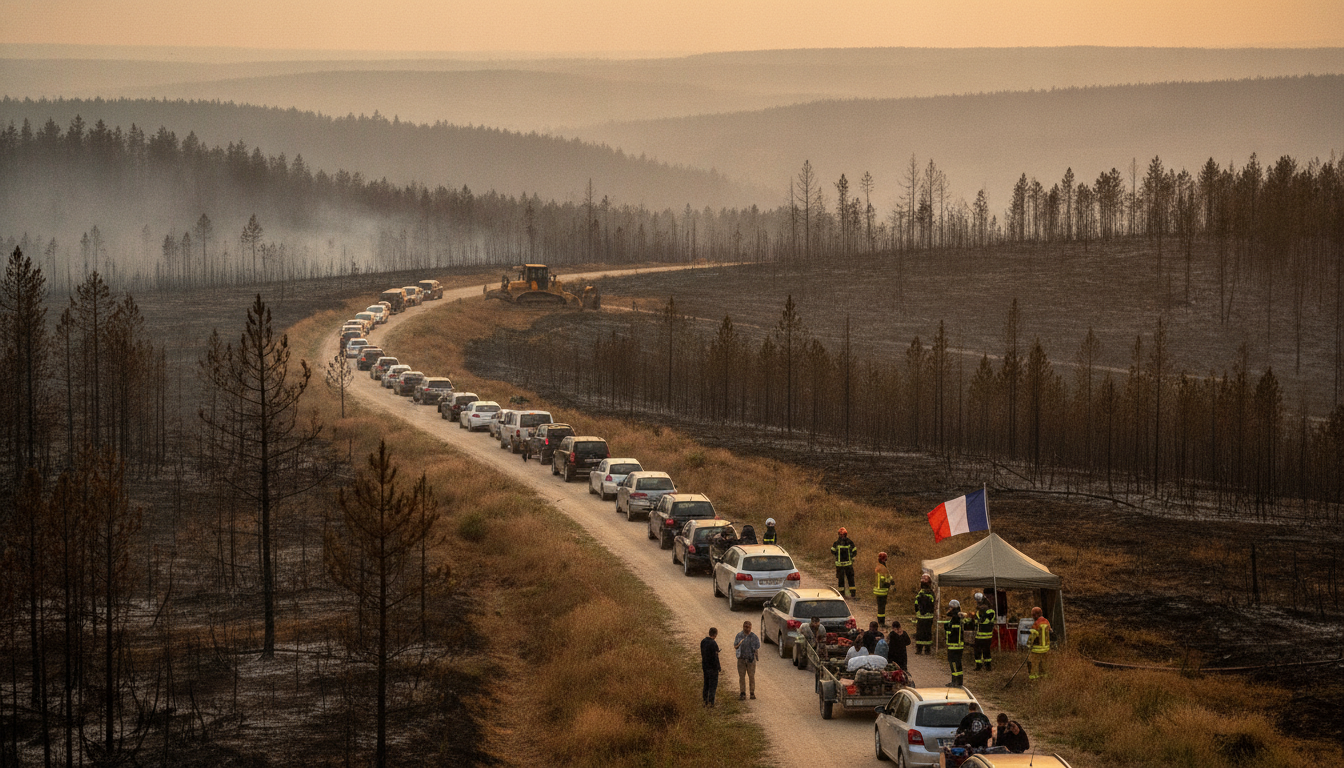
Gironde wildfire stabilizes after week-long battle as crews report limited hotspots
Gironde wildfire stabilizes around 42,000 hectares after a week of intense firefighting; crews regain access for tens of thousands while authorities warn of continued risk.
The Gironde wildfire, which has burned roughly 42,000 hectares of forest, has moved into a phase of consolidation after more than a week of sustained suppression efforts. Fire services reported a sharp drop in active fronts in the Saumos sector, prompting cautious optimism even as teams continue large-scale containment work. Thousands of firefighters, military personnel and volunteers remain deployed across the southwest as authorities lift some evacuation orders and keep others in force.
New turning point reported in Saumos
Officials from the Gironde departmental fire service said progress on Thursday marked a new turning point in the campaign to secure the fire perimeter. Commanders reported that active hotspots in the Saumos area had decreased to a handful, a development they described as significant given the size of the blaze.
While commanders praised the robustness of the response, they emphasized that stabilization does not equal extinguishment and that pockets of heat and smouldering material will require persistent attention. The shift in status has allowed crews to shift from emergency containment to systematic search-and-extinguish operations in some sectors.
National mobilization of crews and aircraft
The response to the Gironde wildfire has drawn a nationwide mobilization of personnel and airborne assets to the region. Authorities reported roughly 3,300 firefighters supported by about 1,500 military personnel, 1,250 police and gendarmerie officers, forest rangers, farmers and hundreds of volunteers working together on the ground.
Aerial resources complemented the ground effort, with 24 aircraft deployed to the zone, including seven provided through the European Union’s civil protection mechanism. Commanders credited the scale of the multi-agency response with preventing a wider catastrophe in populated and ecologically sensitive areas.
Evacuations eased but transport and work disruptions persist
The prefecture authorized the immediate return of about 84,000 residents in nine communes near Bordeaux as conditions improved, though several preventive measures remain in place. Officials said more than half of the roughly 220,000 people evacuated since the blaze began on July 22 are no longer subject to displacement orders.
Transport links remain affected: the A63 motorway to Bayonne reopened in the early hours, but high-speed rail services south of Bordeaux are still limited, with only routes serving Agen and Toulouse running through the impacted area. Economic disruption has been significant, with thousands of workers prevented from reaching jobs and several thousand businesses temporarily closed.
Local community response and animal rescue operations
Local volunteers, tradespeople and municipal teams have played a visible role in relief and recovery efforts, supporting fire services and tending to vulnerable residents and animals. In parts of the peninsula near Cap Ferret, ad hoc animal rescue brigades formed by local authorities have been distributing water and feed to pets and livestock while searching for wildlife casualties.
Residents and small business owners described a mixed mood of relief and alarm: relief at being allowed home, and alarm at the long-term environmental and visual damage to tourism-dependent landscapes. Community groups are coordinating to support displaced families and to assess damage to farms and small enterprises.
Other regions still under threat as investigations proceed
The Gironde crisis has unfolded alongside several other fire outbreaks across France, with incidents in Corsica, the Hautes-Alpes, the Var and an unusual blaze in Burgundy’s wine country. In the Var, a new fire near Brignoles forced the evacuation of some 650 people and affected local infrastructure before containment slowed its spread.
Authorities reported a sustained law-enforcement effort into possible criminal causes, noting that a majority of recent wildfires are attributed to deliberate or negligent human actions. National figures released by government officials indicated hundreds of arrests related to fires nationwide, reflecting an intensified investigative focus as teams seek to determine origins and responsibility.
Ministers stress vigilance despite improved conditions
Interior Ministry officials and local commanders repeatedly cautioned against complacency even as weather conditions and firefighting gains reduce immediate pressure on some fronts. The ministry highlighted the need to secure roughly 240 kilometres of fire edge and warned that dry vegetation and ongoing drought conditions leave the region prone to rapid re-ignition.
Authorities also reported injuries among responders, with more than 200 firefighters treated for wounds or exhaustion during the operation. Officials outlined plans to maintain patrols, controlled burn operations and aerial surveillance to prevent flare-ups while recovery and assessment work proceeds.
The short-term easing of evacuations in parts of Gironde offers a measure of relief to tens of thousands of residents, but officials and community leaders agree the crisis has entered a new phase. Stabilization of the Gironde wildfire reduces immediate risk to towns and infrastructure, yet the scale of ecological damage and the prospect of renewed fire activity mean recovery and vigilance will be required for weeks and months ahead.
