
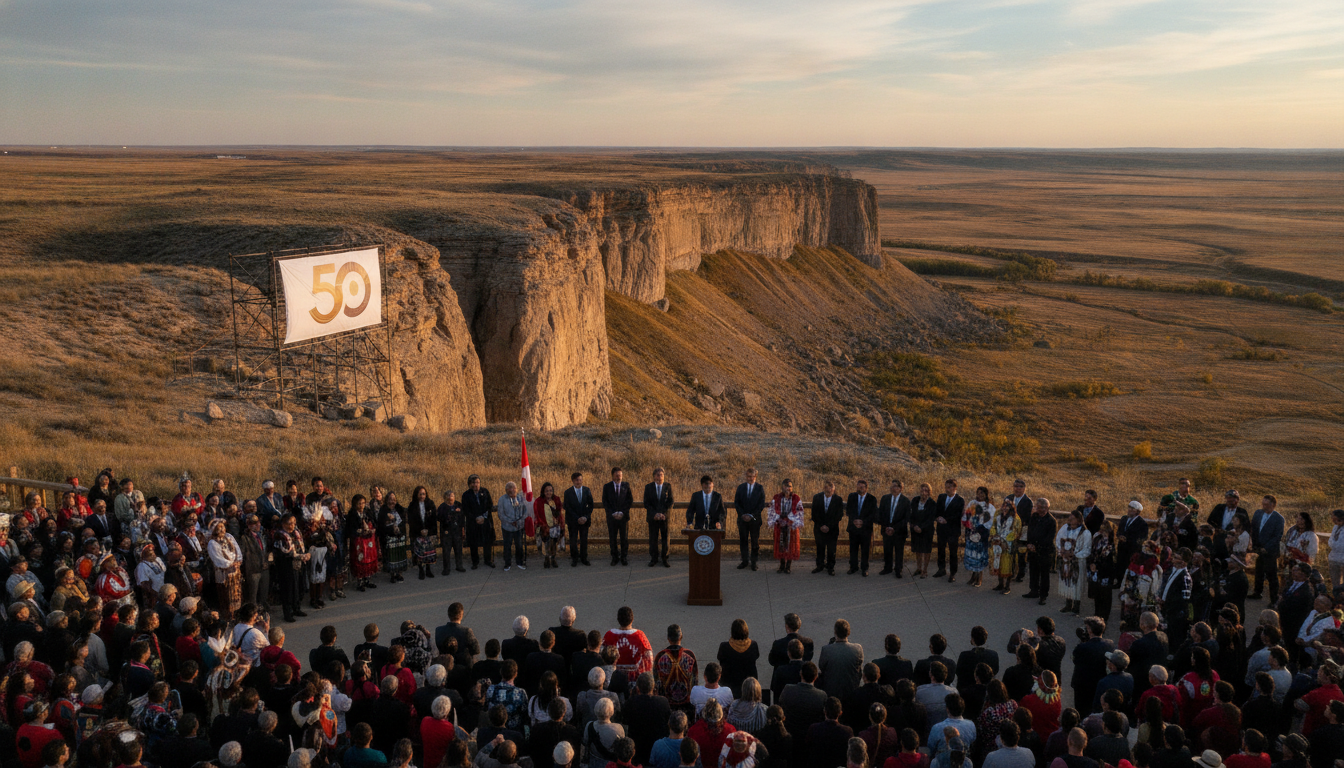
Head-Smashed-In Buffalo Jump featured in National Trust celebration of UNESCO World Heritage 50th anniversary
National Trust marks UNESCO World Heritage 50th anniversary at Head-Smashed-In Buffalo Jump, spotlighting Indigenous heritage and rising international tourism.
Head-Smashed-In Buffalo Jump drew officials, Indigenous representatives and heritage advocates Wednesday as the National Trust for Canada hosted a commemorative event marking the 50th anniversary of Canada signing the UNESCO World Heritage Convention. The gathering at the southern Alberta site highlighted the location’s millennia‑old Indigenous history and the role of international recognition in protecting culturally significant places. Organizers said the celebration reinforced the site’s appeal to visitors from around the world and underscored commitments to stewardship.
National Trust marks UNESCO anniversary at Head-Smashed-In Buffalo Jump
The National Trust for Canada chose Head-Smashed-In Buffalo Jump as one of several national events this week to mark five decades since Canada ratified the World Heritage Convention in 1976. Patricia Kell, chief executive of the National Trust, said the convention creates both an obligation and an opportunity to protect places of outstanding universal value. The day’s program brought local leaders, site staff and visitors together to reflect on long‑term conservation goals and international attention for Canadian heritage.
Living landscape and ancient hunting practices explained to visitors
Staff at the interpretive centre guided guests through displays and the surrounding foothills to illustrate how Plains peoples used the topography in communal hunts. Quinton Crow Shoe, who handles marketing for the site and is a member of the Piikani Nation, said visitors can now “see the vast territory” and imagine the logistics of ancient buffalo hunts. The site’s interpretive programming blends archaeological evidence with Indigenous stories to present a fuller picture of past lifeways.
UNESCO and federal designations have reinforced protection
Head-Smashed-In received UNESCO World Heritage designation in 1981, following earlier recognition as a National Historic Site in 1968 and a Provincial Heritage Site in 1979. Those designations, site staff say, have been important in preventing development that could harm the landscape and in supporting preservation efforts. Local landowners have also played a role by leaving surrounding tracts undeveloped, helping to maintain the visual and ecological integrity of the jump.
International tourism forms a significant share of visitors
The interpretive centre welcomes roughly 60,000 people each year, with about 40 per cent coming from outside Canada, predominantly Europe but also Asia, Australia and New Zealand. Crow Shoe noted that a mention of the site on a popular HBO Max medical drama earlier this year produced a noticeable uptick in local and regional visitors. Staff say that international interest not only bolsters the site’s economic impact, but also provides an opportunity to share Indigenous perspectives with a global audience.
Community stewardship and Indigenous perspectives emphasized
Speakers at the event stressed that recognition of the site supports Indigenous stewardship and cultural continuity. Crow Shoe told the gathering that formal protections are “really appreciated” by Indigenous people because they help preserve land and cultural practices for future generations. The interpretive centre, which opened in July 1987 with members of the British royal family in attendance, is presented as a place for learning, remembrance and dialogue between Indigenous and non‑Indigenous Canadians.
Canada’s World Heritage footprint and national celebrations
Since joining the World Heritage Convention, Canada has had 22 properties inscribed on the UNESCO list, joining more than 1,200 sites worldwide that meet the convention’s criteria for outstanding universal value. The National Trust organized two other commemorations this month at Rideau Canal in Ottawa and at Old Town Lunenburg in Nova Scotia to mark the anniversary date. Kell said the series of events was intended to remind Canadians of the range of natural and cultural places across the country that merit international attention.
The Head-Smashed-In celebration combined formal remarks with guided interpretation to connect international heritage policy to local conservation work. Organizers and site staff framed the occasion as both a recognition of past protections and a call to sustain collaborative stewardship going forward. The event reinforced the site’s position as a gateway for visitors to learn about the plains peoples’ history and the ongoing responsibility to protect landscapes of global significance.
