
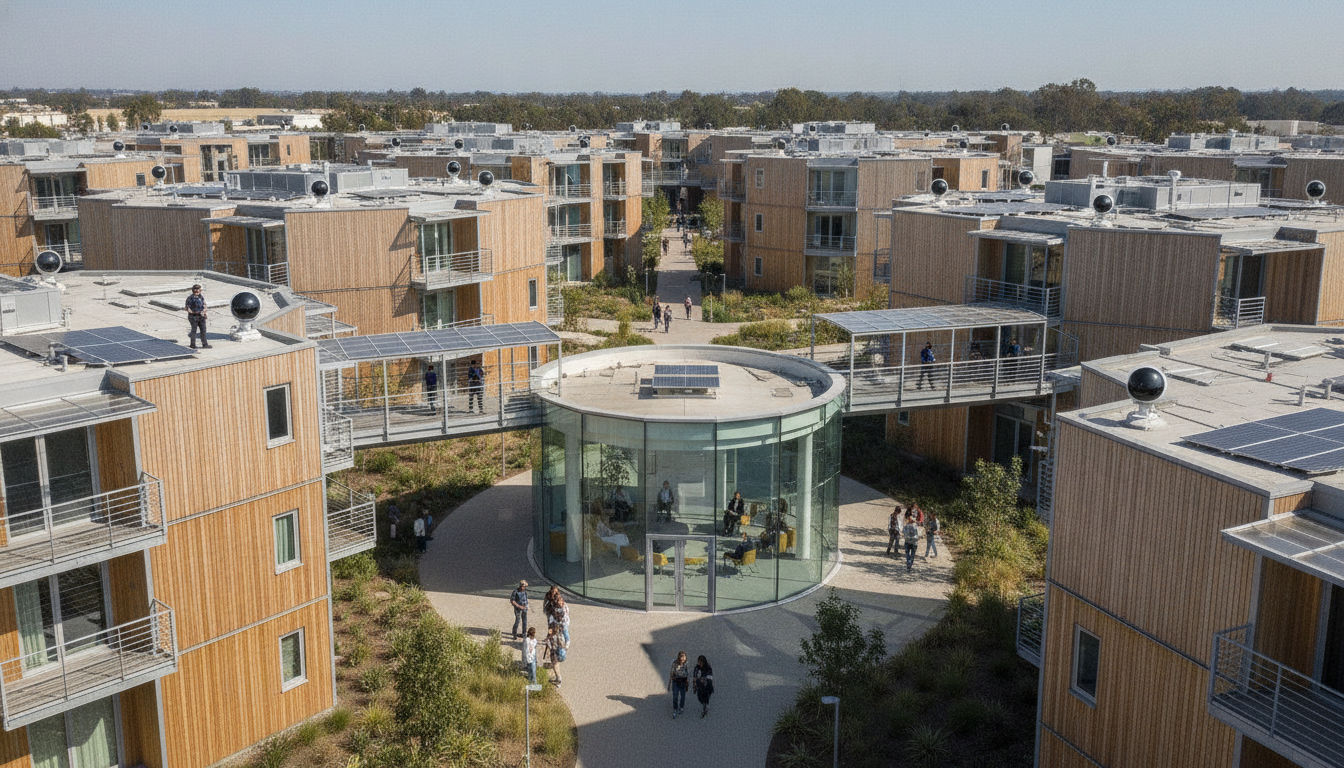
New secure campus model blends 360-degree surveillance, modular hubs and supervised walkways to reshape school safety
A secure campus described by officials reads less like a conventional school, featuring 360-degree external cameras, after-hours motion detection, modular hubs and supervised walkways that reorganize movement and services. The campus design places counselling, staff workspaces and student gathering areas in a central modular complex while portable washroom buildings and monitored corridors link activity zones. Proponents say the configuration aims to balance oversight and access; critics question how surveillance and supervision will affect student experience.
Security Infrastructure and Surveillance
The perimeter is monitored by a continuous 360-degree external camera system that officials describe as the backbone of on-site security. Cameras are paired with sensors designed to detect motion after hours, creating layered detection that alerts staff to unusual activity beyond normal school operations.
School leaders say the surveillance network is intended to deter trespassing and to speed response when incidents occur. Privacy advocates caution that constant monitoring can have chilling effects unless clear policies, retention limits and oversight mechanisms are in place.
After-Hours Detection and Incident Response
After-hours motion detection is configured to distinguish between routine maintenance and potential security breaches, according to descriptions of the site. Alerts from the system feed into a central monitoring station that staff can access remotely or on site for verification and dispatch.
Administrators involved with similar designs argue that automated detection reduces risk and helps protect facilities when buildings are largely unoccupied. Civil liberties groups urge transparent reporting on false alarm rates and the procedures used before cameras or sensors trigger law enforcement involvement.
Modular Complex Centralizes Student Support
A central modular complex houses administrative offices, counselling services, staff workspaces and spaces for students to gather. The design consolidates essential services in a single, flexible structure intended to streamline access to support and to make supervision more efficient.
Modular construction also allows for quicker assembly and future reconfiguration compared with traditional brick-and-mortar buildings. Proponents highlight the potential for co-locating mental-health professionals and student services to improve coordination, but some question whether modular spaces can fully replicate the amenities and permanence of conventional facilities.
Supervised Walkways and Portable Amenities
Portable washroom buildings are connected by supervised walkways that channel movement between activity zones and the central complex. The supervised corridors are intended to reduce unsanctioned congregation and to provide staff with easier lines of sight during transitions and breaks.
Supporters say these controlled circulation paths can reduce incidents and make it simpler to monitor high-traffic times, such as class changes and after-school programs. Opponents counter that heavily managed movement risks diminishing informal social interaction and may make the campus feel more institutional than invitational to students.
Operational Trade-offs and Staff Roles
The campus model places greater emphasis on staff presence and coordinated monitoring to make the security architecture effective. Counsellors and administrative staff located in the modular hub are expected to work alongside security personnel to handle incidents and support students.
This closer operational link can accelerate referrals to support services when concerns are observed, but it also requires investment in training and clear role definitions. Successful implementation, according to experts familiar with similar setups, depends on protocols that prioritize de-escalation and student privacy alongside physical security.
Questions on Student Experience and Community Impact
Community reactions to such campus configurations often hinge on how security measures are communicated and the degree to which student voice is incorporated. Critics warn that visible surveillance and tightly supervised routes can alter campus culture and raise concerns about trust between students and school authorities.
Advocates emphasize the potential safety benefits for vulnerable populations and for sites with prior security incidents. Balanced assessments call for data collection on outcomes such as incident rates, student well‑being indicators and feedback from families and staff to evaluate whether the design meets its stated goals.
The described campus model reframes familiar elements of school design—surveillance, modular construction and supervised circulation—into a single, tightly integrated approach to safety and services. As districts and institutions consider similar configurations, the debate is likely to focus on how to reconcile efficient security with respect for student autonomy, privacy and a positive learning environment.
