
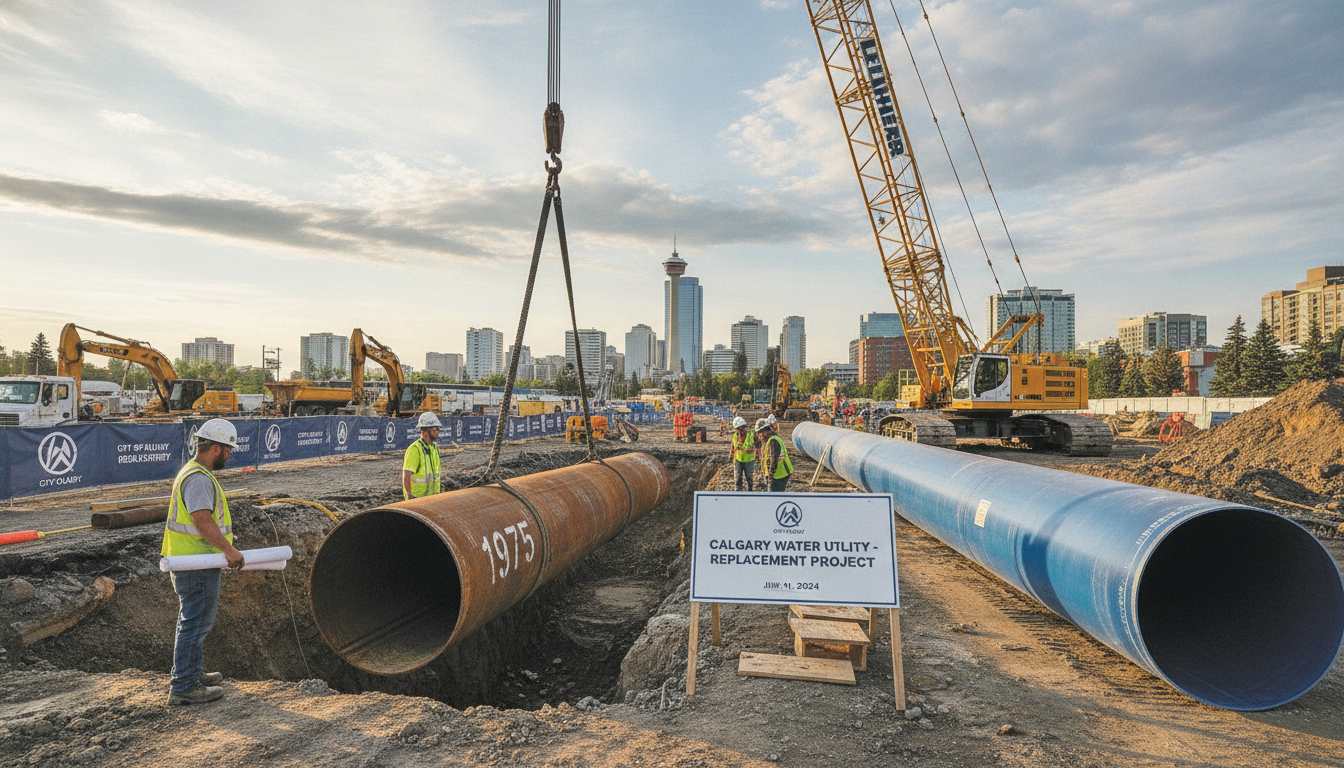
Calgary begins replacement of aging Bearspaw feeder main carrying 60% of treated water
Calgary begins replacement of a 1975 feeder main that carries about 60% of the city’s treated water; the 11 km, up-to-2m pipe runs from Bearspaw toward downtown.
Calgary has launched the replacement of its oldest and most critical feeder main, the concrete transmission line built in 1975 that delivers roughly 60 per cent of the city’s treated water. The work targets an approximately 11-kilometre stretch running from the Bearspaw Water Treatment Plant toward downtown, with sections of the pipe measuring up to two metres in diameter. City engineers say the project addresses long-term reliability risks associated with aging infrastructure and aims to secure the primary supply corridor beneath major arterial routes.
Replacement targets 1975 Bearspaw feeder main
The replacement focuses on the concrete feeder main installed more than four decades ago to convey treated water into Calgary’s distribution network. The pipe was constructed in 1975 and has been a backbone of supply ever since, channeling water from the Bearspaw treatment plant toward central distribution points. Engineers emphasize that the size and age of the feeder main make the work complex and critical to the city’s ability to meet demand.
This feeder main’s scale and alignment make it unusual: in some sections the pipe reaches two metres in diameter, requiring specialized equipment and sequencing during removal and installation. The project will proceed along a roughly 11-kilometre corridor, with work concentrated under major routes that include 16th Avenue N.W. and Memorial Drive. The route and dimensions create constraints for crew access, staging, and traffic coordination.
Feeder main supplies roughly 60 per cent of Calgary’s treated water
City records indicate the feeder main transmits about 60 per cent of treated water produced at Bearspaw into the municipal system, a proportion that underscores the line’s strategic importance. Because such a large share of supply relies on a single transmission corridor, planners regard the replacement as essential to reduce vulnerability from potential failures. Ensuring uninterrupted service while working on a line that carries the majority of treated water is a primary engineering and operational challenge.
Maintaining continuous supply during construction will require temporary measures, including rerouting flows, activating redundant connections where available, and tightly managed shutdowns for tie-ins. Municipal water managers historically build redundancy into systems; this project will test those arrangements and require careful coordination between operations, contractors, and emergency services. Communication with residents and businesses will be important to explain planned impacts and contingency steps.
Route runs beneath 16th Avenue N.W. and Memorial Drive
The feeder main follows a path from Bearspaw toward Calgary’s central area and runs under two of the city’s busiest corridors, 16th Avenue N.W. and Memorial Drive. Working beneath these arterial roads increases the complexity of construction logistics, from trenching and tunnelling choices to traffic management and utility coordination. Planners will need to stage work to limit disruption to traffic flows, transit services, and adjacent properties.
Construction under major roadways typically requires phased closures, temporary lane reductions, and revised signal timing, all coordinated with the city transportation department. The project’s alignment beneath urban corridors also means crews must map and protect other buried infrastructure such as gas, power, and telecommunications lines. Minimizing impacts to commuters and businesses is likely to be a central component of the project plan.
Two-metre diameter sections present engineering challenges
Sections of the feeder main reach diameters of about two metres, a size that demands heavy lifting equipment, substantial shoring, and precise installation methods. Replacing large-diameter pipe requires larger excavation envelopes or the use of trenchless techniques where feasible to limit surface disruption. Contractors will balance methods to reduce disturbance along the route while ensuring the new pipe meets current standards.
Materials and design for the replacement will reflect modern standards for durability and seismic resilience, and engineers will assess whether new alignments or additional redundant pipelines are needed. Where trenchless options like microtunnelling are chosen, crews can install new pipe with minimal open-cut excavation, reducing the footprint on surface operations. Each technique carries trade-offs in cost, schedule, and community impact.
Operational continuity and public communications emphasized
Given the feeder main’s role in delivering the bulk of treated water, maintaining operational continuity during replacement is a priority for municipal managers. Temporary flow diversions, staged cutovers, and reserve capacity in other parts of the system will be used to keep service stable during critical connections. Emergency response plans will be reviewed and tested to ensure backup water supplies are available if an unexpected event occurs.
Clear, timely communication with residents and local businesses will be essential to manage expectations and provide instructions if localized service interruptions are necessary. Regular updates on project milestones, traffic changes, and any planned water impacts help maintain public confidence while work is underway. The city’s ability to coordinate contractors, utility owners, and traffic authorities will influence the project’s smooth execution.
Calgary’s feeder main replacement reflects broader infrastructure renewal priorities as municipalities across Canada address aging water systems. Replacing a central transmission line that dates to 1975 aims to improve reliability, reduce failure risk, and align the pipeline with modern standards. The work will require careful engineering, phased construction, and ongoing public engagement to protect both water service and urban mobility during the upgrade.
