
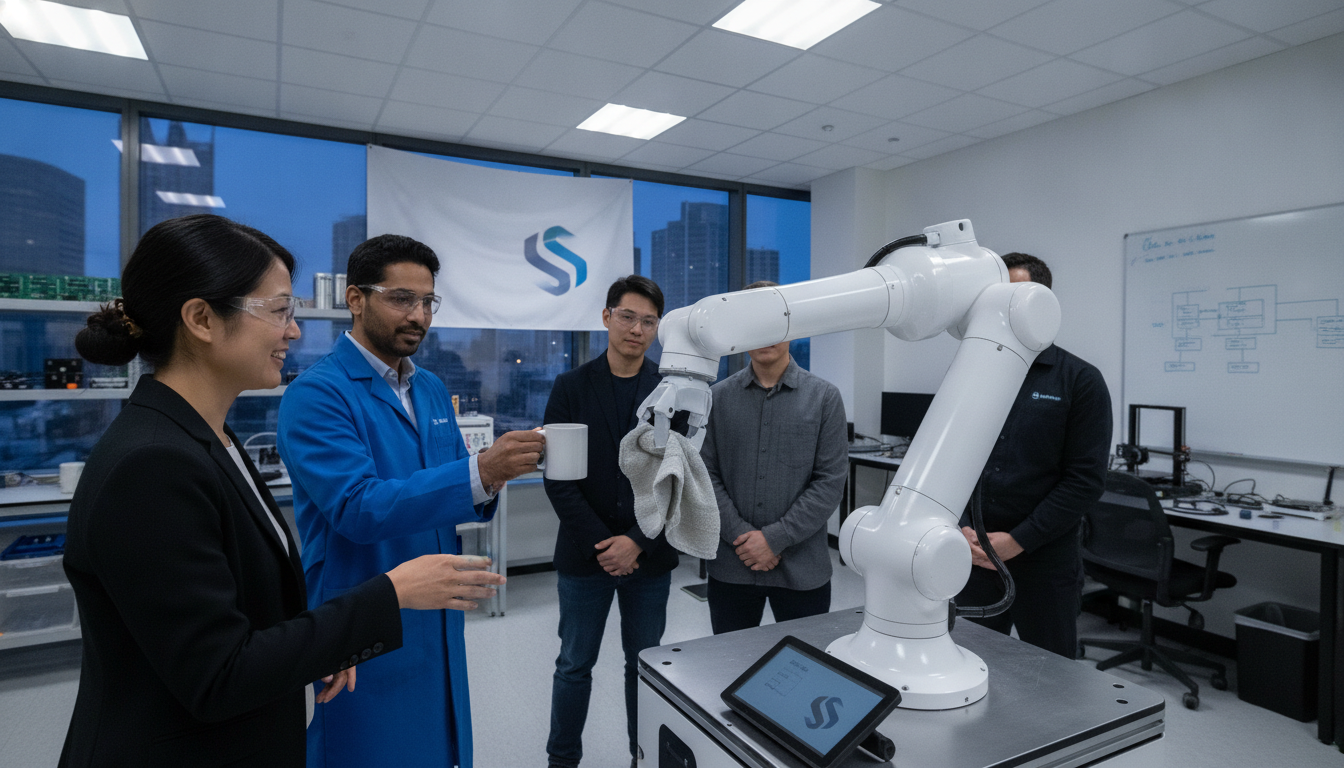
Arlo robotic arm offers new independence for wheelchair users, Ottawa startup says
Sielo Robotics’ Arlo robotic arm is being trialled at the University of Ottawa to help wheelchair users perform daily tasks, with a $1M seed round set to accelerate home beta tests.
The Arlo robotic arm, developed by Sielo Robotics out of the University of Ottawa, is moving from lab demos toward real-world trials after new seed funding and early user testing.
Wheelchair user and accessibility advocate Hollis Pierce tested the assistive arm in the university lab, using a spatial mouse to control Arlo and capture his first-ever self-portrait with a handheld phone.
Sielo Robotics says the device is designed to perform routine care tasks and give people greater independence in their daily lives as the company prepares for broader beta deployment.
User testing at University of Ottawa lab
Participants have been invited to operate Arlo in a controlled lab environment where engineers observe and refine the device’s interface.
Pierce, who tested multiple versions, described an initial learning curve that quickly eased as he adapted to the controls and began using Arlo for small personal tasks.
The company’s technical lead, Rafael Hébert, said the team benchmarks progress by having users perform realistic activities rather than scripted motions.
That approach has revealed both capabilities and limitations in real-world scenarios, helping engineers prioritize software and hardware improvements before home trials.
How Arlo is controlled and what it can do
Arlo is manipulated through a spatial mouse that translates six degrees of motion into precise arm movements, allowing users to reach, grasp and reposition objects.
Sielo’s latest fourth-generation model is designed to feel intuitive to users, with developers comparing the control experience to playing a video game while adding assistive precision.
Engineers say the arm can perform tasks such as bringing a glass to the mouth, picking up small items to place on a tray, and even assisting with personal tasks that normally require caregiver support.
Reproducing complex human actions in unpredictable home environments remains a core engineering challenge, and Sielo is refining Arlo’s software to better handle variability and unexpected obstacles.
Seed funding to speed development
Sielo Robotics completed a $1 million seed financing round in May that the founders say will accelerate product development and expand user testing this summer.
Co‑founder Laila Burns said the company’s early growth was driven by word of mouth and research grants rather than venture capital, and the new funds will allow the team to move beyond student‑competition and grant cycles.
The capital is earmarked for engineering hires, iterative hardware upgrades and broader recruitment of testers for home‑based trials.
Company leaders estimate the funding will shorten timelines toward beta deployments and provide the runway needed to demonstrate reliability in diverse living settings.
Clinical partnerships and beta rollout plans
Sielo Robotics has been working with regional health partners, including a collaborative network tied to a children’s research hospital and a rehabilitation provider, to shape testing protocols.
These partnerships aim to ensure Arlo is evaluated under medically relevant conditions and that clinical stakeholders can advise on safety, usability and integration with existing care routines.
The company plans to place robotic arms in a limited number of homes by the end of the year for beta testing, focusing initially on structured trials rather than full commercial rollout.
Those home trials will collect feedback on day‑to‑day performance, caregiver interaction and how Arlo fits into household workflows.
Price, insurance and access goals
A central goal for Sielo Robotics is to develop a more affordable assistive arm than current market alternatives and to pursue public or private insurance coverage that would reduce out‑of‑pocket costs.
Burns said the team envisions Arlo being eligible for health insurance reimbursement, which would make the technology accessible to a broader population.
Affordability remains a pivotal factor in whether assistive robotics can scale beyond research labs, and Sielo is designing manufacturing and software plans with cost containment in mind.
The startup expects that demonstrating clinical benefit and user independence during beta trials will strengthen cases for reimbursement and wider adoption.
Users, engineers and investors say the technology’s promise lies in returning time and dignity to people who otherwise rely on frequent caregiver assistance.
For Hollis Pierce, the moment he used Arlo to take a self‑photo marked a practical advance and an emotional milestone, underscoring the human impact the company hopes to expand as it moves toward home testing and broader availability.
