
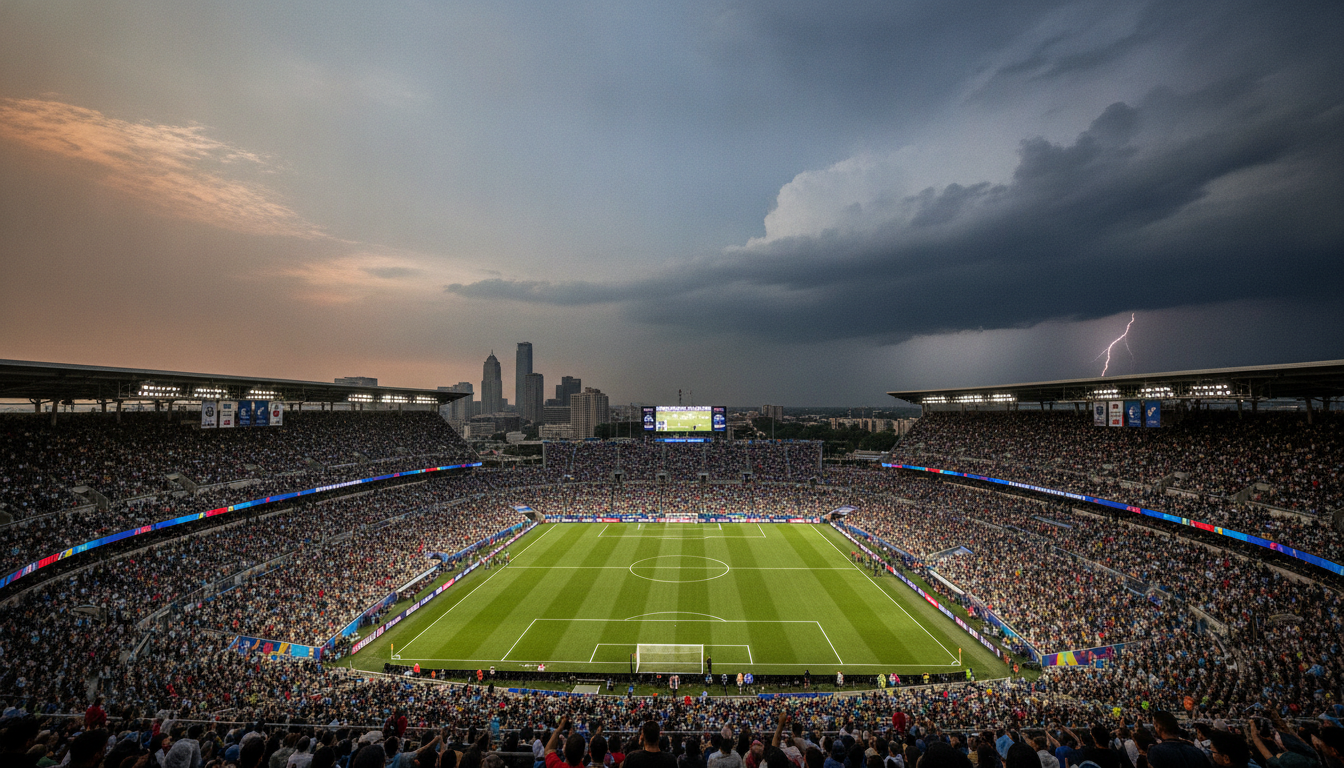
Thunderstorms Expected to Clear Canadian Wildfire Smoke Ahead of World Cup Final at MetLife Stadium
Thunderstorms are forecast to clear Canadian wildfire smoke from East Rutherford before the World Cup final at MetLife Stadium, easing air-quality worries.
The thick haze from Canadian wildfires that has shrouded parts of the U.S. Northeast is expected to be pushed out of the New Jersey area by a line of thunderstorms, meteorologists said, just ahead of the World Cup final between Spain and Argentina. The prediction raised hopes that Canadian wildfire smoke will pose little health risk for fans at the open-air MetLife Stadium while officials continued to monitor severe-weather threats. Authorities and tournament organizers scrambled through the day to balance crowd safety from storms with steps to limit exposure to lingering smoke.
Storms to sweep smoke from the region
Meteorologists from AccuWeather and local broadcast outlets said the incoming frontal system should lift and disperse the densest smoke that has produced poor air quality across the Northeast. Tyler Roys, a senior meteorologist, projected that the most concentrated smoke would be carried away, though a faint haze could remain in the hours after the storms pass.
Forecasters cautioned that the clearing effect depends on the storm track and vigor; a slower-moving front could leave pockets of haze in isolated locations, while stronger convection would dilute particles more rapidly. The expected pattern favors a rapid improvement in visibility and particulate concentrations over metropolitan New York and surrounding suburbs.
Conditions inside MetLife Stadium during storms
Heavy rain and thunder were reported at MetLife Stadium as the storm system moved through, prompting police and stadium staff to urge spectators to seek shelter. State police announced temporary evacuation of the seating bowl and advised fans to move to covered areas while lightning and gusty winds passed through the area.
Tournament personnel distributed ponchos and guided volunteers and staff to shelter, and a nearby Spain training session was suspended after lightning was observed; FIFA said it remained in close contact with local authorities as it assessed playing conditions. The stadium’s open-air design means weather has a direct effect on both field conditions and spectator comfort.
Air-quality forecast and health implications
Air-quality indices tracked a significant improvement in forecasts, moving from “unhealthy for sensitive groups” toward “moderate” as the storms clear pollutants from the lower atmosphere. Meteorologists including WFLA-TV chief meteorologist Jeff Berardelli described the post-storm air as likely to be “dramatically better,” saying widespread dangerous conditions were not expected during match kickoff.
“Moderate” air quality typically implies limited or no health impacts for the general public, though individuals with respiratory conditions may still notice minor irritation. Officials encouraged vulnerable people to take standard precautions — such as limiting prolonged outdoor exertion and carrying necessary medications — until indices return to lower-risk ranges.
Warnings from officials and safety preparations
New Jersey Governor Mikie Sherrill issued public advisories ahead of the storms, warning of the potential for damaging winds, isolated tornadoes, flash flooding and large hail. Emergency-management teams urged residents and event attendees to follow local alerts and move indoors during severe lightning or wind events.
Stadium operators and security teams coordinated with state police and city officials to manage crowd movement and maintain access to indoor shelter, while medical and public-safety units were positioned to respond to weather- or smoke-related concerns. FIFA and local authorities reiterated that safety decisions would be guided by on-site assessments and official weather warnings.
Sources of the smoke and climate context
The haze originated from dozens of active fires across Canada and parts of northern Minnesota, where wildfire activity this season has produced extensive plumes that traveled southward. The Canadian Wildland Fire Information System reported hundreds of active incidents, and analysts noted that larger, longer-burning blazes have been more likely to produce sustained regional smoke impacts.
Meteorologists and climate specialists attributed aspects of the heightened fire season to warmer, drier conditions that extend burn periods and increase fire intensity. Experts stressed that while a single storm front can clear local air quickly, the underlying trend of more frequent and intense wildfires is likely to keep episodic smoke events in the seasonal outlook.
Guidance for spectators and nearby residents
Officials advised fans planning to attend the final to monitor stadium announcements, follow instructions from security personnel, and heed any shelter-in-place orders if storms approach. Spectators with respiratory conditions were encouraged to bring masks or other protection and to remain aware of local air-quality updates until indices stabilize.
Residents in surrounding communities were urged to watch for flash-flood warnings and the possibility of severe gusts that can down trees and power lines, and to avoid travel during the peak of storm activity. Local health departments and emergency-management offices recommended checking official apps or municipal channels for the latest advisories.
Organizers and weather authorities said they would continue real-time monitoring through the evening, but the prevailing forecast called for temperatures near 80 degrees Fahrenheit (about 27 Celsius), lighter breezes and lower humidity once the storms move through. The combination of convective weather to remove smoke and improving conditions afterward offered cautious optimism that the final would proceed with reduced air-quality impacts for most attendees.
