
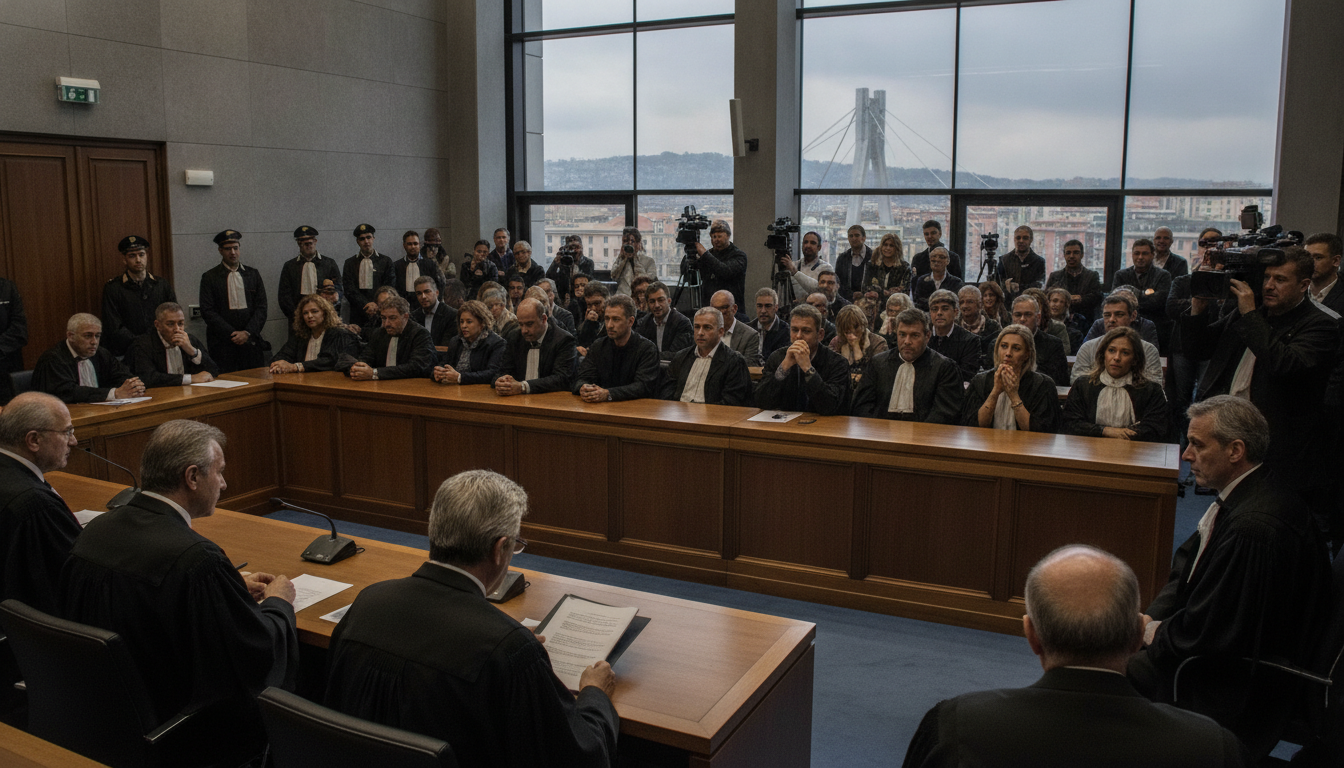
Genoa court convicts 32 over Morandi bridge collapse; sentences up to 12 years
Genoa court convicts 32 over the 2018 Morandi bridge collapse that killed 43; sentences up to 12 years, families welcome the verdict and appeals are expected.
The Genoa criminal court on Thursday found 32 people guilty for their roles in the 2018 Morandi bridge collapse, one of Italy’s deadliest infrastructure disasters that killed 43 people. Sentences handed down reach as high as 12 years in prison, and the verdict drew a mixture of relief from victims’ relatives and immediate promises of appeal from defendants. The trial, which began in 2022, examined years of maintenance decisions, corporate practices and disputed engineering causes tied to the viaduct’s catastrophic failure.
Court delivers guilty verdicts and prison terms
The panel of judges convicted former executives and technical managers for negligence and involuntary manslaughter tied to the collapse of the Morandi bridge. Penalties varied among the 32 defendants, with the longest sentences reserved for those the court found most responsible for maintenance failures. The court’s ruling emphasized a chain of omissions and choices stretching back decades that culminated in the pillar failure on August 14, 2018.
Key defendants and the sentence of Giovanni Castellucci
Among the convicted was Giovanni Castellucci, the former chief executive of the highway operator once responsible for the viaduct. Castellucci was found guilty of negligence and involuntary homicide; he has already been serving time for his involvement in an earlier deadly viaduct collapse in southern Italy. His defence counsel said their client will appeal, and Castellucci maintained he felt responsible but not culpable as the legal process continues.
Judges cite maintenance lapses on pillar nine
Magistrates pointed to a failure to perform minimal maintenance and reinforcement work on the cables of pillar nine between the bridge’s opening in 1967 and its collapse 51 years later. The court concluded that this neglect materially increased the risk of structural failure and that required reinforcement was not carried out. Those findings underpinned the criminal liability assigned to individual managers who oversaw maintenance programs and safety budgets.
Defence arguments and technical disputes over cause
Defence teams contested the court’s narrative, advancing a competing theory that a concealed construction defect and progressive corrosion of cables — rather than routine maintenance omissions alone — sparked the collapse. Lawyers argued that the underlying design and material vulnerabilities predated the defendants’ tenures and could not have been fully mitigated through ordinary upkeep. The technical dispute over cause is expected to reappear in appellate filings as the convicted parties seek to overturn or reduce penalties.
Corporate settlements and ownership changes
Major companies tied to the highway contract, including Autostrade per l’Italia and its engineering unit Spea, avoided trial after reaching agreements with prosecutors, the court confirmed. At the time of the disaster Autostrade was part of the Atlantia group, long associated with the Benetton family, which later sold its stake to the Italian state under intense political and public pressure. Prosecutors used plea agreements and corporate settlements to secure compensation and findings while concentrating criminal liability on former executives.
Families, memorials and the rebuilt bridge by Renzo Piano
Families of the victims attended Thursday’s hearing and expressed cautious satisfaction at the accountability established by the verdict. Nearby, a memorial to those who perished sits close to the new bridge, designed by Genoese architect Renzo Piano and inaugurated in 2020 to replace the lost span. The replacement structure now carries heavy holiday traffic, standing as a functional and symbolic successor to the Morandi bridge while memories of the disaster continue to shape local and national debates over infrastructure policy.
The convictions cap a long judicial reckoning over a disaster that dramatically reframed public scrutiny of Italy’s highway safety and maintenance regimes. Appeals are already anticipated, and those proceedings will determine whether the first-instance sentences are upheld, reduced or overturned. In the meantime, the trial’s findings have rekindled calls for stricter oversight, clearer maintenance obligations and renewed investment in aging infrastructure.
