
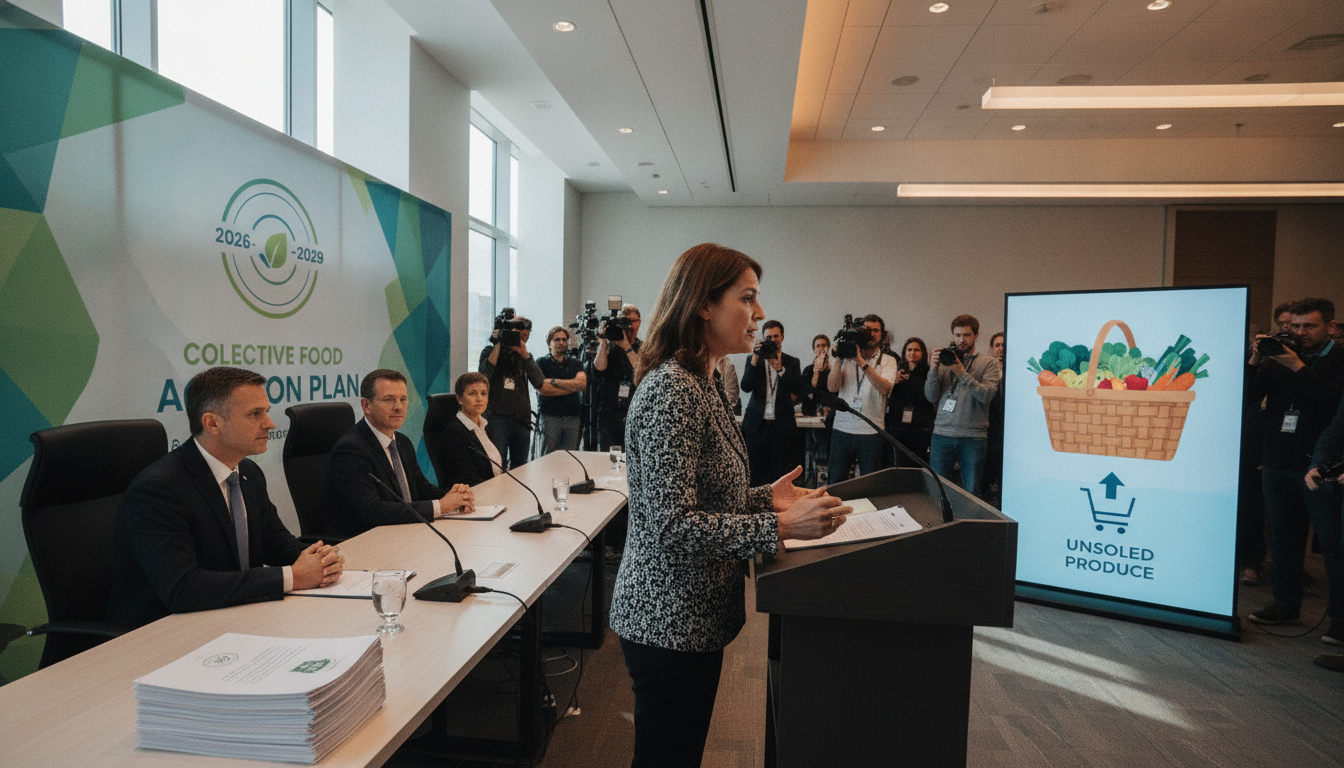
Montérégie food action plan aims to channel farm surpluses to community organizations
A new Montérégie food action plan (2026–2029) will pool logistics, buy downgraded farm surpluses and supply roughly 120 community groups to improve access to healthy local food across the region.
The Montérégie food action plan, launched this summer, brings together a wide collective of community organizations, municipalities and producers to strengthen the region’s food system and reduce early-stage food loss. The strategy, coordinated by the Pôle d’économie sociale de l’agglomération de Longueuil, is built on a 2024 consultation initiated by Laporte MNA Isabelle Poulet and formalizes steps to 2029.
Plan scope and partners
The initiative covers an estimated 120 organizations across Montérégie, from Sorel-Tracy to Salaberry-de-Valleyfield and Longueuil. Participants include food banks, social-economy enterprises, collective kitchens, municipal services and local producers who will share resources and coordinate supply.
Coordination is led by David Miljour of the Pôle d’économie sociale, who says the plan responds to practical challenges faced by community kitchens and social services that now spend excessive time and money procuring groceries. The strategy emphasizes collaborative purchasing, shared storage and pooled transportation to improve efficiency and reduce costs.
Shared logistics to tackle supply challenges
A central element of the Montérégie food action plan is mutualizing logistical assets such as warehouses, refrigerated storage and distribution routes. Smaller organizations will be able to access cold chain infrastructure without shouldering the full capital or operational burden.
By combining collections and deliveries, the collective expects to reduce duplicate trips and lower the per-unit cost of food procurement. Organizers say that increased volume will also strengthen bargaining power with suppliers and create opportunities for social-economy enterprises to develop sustainable revenue streams.
Buying and revaluing farm surplus
The plan specifically targets agricultural surpluses and downgraded produce that do not meet retail aesthetic standards but remain safe and nutritious. An initial objective is to purchase and revalorize roughly 45 tonnes of such surplus produce, with the intent to scale that volume over time.
Local producers will be compensated for downgraded items rather than relying solely on donation models, a shift intended to promote fairness and long-term partnerships. Project leaders describe the approach as creating pay-for-service relationships that can support both farm incomes and community food provision.
Farmer and cooperative examples
Jardins de la Résistance, a Huntingdon cooperative that has run a community-supported agriculture model for 17 years, is cited as an example of how farm-to-community links can work. Co-op members say box schemes produce fewer unsellable items than tiendas that must meet supermarket cosmetic standards, yet a small percentage of harvest still falls outside retail criteria.
The coop already diverts about 5 percent of its harvest to local partners, and it partners with Complices Alimentaires to blanch, freeze and repackage surplus vegetables into socially priced portions. That model demonstrates how modest processing and redistribution can extend shelf life, maintain nutrients and reach households with constrained budgets.
Economic pressures and food access
Rising food costs are a central driver for the Montérégie food action plan. Coordinators point to a significant increase in the cost of cooking over recent years, which has strained community kitchens and social enterprises that prepare meals for seniors or residents in need.
Proponents argue that by lowering acquisition costs, shortening supply chains and promoting local sourcing, the plan can expand access to fresh, affordable food in parts of Montérégie where grocery options are limited. The strategy also aims to address geographic disparities, including in areas such as Haut‑Saint‑Laurent where proximity to farmland has not translated into affordable produce for local residents.
Implementation timeline and measurable goals
The Plan d’action collectif 2026–2029 sets out 17 measures to be implemented by 2029 that cover procurement, financing, commercialization and capacity building. Early priorities include establishing shared storage sites, formalizing purchase agreements with producers and launching pilot processing projects to handle downgraded produce.
Organizers stress a phased rollout: initial commercial volumes will be modest while systems for collection, processing and distribution are tested. Success metrics will include tonnes of surplus revalorized, numbers of organizations served, reductions in per-meal procurement costs and levels of producer remuneration.
Longue-term scaling will depend on sustained funding, municipal cooperation and the commercial viability of social-economy ventures created through the plan. Weekly coordination and data-sharing among partners will be important to refine routes, storage needs and pricing models.
This collective strategy reframes surplus as a resource rather than waste and seeks to align the agricultural abundance of Montérégie with the nutritional needs of its communities. By combining mutualized logistics, fair compensation for farmers and targeted processing and distribution, the Montérégie food action plan aims to reduce food loss while improving access to healthy local food across the region.
