
Calgary Stampede becomes focal point for Alberta independence campaign as rival breakfasts draw large crowds
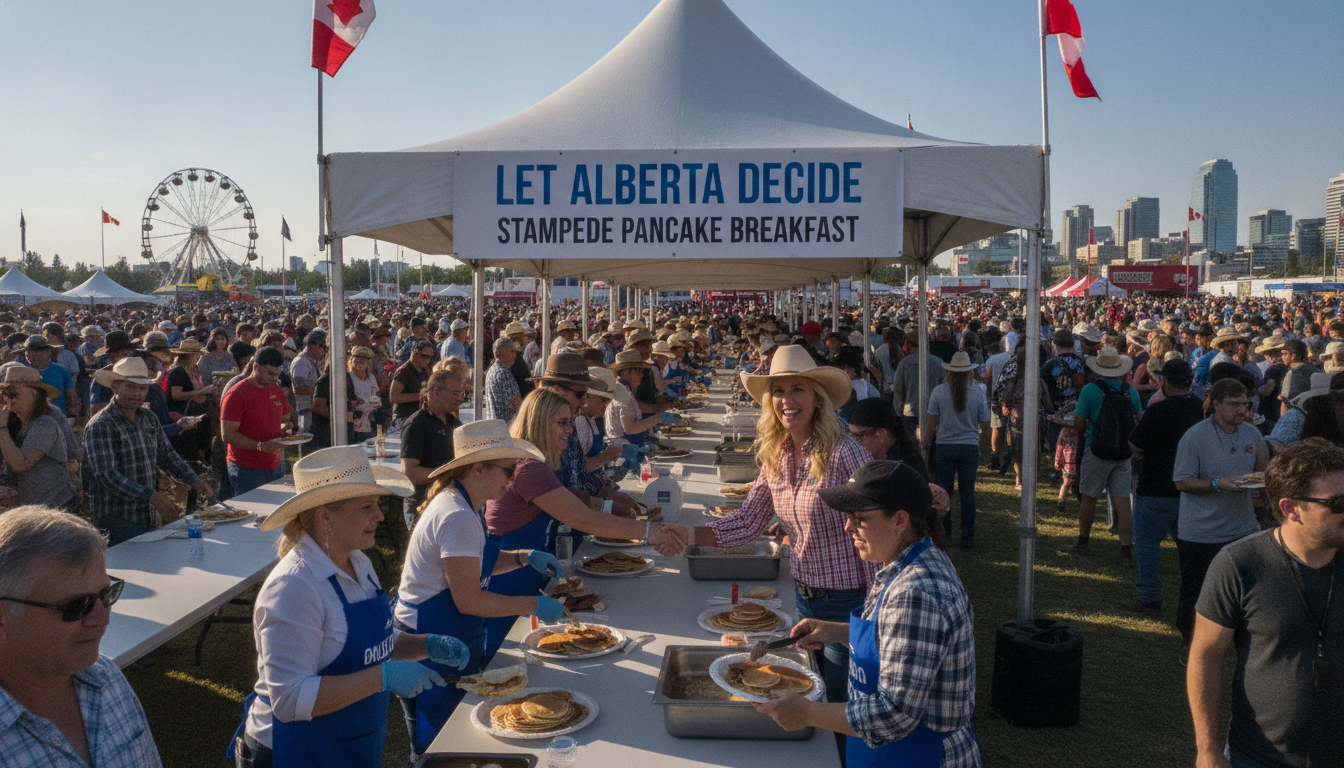
At the Calgary Stampede, a pro-independence group staged a high-profile pancake breakfast as Prime Minister Mark Carney also attended events, underscoring how the festival has become a key battleground for conversations about Alberta’s future. The Calgary Stampede served as the backdrop for parallel gatherings on the event’s final weekend that drew hundreds of participants and media attention. Organizers of the independence movement said presence at the Stampede was a deliberate effort to expand their reach beyond traditional rural support. Political activity at the Stampede intensified debate ahead of the scheduled October 19 referendum.
Independence Group Holds Pancake Breakfast at Ranchman’s
Let Alberta Decide organized a morning pancake event at Ranchman’s Cookhouse and Dancehall that attracted a substantial crowd on the final Sunday of the Stampede. Attendees queued for plates of eggs, sausages and pancakes while speakers addressed the group from a downtown venue known for its western atmosphere. The visible turnout included a range of supporters, from long-time advocates to newer participants who said recent federal politics pushed them toward the movement. Organizers framed the event as both a community gathering and a recruitment opportunity in a high-profile public setting.
Event leaders emphasized that holding the breakfast at the Stampede was strategic, aiming to reach visitors and residents who might not have encountered the movement’s message. Ranchman’s, with its central location and reputation as a Stampede staple, provided a stage where organizers could engage festival-goers in informal conversations. Volunteers and staff worked through the morning to manage lines, serve food and distribute materials that outlined the group’s aims and next steps. Attendees described the atmosphere as lively and convivial, despite the national stakes implicit in the discussions taking place.
The group’s co-leaders said the goal was to broaden the movement’s base beyond those who have supported Alberta independence for years. They acknowledged an existing core of committed supporters but said the Stampede provided access to undecided Albertans and those who have reservations about separation. Messaging at the breakfast focused on economic grievances and perceived federal policy failures, themes organizers believe resonate with voters across southern Alberta. The event’s tone mixed political advocacy with community outreach in an effort to normalize the independence conversation.
Organizers also highlighted logistics and outreach as critical to their strategy, noting that a festival environment gives them a chance to engage people who might not attend formal political rallies. Volunteers reported high levels of engagement at booths and in line conversations, while leaders flagged the need to convert casual interest into sustained involvement. They stressed that outreach at events like the Stampede represents a shift toward more visible, urban-facing activism. The breakfast served as both a symbolic and practical step toward expanding the group’s footprint.
Organizers Target Broader Alberta Voters at Stampede
Leaders said the movement has long relied on a dedicated base in rural areas but now intends to court voters in cities and suburbs who are less certain about independence. The Stampede’s mix of rural and urban attendees made it an attractive venue for that outreach. Organizers pointed to conversations with younger adults, families and newcomers as evidence that their messaging can find traction beyond traditional constituencies. They said the goal is to introduce the question of sovereignty in a softer, community-oriented setting rather than through confrontational rallies.
Campaigners framed their pitch around specific grievances, including energy policy and concerns about representation in Ottawa, seeking to translate those issues into broader support for a public vote. Speakers emphasized economic arguments tied to resource development and provincial autonomy as central reasons for considering independence. At the same time, outreach efforts included appeals to civic pride and local identity, aiming to reframe complex constitutional questions in everyday terms. Organizers acknowledged the challenge of persuading voters who currently favour staying in Canada but said incremental engagement at events like the Stampede is part of a longer campaign.
Polling has continued to show that a majority of Albertans still lean toward remaining in Canada, yet organizers argued that public opinion can shift with sustained effort. They said the Stampede offered a rare opportunity to mingle with a diverse cross-section of Albertans, from farmers and energy workers to small-business owners and urban professionals. Volunteers documented conversations and collected contact information, intending to follow up with people who showed interest. The group stressed that outreach required patience and a willingness to answer questions about the practical implications of independence.
Critics and opponents have warned that outreach at high-profile events can normalize separatist rhetoric, and some community members voiced discomfort with political campaigns occurring in festival spaces. Local leaders and residents expressed a mixture of curiosity and concern about the potential for divisive messaging at a family-oriented celebration. Event organizers and city officials face the balancing act of protecting free expression while ensuring the Stampede remains a welcoming environment for all attendees. The debate over political activity at festival venues is likely to continue as the referendum date approaches.
VIP Tickets, Online Influencers and Fundraising Signals
The Ranchman’s breakfast included premium “VIP” experiences that sold for a significant fee, reflecting a fundraising component to the organizers’ outreach. The VIP package attracted donations that helped underwrite the event and provided additional perks such as reserved seating and commemorative items. Organizers said these offerings catered to supporters who wanted a more structured engagement while contributing financially to the movement’s efforts. The presence of paid tiers indicated an attempt to professionalize campaign activities and generate resources for longer-term advocacy.
Online influencers with ties to separatist advocacy attended and amplified the event on social platforms, expanding its reach beyond the physical crowd. Several attendees noted that social media coverage generated additional interest and drew people who had seen posts in the days leading up to the festival. Organizers said influencers were part of a broader communication plan intended to shape narratives and mobilize supporters outside traditional media channels. The blending of in-person events and digital outreach underlined how modern political movements use multiple tools to grow their visibility.
Fundraising and merchandising at the breakfast signalled a shift from grassroots outreach toward a mixed-model campaign that combines donation drives with paid events. Leaders argued the approach was necessary to fund travel, materials and the legal work associated with organizing a referendum. Opponents countered that monetizing political events risks turning civic debate into a commodity and could limit participation to those who can afford premium experiences. The inclusion of paid options raised questions about access and the balance between fundraising and broad-based engagement.
Security and event logistics reflected the dual role of the Stampede as both festival and political stage, with organizers managing crowd control and ensuring a safe environment for speakers and attendees. Staff coordinated with venue operators to handle lines, food service and seating arrangements while adhering to local regulations. The mix of visible supporters and counter-demonstrators required careful planning, according to private event managers and volunteers. The operational demands reinforced the idea that political campaigning at mass gatherings carries both opportunity and complexity.
Prime Minister Mark Carney’s Visit Draws Mixed Reaction
Prime Minister Mark Carney attended Stampede events and participated in community breakfasts, drawing both warm greetings and vocal opposition from festival attendees. Carney’s presence, including meetings with Indigenous leaders and appearances at chuckwagon races, underscored how high-profile visits can become focal points for political debate. At several public engagements, the prime minister was met with supportive comments as well as shouts from those who oppose federal policies. The mixed reactions highlighted the polarized mood on display at this year’s Stampede.
Carney told attendees he felt optimistic about progress on major infrastructure initiatives when questioned about proposed pipelines, signaling federal interest in resolving long-standing energy transport disputes. His comments were brief but were picked up by attendees who described them as a hopeful sign for project advancement. Supporters in the crowd praised the prime minister’s attendance as a sign of engagement with Alberta communities. Detractors, however, staged visible protests and criticized federal decision-making that they said has disadvantaged provincial interests.
At a community breakfast in Sunnyside, local and federal officials joined the prime minister for discussion about regional concerns, including economic stability and national cohesion. Calgary Liberal MP Corey Hogan told attendees the looming referendum casts a shadow over policy conversations and urged unity in addressing global challenges. Business and civic leaders at the gathering emphasized the need for national cooperation to navigate trade shifts, geopolitical risks and climate impacts. Organizers of the event said they aimed to show a different tone from the partisan confrontations visible elsewhere on the Stampede grounds.
Not all responses were positive, and some attendees voiced anger at what they described as the federal government’s appropriation of conservative policy ideas. Protesters and vocal critics shouted messages opposing the prime minister and questioned his policy record. The presence of strong reactions from across the political spectrum illustrated the Stampede’s role as a public square where sentiment about national leadership plays out visually and loudly. Local authorities and event managers said they were mindful of ensuring public safety while protecting the right to protest.
Local Voices and Voter Sentiment at Stampede Gatherings
Festival conversations revealed a diversity of opinions among Calgarians, ranging from firm opposition to independence to growing curiosity about secession as a political option. Some attendees, long committed to the idea of provincial sovereignty, described the Stampede breakfast as a welcome space to connect with like-minded people. Others said they attended out of curiosity, seeking answers about how independence would affect jobs, social services and everyday life. The tone of conversations varied by group and venue, reflecting the complexity of public sentiment in Alberta.
A number of residents expressed frustration with federal policy and a sense that Alberta’s priorities have been sidelined, while others cautioned against the economic and constitutional risks of leaving Canada. People who voiced support for independence often cited recent federal election outcomes and energy policy decisions as catalysts for their change in perspective. Conversely, those who oppose separation stressed the benefits of remaining within the federation and warned about the uncertainty a split could trigger. These split views suggest a deeply personal dimension to political calculations for many voters.
Grassroots organizers and volunteers documented conversations at the Stampede to inform follow-up outreach, aiming to convert interest into participation in upcoming mobilization efforts. They said personal contact remains crucial for persuading undecided voters and for clarifying the practical steps that would follow any referendum result. Opponents of independence likewise intensified their own outreach at Stampede events, distributing materials and seeking to counter misinformation. The exchanges at the festival reflected an intense, highly localized phase of campaigning ahead of the scheduled vote.
Observers noted that while polling continues to show majority support for remaining in Canada, sentiment can vary significantly by region and demographic group within Alberta. Organizers on both sides of the debate seemed aware that the coming months would be critical in shaping public opinion. Several community leaders urged calm, respectful discussion and warned against polarizing tactics that could damage civic life. The Stampede environment, with its mix of entertainment and politics, served to highlight the importance of respectful discourse in heated public debates.
Economic Concerns and Business Leaders’ Message
Business leaders at Stampede breakfasts emphasized recovery and results, saying companies and investors want clarity on policies that affect markets and supply chains. The Calgary Chamber of Commerce and other local business figures told audiences they have seen significant progress in recent months but now expect tangible outcomes. Business speakers framed economic stability as linked to national and international confidence and urged politicians to prioritize delivering measurable improvements. They cautioned that political uncertainty, including talk of separation, can complicate investment decisions.
Calgary’s business community argued that unity and predictable policy frameworks are essential for responding to changing trade relationships and climate-driven disruptions. CEOs and chamber officials attending the festival urged elected officials to focus on infrastructure, workforce development and regulatory certainty. They warned that prolonged political conflict could divert attention from pressing economic challenges and slow recovery in key sectors such as energy and manufacturing. The message from business leaders was consistent: results and reliable governance matter to companies that employ thousands in the region.
Some entrepreneurs and small-business owners at Stampede events expressed concern that a referendum could disrupt commerce and create short-term instability, particularly if negotiations over assets and trade arrangements followed a vote. Others said they believed stronger provincial control might better protect local industries and encourage investment in Alberta’s resources. These divergent economic perspectives underscored the complexity of weighing immediate business risks against longer-term political aspirations. Business associations said they would continue to advocate for policy certainty irrespective of constitutional debates.
Economic arguments figured prominently in conversations at both the independence breakfast and the prime minister’s appearances, reflecting how livelihoods and local prosperity are central to the choices voters face. Speakers connected infrastructure projects, such as proposed pipelines, to wider discussions about jobs, regional growth and national competitiveness. The interplay between economic priorities and constitutional questions ensured that discussions at the Stampede remained grounded in everyday concerns about employment, taxation and public services. For many attendees, economic clarity was a decisive factor in shaping views on separation.
Calgarians left the Stampede grounds with conversations about identity, economics and governance fresh in their minds as the city transitions from festival mode to a sustained period of political engagement ahead of the October 19 referendum. Communities and leaders on all sides acknowledged the coming months will be decisive as organizers continue outreach, opponents mobilize, and ordinary voters weigh the practical consequences of competing visions for Alberta’s future. The Stampede episode made clear that the province’s political debate will continue well beyond the rodeo arenas and pancake lines.
