
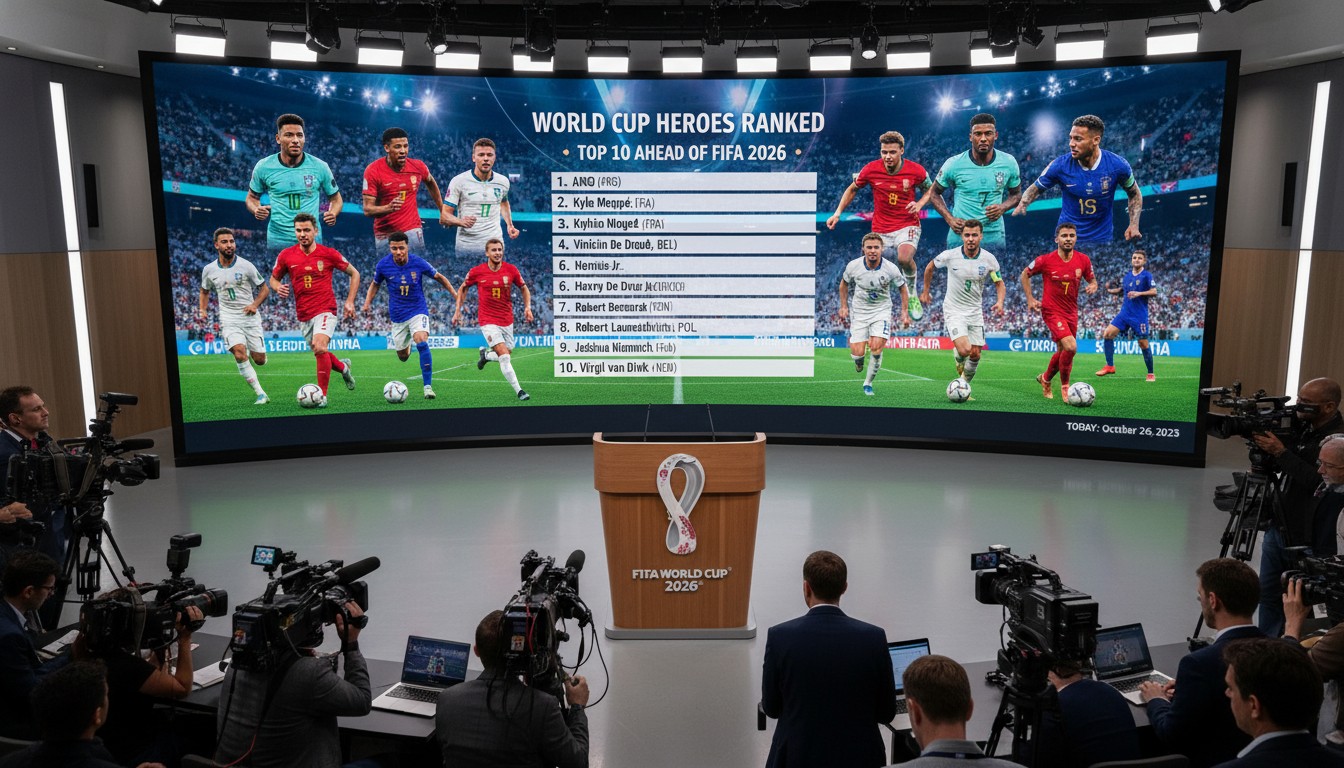
Top 10 World Cup heroes ahead of the 2026 tournament
Ranking the top World Cup heroes from Pelé to Zidane and examining their defining moments, records and legacy as football heads into the 2026 World Cup and influence.
Football’s global stage has produced characters whose performances and personalities became symbols far beyond sport, and the debate over the greatest World Cup heroes continues as the 2026 tournament approaches. This review ranks ten figures whose World Cup careers left lasting marks on national identities, tactical thinking and the sport’s global reach. The list draws on trophies, decisive moments and cultural impact to explain why these players remain reference points for fans and players alike. Their stories show how single matches and gestures can shape reputations for decades.
Pelé three time champion and global icon
Pelé remains the benchmark for World Cup success having won three tournaments in 1958 1962 and 1970 and carrying Brazil to global prominence. His blend of skill vision and scoring made him a cultural ambassador who altered public perceptions of footballers from the developing world. Pele’s ability to perform across positions and his leadership on and off the field helped make Brazil synonymous with creative football for generations. The ripple effects of his career continue to shape how countries use football as a tool of soft power.
Maradona and the defining 1986 performance
Diego Maradona’s 1986 World Cup in Mexico crystallized his complex legacy with moments of genius and controversy in the same match against England. His solo run that produced the so called goal of the century sits alongside the infamous handball that became the hand of God in a tournament that Argentina ultimately won. Maradona combined extraordinary technique with a combative temperament that made him both idol and lightning rod. His exploits on the pitch amplified Argentina’s national narrative and remain central to any discussion of World Cup heroes.
Cruyff and the revolution in playing style
Johan Cruyff did not lift the World Cup trophy but his influence on the 1974 Netherlands team and on global tactics makes him indispensable to the conversation on World Cup heroes. Cruyff’s interpretation of space movement and positional interchange helped codify what became known as Total Football and later informed styles from Ajax to Barcelona. His career shifted football from a purely physical contest to a choreographed art form that valued intelligence and team geometry. The techniques and ideas he promoted endure in coaching curricula worldwide.
Beckenbauer’s dual World Cup impact
Franz Beckenbauer is one of the few individuals to shape World Cup history both as a player and as a manager having captained West Germany to victory in 1974 and guided the united German team to the 1990 title. As a sweeper he redefined defensive play by initiating attacks and controlling tempo from the back. His later administrative role in German football and in World Cup hosting amplified his influence despite later controversies around tournament bidding. Beckenbauer’s career illustrates how tactical innovation and institutional leadership can combine to shape a national footballing era.
Ronaldo and Zidane’s final match moments
Ronaldo and Zinedine Zidane represent two very different but equally resonant models of World Cup heroism manifesting in finals and tournament narratives. Ronaldo bounced back from medical crises and injuries to star in Brazil’s 2002 triumph and to redefine the striker role with speed technique and clinical finishing. Zidane lifted France in 1998 with two goals in the final and remained a dominant playmaker in 2006 even as his headbutt in that final complicated his legacy. Both players produced moments that became shorthand for triumph and tragedy on football’s biggest stage.
European stalwarts and records that endure
A group of European greats from Ferenc Puskás to Lothar Matthäus Jimmy Greaves and Miroslav Klose underpin many of the records and stories that feed the World Cup mythology. Puskás’s scoring feats with Hungary set standards in the 1950s while Matthäus’s longevity and leadership helped Germany in five tournaments culminating in the 1990 title. Greaves earned a special place in England’s 1966 memory despite injuries that kept him out of the final. Klose finished his career as the World Cup top scorer and personified fair play and consistency across four tournaments. These players shaped records and national memories that endure.
How moments became national narratives
World Cup heroes become more than athletes because key matches are absorbed into wider public memory and political life. A single tournament goal a controversial decision or a display of leadership can be invoked in celebrations state events and even diplomacy years later. Nations often use the World Cup to craft stories about unity resilience and international standing and the players on this list provided the raw material for those narratives. That interplay between sport and society explains why debates over the greatest World Cup heroes are so persistent.
The ranking of these ten players is not an attempt to close the argument but to highlight how trophies iconic performances records and cultural influence combine to create hero status. As football prepares for the 2026 World Cup the memories of Pelé Maradona Cruyff and others will continue to shape expectations and inspire new generations to chase the moments that turn players into symbols.
