
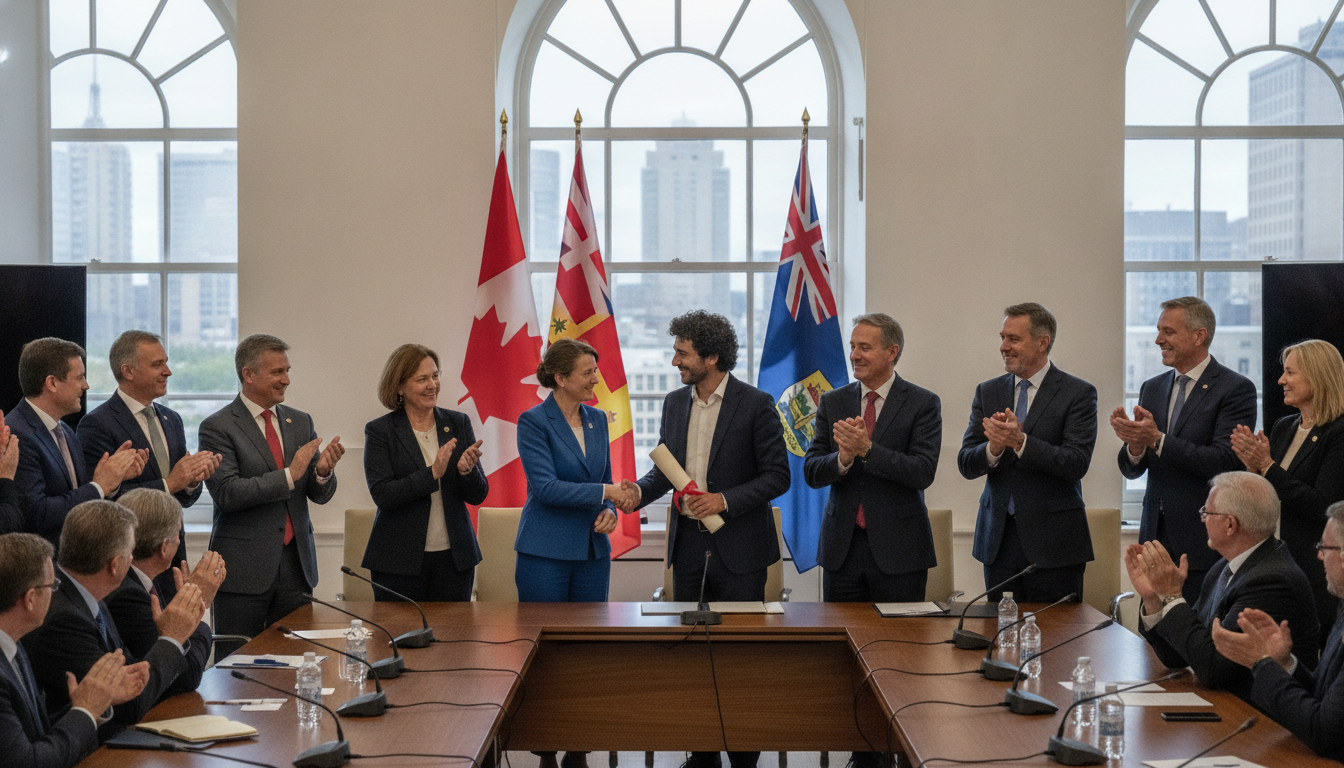
Ministers pledge to help employers in retaining francophone immigrants through expanded workplace initiative
Federal and provincial ministers expand the Initiative Culture d’entreprise to New Brunswick and Ontario to support employers in retaining francophone immigrants.
The federal, provincial and territorial ministers responsible for the francophonie concluded two days of meetings in Winnipeg with a pledge to help employers improve retaining francophone immigrants in minority-language communities. The ministers announced the expansion of the Initiative Culture d’entreprise — a program to help employers create workplace practices that support francophone newcomers — from Manitoba to New Brunswick and Ontario. The commitment is part of broader efforts tied to the 2023–2028 Plan of Action for Official Languages.
Ministers commit to employer-led retention of francophone immigrants
The ministers framed retention as primarily an employer responsibility and flagged workplace culture as a decisive factor in whether francophone newcomers stay. Federal Minister Marc Miller underscored that stable, suitable employment is central to integration, and ministers discussed how governments can better support employers to build francophone-friendly workplaces. Officials said recruitment of workplace partners will continue to roll out the initiative across provinces and territories where French is a minority language.
Ministers stressed that retention goes beyond hiring and involves tangible supports such as language-accessible training, mentorship, and pathways to promotion. They argued that by investing in employer capacity to retain French-speaking staff, jurisdictions can strengthen local francophone communities and labour markets. The measure is intended to complement settlement services and community-based supports already aimed at newcomers.
Culture d’entreprise initiative expands to New Brunswick and Ontario
The Initiative Culture d’entreprise, launched earlier in Manitoba, will now be available to employers in New Brunswick and Ontario, ministers announced at the close of the annual council. The program provides tools and guidance for employers to adapt workplace policies, onboarding and career development to better meet the needs of francophone immigrants. Officials say the expansion follows pilot work in Manitoba and reflects demand from employers and francophone community organizations.
Program officials described the initiative as a mix of employer assessments, tailored training and resource sharing that helps workplaces monitor retention outcomes. The expansion is intended to create regional hubs of practice that employers in minority-language settings can draw on. Ministers indicated further provincial rollouts are planned as recruitment of participating workplaces continues.
Manitoba and New Brunswick sign $40,000 exchange partnership
In a parallel development, Manitoba and New Brunswick signed a new annual partnership committing $40,000 each year for cultural, educational and economic exchanges between the two provinces. The agreement aims to deepen ties between francophone communities and open new markets for businesses that operate bilingually. New Brunswick’s minister responsible for the francophonie, Robert Gauvin, said the funding will help facilitate interprovincial collaboration and create opportunities for enterprises and cultural organizations.
Officials described the exchange funding as modest but strategic, enabling short-term projects, study tours and sectoral networking that can spark longer-term collaboration. The New Brunswick Secretariat’s executive director, Vicky Deschênes, noted similar agreements were reached with Quebec and Ontario during the same meeting cycle, indicating a broader push to knit francophone communities together across provincial lines.
Plan of Action mid-term review and immigration targets
Ministers used the Winnipeg meeting to take stock of the 2023–2028 Plan of Action for Official Languages at its mid-point, assessing where investments have worked and where gaps remain. A central focus was the role of francophone immigration in sustaining minority-language communities and whether current supports are achieving intended integration outcomes. Officials asked whether funding is being spent effectively and how its impact on retention can be measured.
Federal ministers reiterated that immigration targets remain a policy priority. They reported progress toward a national goal of increasing francophone immigration to 10 percent of newcomers, with current figures cited at roughly 8.9 percent. Ministers acknowledged that numerical gains bring integration challenges and said policy adjustments may be needed to ensure newcomers can find francophone jobs and community supports.
Practical steps emphasized: jobs, training and employer partnerships
Throughout the meetings, concrete measures were prioritized over broad commitments, with repeated references to job quality, workplace language practices and employer-led training. Ministers and officials discussed incentives for employers to offer bilingual positions, language training funded through partnerships, and tools to evaluate workplace inclusiveness for francophone staff. The discussion sought to link settlement programming with labour market needs, reducing mismatches that can push newcomers away from francophone communities.
Participants highlighted success stories where employers who adopted francophone-friendly practices reported better retention and clearer career paths for French-speaking employees. Ministers encouraged provinces and community partners to document those cases and scale effective approaches across sectors that are experiencing labour pressures.
Electoral period limits comment from Manitoba minister
Manitoba’s minister for francophone affairs, Glen Simard, refrained from commenting in detail at the closing of the meeting, citing a period of restraint ahead of a scheduled by-election in the Pas-Kameesak riding on July 21. Ministers acknowledged that electoral timelines can temporarily limit public communications, but they said intergovernmental work and program implementation would continue within established guidelines. Officials confirmed that the by-election schedule will not change the provinces’ commitments to the initiative rollouts and interprovincial exchanges.
The ministers left Winnipeg with an operational agenda: recruit more employers into the Culture d’entreprise initiative, document effective retention practices, and scale small interprovincial funding arrangements that connect francophone communities. They framed these steps as necessary to translate higher francophone immigration numbers into durable community growth and stronger bilingual labour markets.
Looking ahead, governments will track retention metrics and seek employer partners willing to pilot bilingual hiring practices and career supports for francophone newcomers. The ministers said they expect continued cooperation across federal, provincial and territorial lines as the initiative expands to new jurisdictions.
