
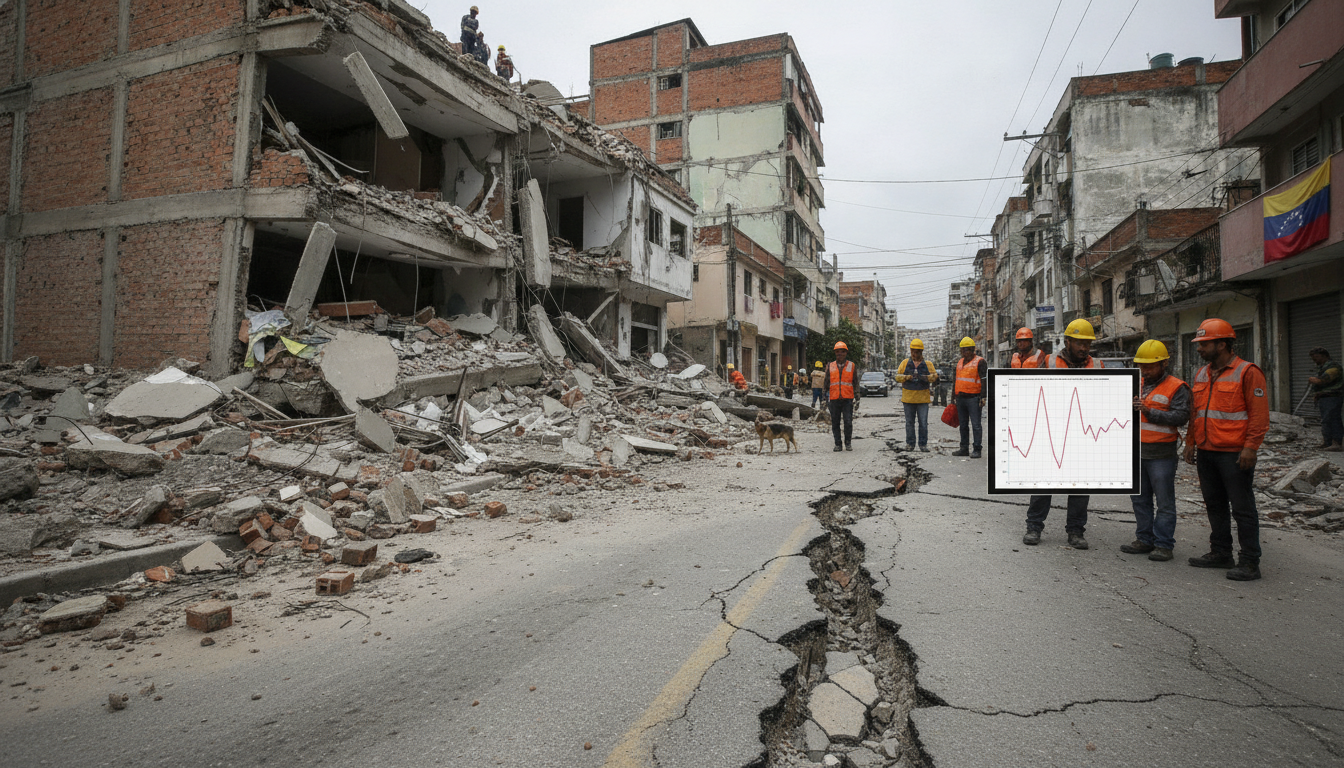
Venezuela earthquake doublet: Two shallow temblors and an eastward rupture devastated Caracas coast
Venezuela earthquake doublet on June 24 sent amplified shaking toward Caracas and coastal towns, killing over 2,200 and destroying hundreds of buildings.
The Venezuela earthquake that struck on June 24 consisted of two powerful temblors just 39 seconds apart, unleashing prolonged, destructive shaking across the capital and coastal communities. The Venezuelan government reported more than 2,200 deaths and widespread structural collapse in La Guaira, Caraballeda and surrounding areas. Scientists and engineers say a rare combination of a doublet, a rupture that propagated east toward Caracas, very shallow faults and soft coastal soils helped turn a single event into a calamity.
Double temblor struck within 39 seconds
Seismologists described the event as a “doublet,” with an initial magnitude-7.2 shock followed 39 seconds later by a larger magnitude-7.5 quake. The close timing meant buildings and infrastructure endured two episodes of violent shaking with almost no time to recover between them. Experts have said the first quake likely triggered the second, producing chaotic motion that exceeded what many structures were designed to resist.
The extended duration of strong ground motion increased stresses on columns and load-bearing elements, contributing to catastrophic collapses in some multi-storey buildings. Emergency crews faced immediate life-saving challenges as aftershocks and continued instability hampered search-and-rescue operations.
Fault rupture traveled east toward Caracas
Initial analyses indicate the rupture began on the Boconó fault system and then propagated east along the San Sebastián fault toward Caracas. That eastward path carried destructive seismic energy more than 100 miles toward densely populated zones, focusing strong shaking on cities that might otherwise have been spared. U.S. Geological Survey and university seismologists noted that if the rupture had moved west instead, the pattern of damage would likely have been very different.
The alignment of the San Sebastián fault beneath low-lying coastal districts helps explain why damage was concentrated in particular neighborhoods. The direction of rupture and the location of populated areas combined to concentrate energy in ways that satellite analysis and field surveys are now mapping.
Coastal ground shifted as much as 1.5 feet
Post-quake satellite imagery and geodetic measurements showed measurable horizontal displacement along the coast, with some zones moving as much as 1.5 feet to the west. The displacement was especially clear in areas where the fault runs just offshore or directly beneath urban strips, including parts of La Guaira and the Playa Grande neighborhood. Simón Bolívar International Airport registered contrasting east-west shifts between its northern and southern halves, evidence of the strike-slip motion along the fault seam.
Although the fault did not appear to break the surface everywhere it passed, the subsurface shift was sufficient to crack pavement, warp runways and undermine foundations. Engineers say such lateral movement near built environments substantially increases the risk of structural failure even without clear surface rupture.
Directivity amplified shaking to the east
Scientists point to a “directivity” effect as a likely amplifier of shaking toward Caracas and nearby coastal towns. As the rupture moved eastward, seismic waves stacked and intensified in front of the propagating fault tip, much like waves piling up ahead of a moving vessel. That concentration of wave energy can raise ground motion amplitude enough to move vulnerable buildings from heavy damage to collapse.
Seismologists caution that directivity’s precise contribution will only be quantified after additional data are analyzed, but the phenomenon offers a coherent explanation for why strong shaking reached areas tens of miles from the epicenter.
Soft soil and coastal construction amplified damage
Low-lying coastal zones in Venezuela sit on thick, unconsolidated sediments — former sea and lake bottoms — that can dramatically amplify seismic waves. When amplified ground motions match a building’s natural sway frequency, resonance can intensify oscillations and multiply structural stress. Satellite and mapping efforts show that most of the total building losses occurred in such soft-soil corridors along the shoreline.
In Caraballeda, at least 152 buildings were reported destroyed, while the Playa Grande neighborhood suffered the collapse of roughly 246 structures, according to post-event analyses. High-rise collapses and the toppling of coastal blocks concentrated human losses in districts that combined dense occupancy with ground conditions unfavorable to seismic resilience.
Building failures raise questions about construction and enforcement
Venezuelan seismic codes are considered among the more rigorous in the region, but the scale of destruction has prompted urgent questions about whether those standards were followed and enforced. Preliminary field observations cite frequent failure modes: soft-story collapses where ground-floor openings lacked adequate bracing, columns that appear to have been under-reinforced, and older structures that predate modern code improvements.
Some buildings failed completely while others sustained severe nonstructural damage yet remained standing, allowing occupants to escape. That mix suggests both construction deficiencies and differences in building vintage and design philosophy influenced survival outcomes. Full forensic engineering studies will be required to separate the roles of design, construction practice and extraordinary seismic loading in the worst failures.
Recovery teams continue search-and-rescue and damage assessment amid ongoing aftershocks and logistical hurdles. Authorities and international observers say a comprehensive accounting of fatalities, the causes of each collapse and the repair needs for infrastructure will take weeks to months. The convergence of a rare doublet, an eastward-propagating shallow rupture and soft coastal geology offers a preliminary framework for understanding why the Venezuela earthquake produced such devastating results.
