
Tanker struck in the Strait of Hormuz amid first US–Iran exchanges since June protocol
Tanker struck by unidentified projectile in the Strait of Hormuz as US and Iran exchange strikes; crew unharmed and shipping routes face renewed strain.
Tanker struck in the Strait of Hormuz
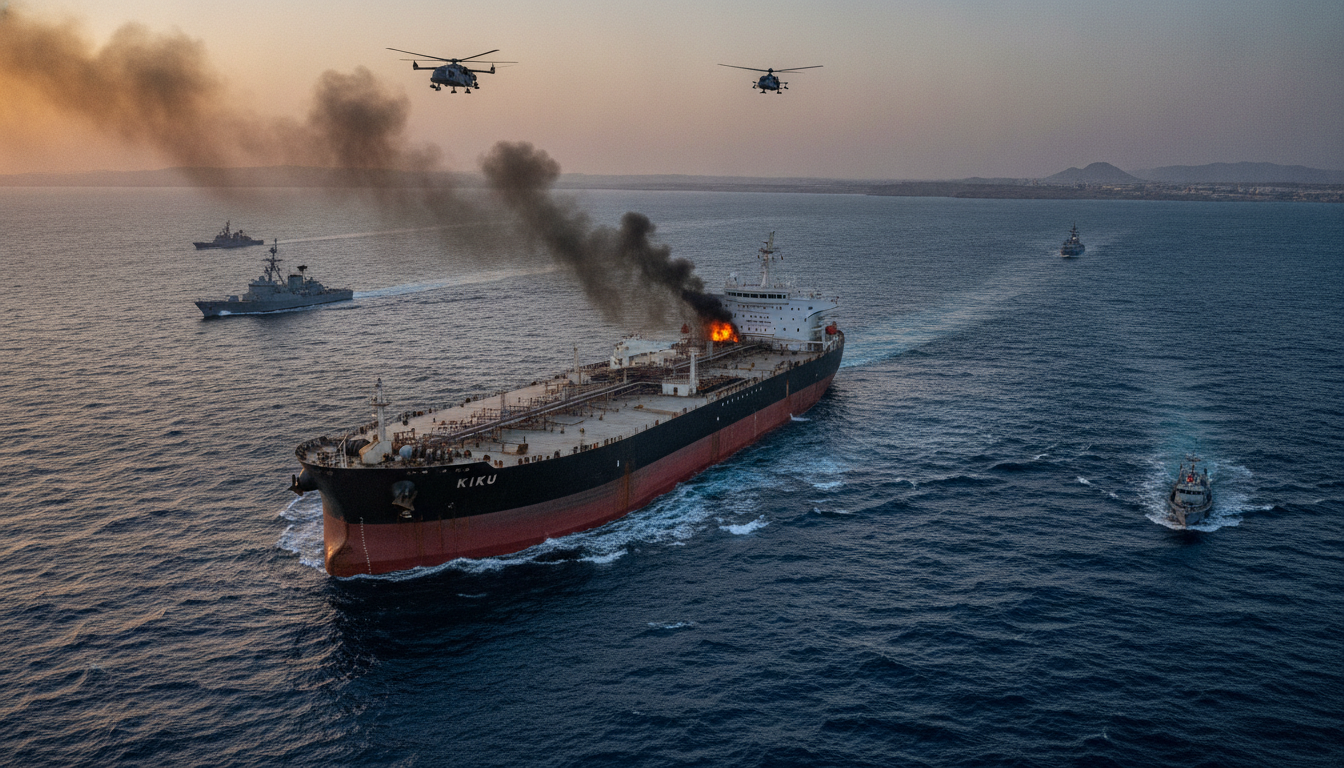
A commercial tanker was hit by an unidentified projectile while transiting the Strait of Hormuz, British maritime agency UKMTO reported, marking a tense moment in an already fragile calm. The incident occurred after initial exchanges of strikes between United States and Iranian forces following a June 17 protocol agreement, raising immediate concerns for regional shipping safety.
The vessel, identified by private tracking firm Vanguard Tech as the Panama-flagged KIKU, sustained damage near its bridge area but the crew was reported safe and no environmental spill was confirmed. Authorities continue to investigate the origin of the projectile as international shipping operators reassess routing through the narrow transit corridor.
Damage assessment and crew status
UKMTO said the ship’s bridge suffered damage but that the crew remained uninjured and on board, a detail likely to shape the immediate operational response. Maritime insurers and classification societies will require formal surveys before the KIKU can resume normal operations or be moved to a repair facility.
Officials have not publicly attributed responsibility for the strike, and an initial report noted no detectable environmental contamination. Shipping companies and flag states typically wait for forensic analysis and official notifications before issuing formal statements on liability or compensation.
US and Iran report reciprocal strikes
Iran’s Islamic Revolutionary Guard Corps announced it had struck American positions in the Gulf in retaliation for U.S. strikes inside Iran, describing the actions as countermeasures. The U.S. military said its operations targeted sites it assessed as missile and drone storage as well as coastal radar installations, and later released video footage of its strikes.
These exchanges represent the first known kinetic blows between the two countries since the June 17 protocol, complicating an already delicate diplomatic track. Washington has characterized previous maritime damage in the area as Iranian attacks, while Tehran has condemned U.S. actions as violations of the protocol and the UN Charter.
Maritime traffic and evacuation process under strain
Ship-tracking data cited in regional reports showed dozens of commercial vessels continuing to transit the Strait of Hormuz despite the heightened tensions. Authorities recorded variations in daily passage counts as operators weighed route safety; some vessels chose a corridor along Omani waters while others followed alternative, uncertified tracks.
The International Maritime Organization has said an evacuation and relief process for vessels and seafarers blocked in the Gulf will resume only once additional security confirmations are secured. Earlier phases of the evacuation reportedly removed thousands of seafarers and scores of ships from the most exposed zones, but the suspension following the recent attacks delayed further movements.
Diplomatic reactions and public statements
U.S. officials, including the vice president, urged restraint and pointed to diplomatic channels for resolving implementation disagreements over the June protocol. Tehran’s foreign ministry condemned U.S. strikes as a breach of the ceasefire agreement and warned that continued aggression would prompt broader responses.
Political leaders outside the immediate conflict zone have called for de-escalation and verification of compliance with the protocol, while regional actors emphasize the importance of keeping the Strait of Hormuz open for global trade. Public statements from the parties have underscored competing narratives about who is responsible for recent attacks on commercial shipping.
Linkages to Lebanon–Israel framework complicate regional picture
The episode adds strain to parallel diplomatic efforts in the region, including a U.S.-mediated framework announced to address tensions between Israel and Lebanon. Leaders in Beirut and Jerusalem have reacted divergently to the framework, with opponents warning it could inflame internal divisions rather than stabilize borders.
Hezbollah and its political allies have framed the Israel–Lebanon discussions as connected to the wider conflict dynamics in which Iran is a central actor, suggesting that progress on one track could be undermined by activity on another. Demonstrations and incendiary rhetoric in several capitals reflect the risk that localized incidents in the Gulf can reverberate across multiple theatres.
The security environment in and around the Strait of Hormuz remains volatile, and maritime authorities are likely to maintain heightened alerts while investigations proceed and diplomatic channels convene. Continued monitoring, clear attribution and swift communication between naval forces and commercial operators will be essential to prevent further disruptions and to secure passage for civilian shipping.
