
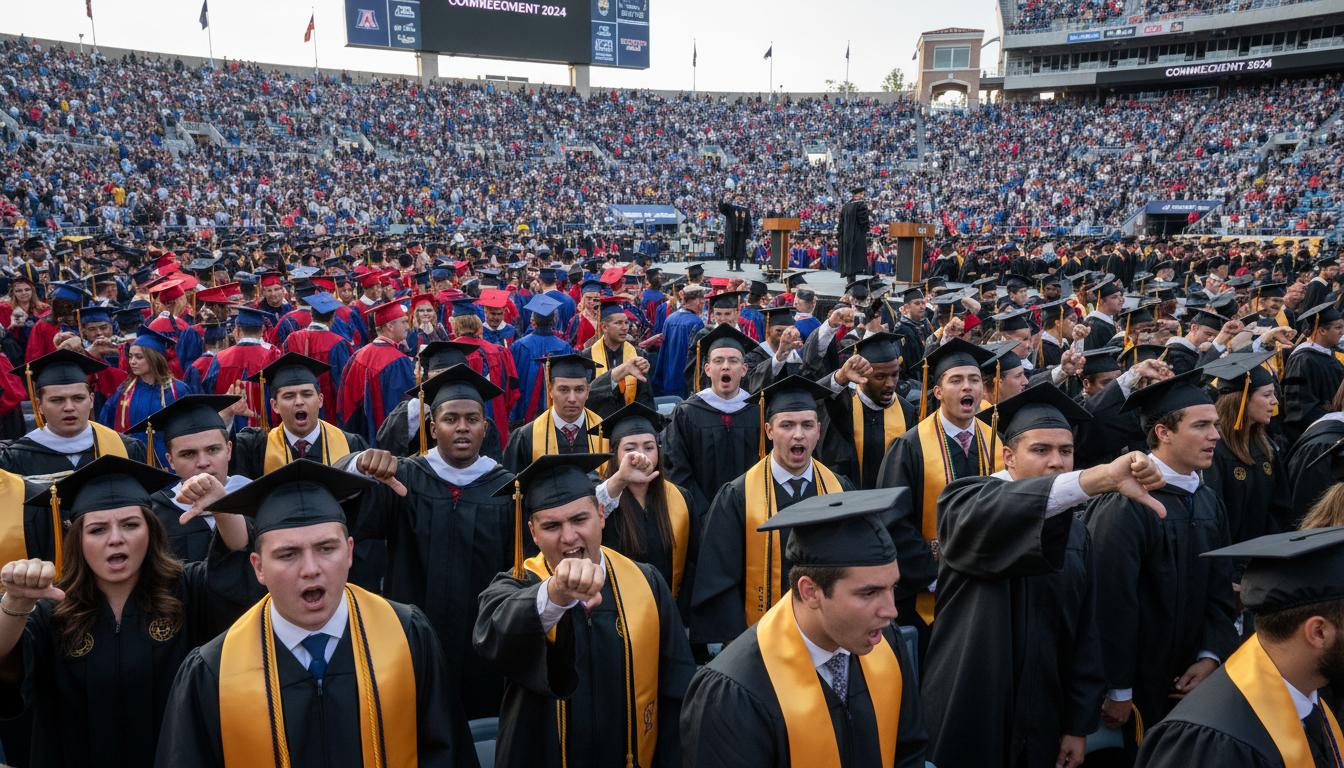
AI at commencement: Graduates booed speakers who framed AI as the next industrial revolution
Graduation crowds at multiple U.S. universities this month rejected upbeat portrayals of AI at commencement, with students loudly booing a speaker who called artificial intelligence “the next industrial revolution” and interrupting a separate address by a high-profile tech executive. The reaction highlights rising student unease about AI at commencement and the workplace realities that many graduates now face. (abcnews.com)
UCF graduates interrupt speech after AI remark
At the University of Central Florida, thousands of students gathered for a College of Arts and Humanities ceremony on May 8 when Gloria Caulfield, a Tavistock Development Company executive, described AI as an industrial-scale transformation. Her remark prompted an immediate eruption of boos that left the speaker visibly surprised and the audience chanting and jeering before alternating between boos and cheers. (tampabay.com)
Video of the exchange circulated widely online, showing Caulfield pause, turn to fellow speakers and laugh as the noise mounted, then attempt to continue amid mixed reactions. Campus observers said the crowd included humanities and communications graduates who later described the response as a collective expression of frustration rather than a single instigator’s act. (abcnews.com)
Eric Schmidt met with sustained heckling at University of Arizona
The trend continued at the University of Arizona’s May 15 commencement, where former Google CEO Eric Schmidt faced persistent boos and interruptions when he discussed the role students would play in shaping artificial intelligence. The unrest at that ceremony followed organized calls from several student groups to remove Schmidt as speaker amid allegations and a pending lawsuit that he has denied. (news.arizona.edu)
Local reports said the booing began before Schmidt took the stage and persisted through large portions of his remarks, including when he urged graduates to seize opportunities in the AI era. University officials proceeded with the program, and the ceremony concluded after scheduled addresses and recognitions. (kold.com)
Students point to bleak hiring prospects and economic grievances
Analysts and student commentators tied the backlash to broader economic anxiety among young people, noting steep drops in job-market optimism over recent years. A Gallup survey reported that only 43 percent of Americans aged 15 to 34 said 2025 was a good time to find a job locally, a marked decline from prior polling and a factor that observers say fuels skepticism about AI’s promise. (news.gallup.com)
Commentators argue that for many graduates AI is not a neutral technological advance but a mechanism that can concentrate wealth and displace entry-level work, intensifying existing inequalities. Tech critic Brian Merchant framed the reaction as part of a wider rejection of “hyper-scaling capitalism” embodied by AI, saying students’ boos reflect anger at how the technology has been deployed rather than unfamiliarity with the concept. (bloodinthemachine.com)
Not all commencement mentions of AI drew backlash
The reaction was not uniform across campuses. Nvidia CEO Jensen Huang, who delivered Carnegie Mellon University’s commencement address earlier in the season, praised AI as a reinvention of computing and did not encounter the same audible opposition, according to accounts of that ceremony. The difference underlines how audience composition, the speaker’s profile and local campus dynamics shape responses. (techcrunch.com)
Observers noted that STEM-focused audiences and institutions with deep ties to the tech industry tend to receive pro-AI messages with less hostility than arts and humanities cohorts, where graduates may be more exposed to debates about artistic labor, surveillance and wage pressure. That divergence helps explain why some speakers sailed through while others were met with visible resistance. (odaily.news)
Universities face renewed scrutiny over speaker selections and ceremonies
The booing episodes come amid a wider wave of commencement controversies this year, as campus groups increasingly demand reconsideration of high-profile speakers for reasons ranging from political views to allegations of misconduct. Administrators are grappling with tensions between honoring donors and public figures and responding to student calls for accountability at symbolic events like graduation. (insidehighered.com)
Some institutions have seen petitions, organized protests and public debate in the weeks before ceremonies, making commencements a focal point for broader campus activism. Experts say the visibility of these events and the emotional stakes for graduates mean that ceremonies are likely to remain flashpoints for contested messages about the future of work, technology and civic life. (tucson.com)
Students’ reactions at recent commencements have elevated the conversation about how universities, employers and policymakers should address the intersection of AI, labor and equity. As thousands of graduates enter a tight job market, their visible unease at messages that promise technological progress but also suggest disrupted career paths has forced a public reckoning over what an AI-driven future will mean for new entrants to the workforce. (news.gallup.com)
