
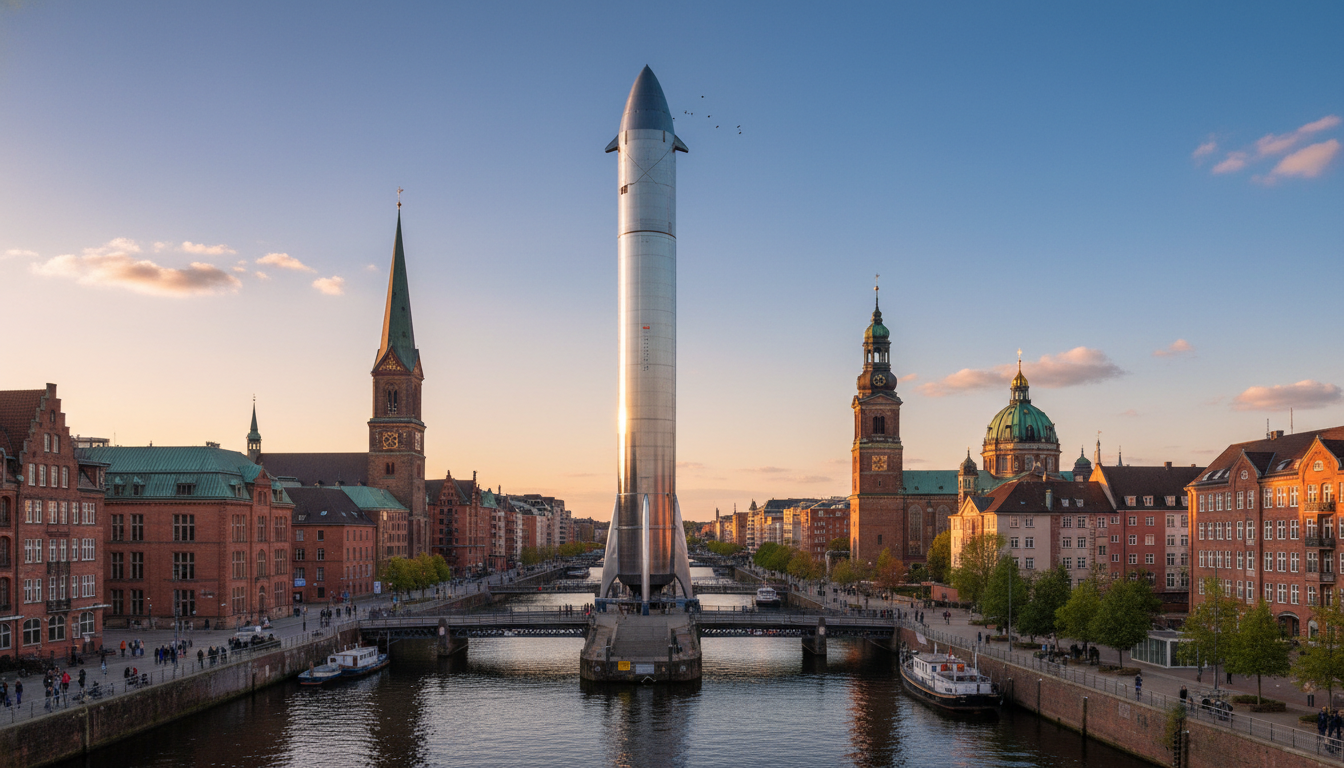
Starship launch in Germany would dwarf church spires and reshape skylines
SpaceX Starship launch in Germany would reshape skylines, dwarf church spires and create regulatory, safety and heritage challenges incl. Hamburg and Munich.
The prospect of a Starship launch in Germany has renewed debate over urban skylines and public safety, as the fully stacked vehicle would tower well above many historic spires. A Starship launch in Germany would be visible for miles and could change how residents and planners view city horizons. Officials, heritage groups and urban planners say the hypothetical scenario raises questions about regulation, infrastructure and cultural impact.
Starship would dwarf historic church spires
A fully assembled Starship rising on a coastal or inland pad would exceed the height of many prominent church towers that define German city skylines. Landmarks such as central Hamburg and Munich spires that have pierced the horizon for centuries would be outscaled by a modern orbital vehicle. That contrast between heritage architecture and rocket technology is central to conversations about where a launch facility could be sited.
Local skylines are a patchwork of historic and modern structures, and a towering launch vehicle would introduce a new vertical element that is unprecedented in most German cities. For residents and tourists, the visual dominance of a launch stack would become a daily reminder of aerospace activity near urban areas. Planners must therefore weigh aesthetic and cultural values alongside technical feasibility when considering sites.
Visual impact on Hamburg and Munich skylines
Cities like Hamburg and Munich anchor regional identity with church steeples and historic domes that are focal points for orientation and tourism. A launch site in or near these metros would create a striking juxtaposition between centuries-old masonry and contemporary aerospace hardware. Visual simulations produced in planning discussions show how a launch complex could be visible from city centers and waterfront promenades.
The visibility factor also carries secondary effects: night-time illumination during pre-launch operations, contrails and plume signatures during ascent, and longer-term changes in how cityscapes are photographed and marketed. Those alterations would affect not only residents but municipal branding and cultural promotion strategies.
Safety, airspace and regulatory hurdles
A Starship launch in Germany would trigger a complex regulatory review spanning aviation authorities, environmental agencies and municipal governments. Launch operations require temporary airspace closures, exclusion zones on land and sea, and strict hazard assessments for debris and overpressure. German and European regulations for such activities are robust and would demand thorough environmental and safety studies.
Coordination with Federal Aviation Office (Luftfahrt-Bundesamt), maritime authorities and local emergency services would be necessary to establish acceptable risk levels and contingency plans. Permitting timelines and public hearings could stretch for years, and any proposal would face intense scrutiny from safety regulators and community stakeholders.
Infrastructure and logistical challenges for launch pads
Building a launch facility capable of handling a vehicle the size of Starship requires specific infrastructure: large assembly buildings, heavy-rail transport links or barge access, propellant storage and high-capacity electrical and water systems. Urban ports and industrial zones are potential candidates, but retrofitting them for orbital launch presents high costs and technical barriers. Transporting large rocket stages through city streets or along inland waterways would present its own logistical headaches.
Additionally, supply chains for cryogenic fuels and specialized materials would have to be established or expanded, and local utilities scaled to meet significant peak demands during operations. The choice between coastal and inland sites will hinge on safety buffers, environmental constraints and the ability to isolate exclusion zones from densely populated areas.
Cultural heritage concerns and public reaction
Heritage bodies and conservationists are likely to scrutinize any plan that changes the visual integrity of protected sites. Church towers and historic skylines are often legally protected or form part of conservation areas, which complicates proposals for high-visibility industrial projects nearby. Public sentiment can be fiercely protective of these symbols, and community opposition could shape or halt plans long before technical assessments conclude.
Public consultation processes will be crucial, and transparent impact studies will be needed to address concerns about noise, night lighting, air quality and tourism impacts. In many German cities, citizens’ initiatives and local councils wield considerable influence, meaning that any successful proposal must secure broad local support.
Economic and tourism implications
Proponents argue that a launch facility could deliver economic benefits through high-tech jobs, supplier contracts and tourism tied to launches and associated museums or visitor centers. A regular launch cadence might create a new niche of aerospace tourism, drawing enthusiasts and raising regional visibility on the global stage. The presence of aerospace activity could also spur investment in research and development clusters and university partnerships.
Opponents caution that the economic upside must be balanced against potential declines in traditional tourism if the character of historic districts is perceived as altered. Municipalities will need to perform careful cost-benefit analyses, weighing immediate construction and operational gains against long-term cultural and environmental costs.
Public attitudes toward a Starship launch in Germany will be shaped by safety assurances, regulatory transparency and tangible local benefits. The debate encapsulates broader tensions between preserving historic urban identities and accommodating large-scale technological projects that carry both promise and disruption.
