
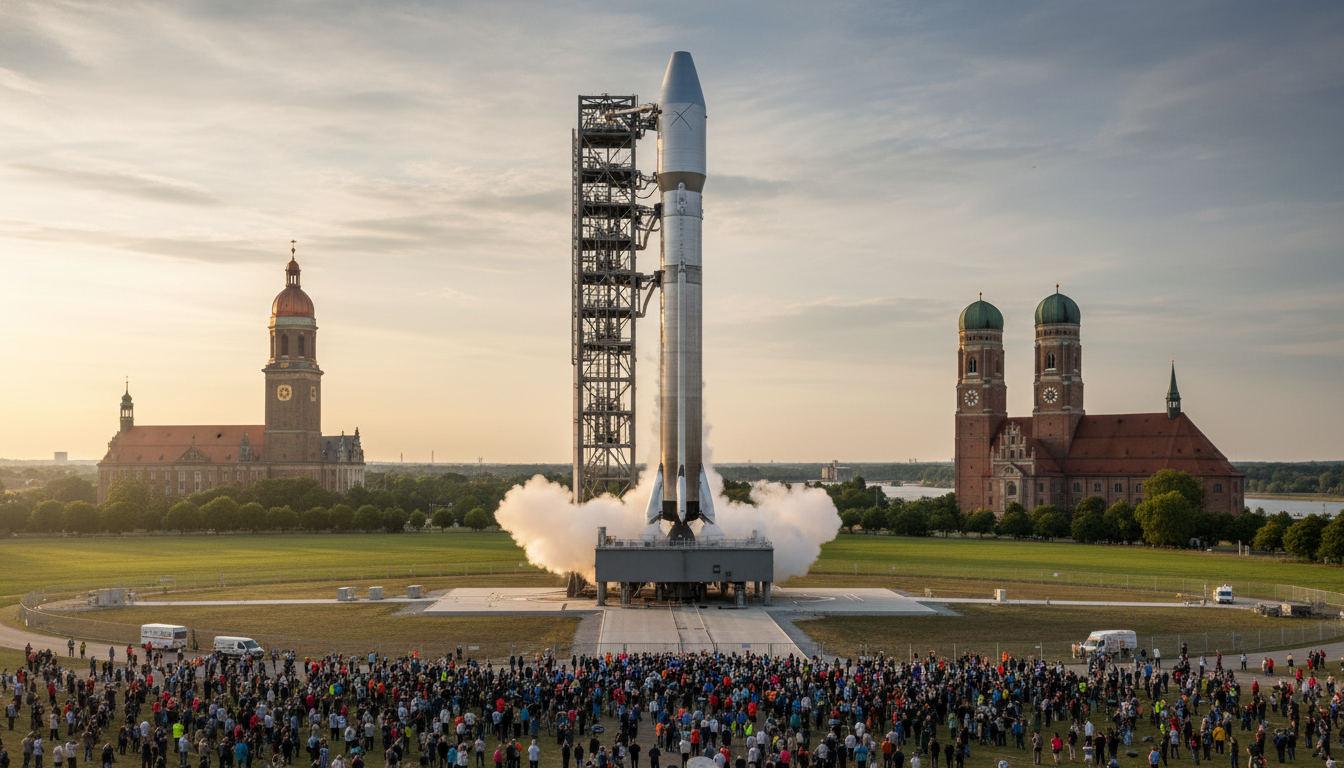
Starship Launch in Germany Would Tower Over City Landmarks, Prompting Safety and Planning Debate
Hypothetical Starship launch in Germany would dwarf historic churches and reshape urban safety, planning and tourism debates in Hamburg, Munich and beyond.
A hypothetical Starship launch in Germany would dramatically alter skylines and raise fresh questions about safety, regulation and local planning. Visual comparisons suggest the SpaceX vehicle would rise tens of meters above iconic structures, making any such operation impossible to overlook. City officials, safety experts and heritage groups say the prospect requires detailed assessment before any launch is considered on German soil.
Starship would dwarf Hamburg and Munich landmarks
The scale of the Starship is central to the discussion around a Starship launch in Germany, with estimates indicating the rocket could exceed the height of many historic churches. In Hamburg, for example, a full-size orbital vehicle would top St. Michaelis by roughly ten meters in hypothetical comparisons. In Munich the difference would be even more pronounced, with some landmark towers potentially overshadowed by as much as fifty meters.
These comparisons underline why residents and planners are reacting strongly to the idea of an urban launch. The visual dominance of a multi-story rocket above a city center shifts the conversation from purely technical feasibility to urban character and cultural preservation.
Projected visibility across multiple cities
Observers note that the visibility of a Starship launch would not be confined to neighborhoods near a launch pad; its ascent and vertical scale would be visible across broad urban areas. In compact European cities, where tall structures are rare and skylines are low, a single launch could be seen from several kilometers away. That level of visibility carries implications for crowd management, transport, and the general public’s right to safe observation.
Tourism and public curiosity are likely to multiply the number of observers, increasing the logistical burden on municipal services. Authorities would need to plan routes, viewing zones and communications to prevent congestion and ensure safety.
Regulatory and airspace challenges
A Starship launch in Germany would trigger a complex web of regulatory reviews, spanning aviation authorities, environmental regulators and municipal planning departments. Launch clearances require coordination with civil aviation to protect airspace and ensure commercial flights are rerouted or grounded as necessary. Environmental impact assessments would likely examine noise, emissions and potential effects on protected sites and wildlife.
Regulatory timelines and cross-border coordination with neighboring countries would also factor into any decision. Given the scale and novelty of such an operation, regulators would be expected to demand exhaustive safety documentation and contingency plans.
Emergency planning and public safety concerns
Emergency-services planners stress that an urban launch heightens the stakes for contingency planning. Potential failure modes during ascent, staging or descent create scenarios that emergency responders have limited experience handling within dense cityscapes. Local fire, police and medical services would need specialized training and equipment to respond effectively to launch-related incidents.
Evacuation routes, shelter-in-place guidance and real-time public communications would be essential elements of any approved launch plan. Municipal agencies would likely insist on drills and collaborative exercises with the launch company well in advance of a permitted operation.
City officials weigh infrastructure and tourism impacts
City leaders see a Starship launch in Germany as a double-edged sword: a unique attraction that could draw international attention, but also a stress test for infrastructure. Boosts to hospitality and local businesses could be significant around a launch event, while transport systems would face unusual surges in passenger numbers. Authorities must balance potential economic benefits with the costs of expanded policing, traffic control and temporary public works.
Heritage organizations and resident associations are already signaling the importance of preserving sightlines and protecting historic fabric. Any negotiation with a launch provider would likely include strict conditions to limit disruption and safeguard cultural assets.
Starship dimensions and technical context
Understanding the technical profile of the vehicle helps explain the concerns. The Starship system is designed as a massive two-stage launch vehicle with heights that place it among the tallest rockets ever built. Its size and fuel requirements influence not only the visible scale but also the structure and footprint of launch infrastructure. Launch pads, flame diverters and exclusion zones necessary for a rocket of this size would occupy substantial land and require bespoke engineering solutions.
Operational cadence, payload types and landing plans also shape municipal risk assessments. Reusable systems that return stages to near-shore or on-land landing sites introduce additional planning considerations that authorities must evaluate.
Debate over a Starship launch in Germany is likely to continue as stakeholders weigh the technical possibilities against urban priorities, safety standards and heritage protection.
