
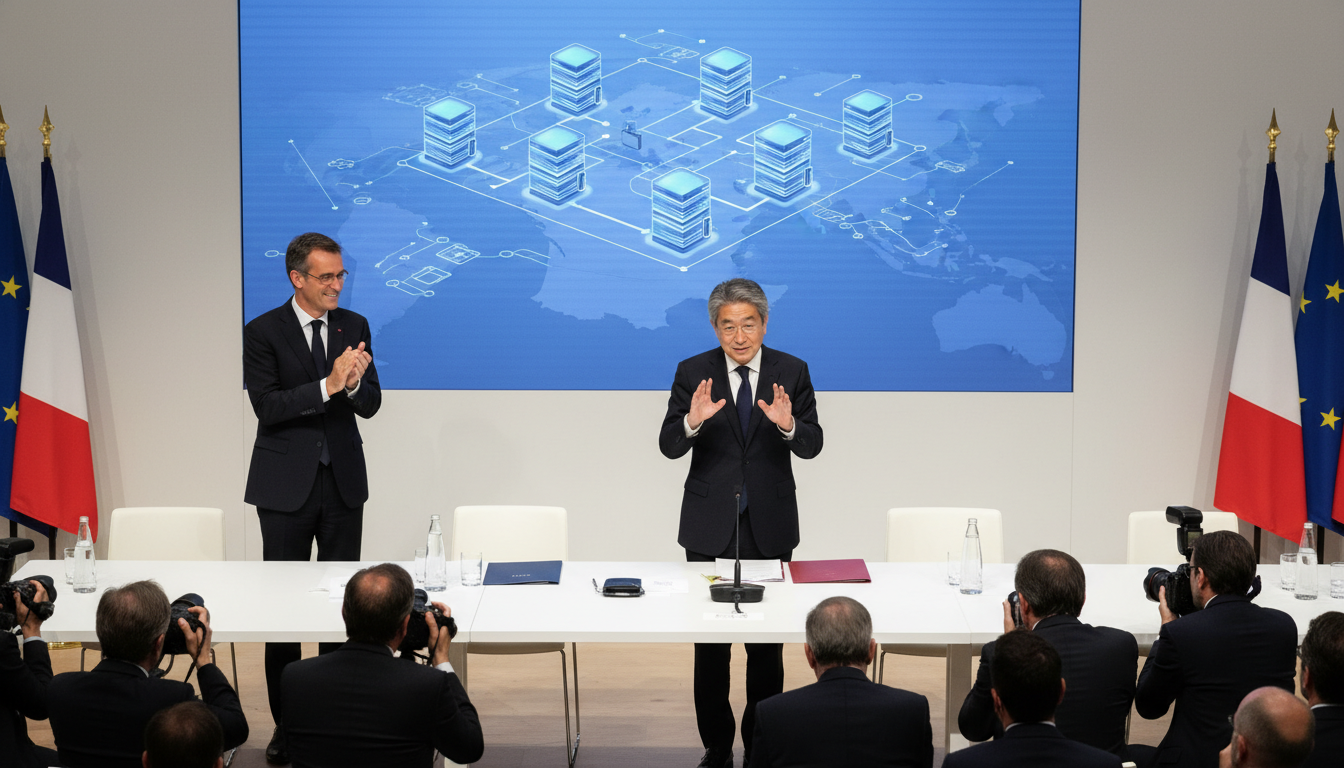
SoftBank to invest €75 billion to build data centers in France
SoftBank to invest up to €75 billion in France to add 5GW of data center capacity, starting with 3.1GW in Hauts-de-France by 2031; major AI infrastructure move.
SoftBank announced on May 31, 2026 that it will spend up to €75 billion to expand data center capacity in France, marking a major move into European AI infrastructure. The plan aims to develop and operate as much as 5 gigawatts of additional data center power, with the first phase targeting 3.1 gigawatts in the Hauts-de-France region by 2031. The announcement elevates France’s profile in a global race to host compute for artificial intelligence and cloud services.
SoftBank unveils scale and funding for French deployment
SoftBank said the multi-billion-euro program will be its largest AI infrastructure investment in Europe and one of the company’s most significant overseas technology commitments. The company framed the effort as a long-term buildout of physical capacity to service growing demand from hyperscalers, AI firms and enterprise cloud customers. Financial details indicate the investment could reach €75 billion (roughly $87 billion), which would cover land, construction, power and associated network infrastructure.
The plan positions SoftBank to capture orders for compute and colocation as Europe seeks to secure local AI capacity and reduce dependency on non-European data routes. Executives described the project as phased and scalable, allowing capacity to expand in response to customer demand and regulatory constraints. Officials emphasized that the investment will be implemented in stages to manage permits, grid integration and local supply chains.
First-phase sites chosen in Dunkirk, Bosquel and Bouchain
The first tranche of capacity will be concentrated in three sites: Loon-Plage near Dunkirk, Bosquel and Bouchain, all located in or near the Hauts-de-France region. SoftBank plans those facilities to deliver about 3.1 gigawatts of capacity by 2031, creating a regional hub for high-density computing. Company materials indicate the sites were chosen for proximity to power infrastructure, fiber connectivity and industrial logistics.
Local and regional authorities are expected to play a role in facilitating permits, land access and workforce development for the construction phase. The move is likely to spur contract awards to construction firms, electrical suppliers and data-center specialty vendors in the coming years. Residents and municipal leaders will face negotiations over land use, environmental reviews and community benefits tied to the projects.
Ambition: 5 gigawatts targeted for European AI demand
SoftBank’s stated aim is to reach up to 5GW of additional capacity across France, a target that reflects rapid growth in AI compute requirements. That level of power would place the company among the larger single-country data center investors in Europe if fully realized. SoftBank has also highlighted commercial relationships with major AI developers and cloud providers as underpinning demand for the new capacity.
Industry analysts note that AI model training and inference workloads consume substantial and steady power, prompting long-term capacity planning and direct investment in generation and grid upgrades. SoftBank’s announcement signals a bet that European demand for locally hosted AI infrastructure will continue to accelerate through the end of the decade. The company’s dual role as investor and customer in AI ecosystems adds commercial momentum to its build plans.
French government frames investment as strategic for AI value chain
France’s economic minister, Roland Lescure, welcomed the commitment and described it as a testament to President Emmanuel Macron’s ambition to anchor parts of the AI value chain in France. Government officials have repeatedly promoted industrial-scale compute as a cornerstone of national AI strategy, citing data sovereignty, research competitiveness and high-skilled jobs. Ministers said they will coordinate with SoftBank to smooth regulatory processes and support workforce initiatives tied to the projects.
Paris has been courting major data center investments as part of a broader effort to attract semiconductor fabs, AI labs and cloud infrastructure. Officials expect ancillary economic activity from site development, including logistics, maintenance services and local supply chains. However, ministers also acknowledged that oversight will be needed on environmental, planning and grid matters as projects proceed.
Environmental and grid concerns echo debates in the United States
The announcement comes amid heightened scrutiny of data center construction in other jurisdictions, notably the United States, where opposition has grown over environmental impacts and stress on local electricity networks. Critics in the U.S. have argued that rapid expansion of compute hubs can strain grids, raise utility costs and create land-use tensions with communities. SoftBank’s earlier U.S. initiatives, including plans tied to a large natural gas-fired power plant to support an Ohio facility, have drawn public debate over energy sourcing and sustainability trade-offs.
In Europe, regulators and utilities are already weighing integration strategies that prioritize renewables, grid upgrades and energy efficiency measures for large compute sites. SoftBank has signaled a willingness to work with grid operators and policymakers on power procurement and capacity planning, but detailed plans for energy sourcing and emissions controls have not been fully disclosed. Observers say transparency on these topics will be important to secure permits and local acceptance.
Market implications and competition across Europe
SoftBank’s headline investment is likely to reshape competition for large-scale AI infrastructure in Europe, prompting incumbents and new entrants to accelerate project pipelines. Countries across the continent have been promoting their own combinations of renewable energy access, favorable regulation and digital sovereignty to attract data center projects. A major SoftBank presence in France could influence regional pricing, supply-chain dynamics and where hyperscalers choose to place future AI workloads.
Financial markets and industry participants will watch how SoftBank phases capital deployment and negotiates power and fiber commitments, since execution risk is concentrated in permitting and grid integration. The initiative may also prompt policy responses aimed at balancing economic benefits with environmental safeguards, workforce training and long-term energy planning. For local economies, the projects represent both an opportunity for job creation and a test of infrastructure resilience.
SoftBank’s plan to build substantial new data centers in France underscores how national strategies for AI and cloud capacity are increasingly tied to physical infrastructure decisions. As the company moves from announcement to implementation, regulators, utilities and communities will shape the contours of the program and determine whether the investment delivers the jobs, innovation and sustainability outcomes that officials have promised.
