
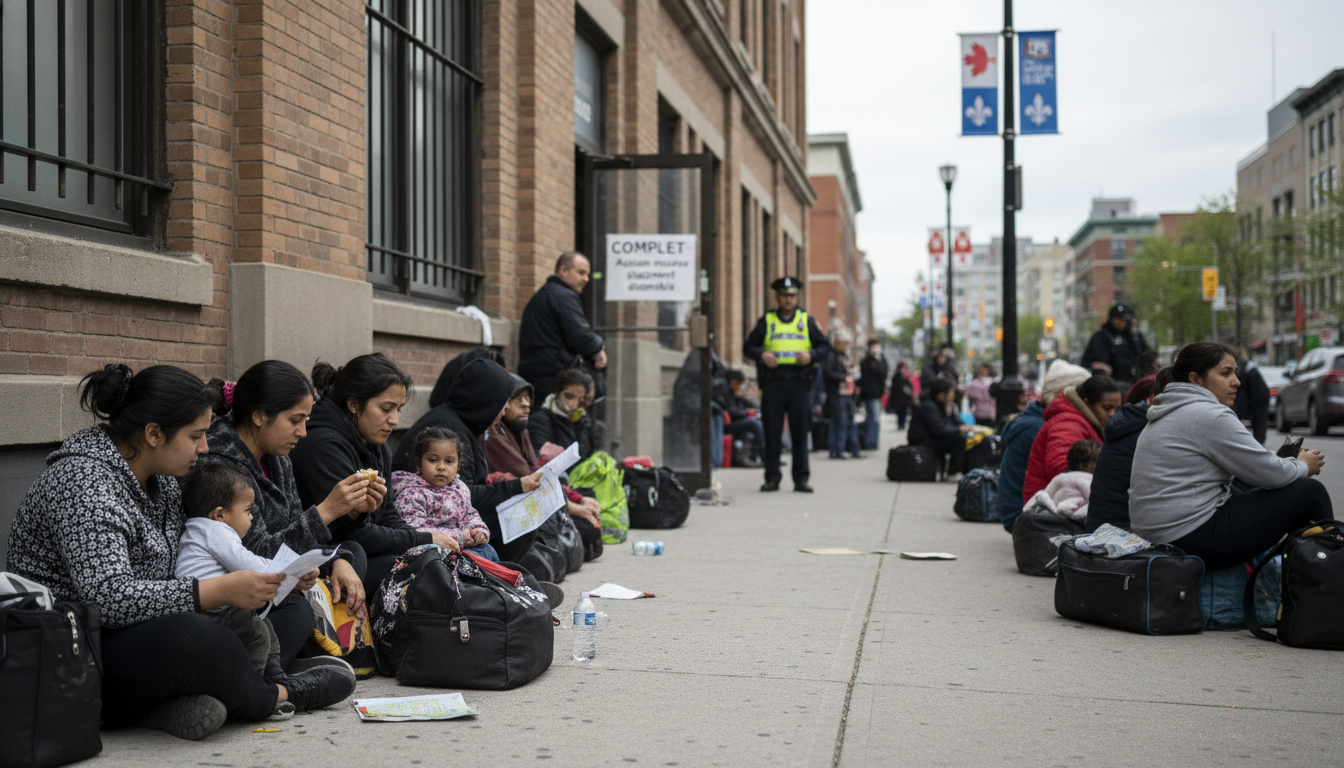
Asylum seekers in Quebec face tighter shelter rules as arrivals fall
Asylum seekers in Quebec have dropped from thousands in 2023 to a fraction today, but tightened shelter rules and cuts to supports are increasing claimant vulnerability.
Quebec is receiving far fewer asylum seekers than in 2023, but advocacy groups warn that recent policy and program changes have left many claimants more precarious. Service providers say stricter eligibility for emergency shelter, reduced financial thresholds and cuts to local supports are compounding hardships. Officials and legal advocates link the shifts to changes in the Safe Third Country framework, the closure of Roxham Road and new federal legislation.
Arrivals have fallen sharply since 2023
Monthly arrivals of asylum seekers to Quebec declined from an average of about 5,440 per month in 2023 to roughly 1,690 per month in 2026, according to Louis‑Philippe Jannard, coordinator of protection at the Table de concertation des organismes au service des personnes réfugiées et immigrantes (TCRI).
Despite the drop in new arrivals, Quebec still holds an estimated 190,000 people with outstanding asylum claims, representing about 37 percent of claimants nationwide. Service providers say the sheer backlog keeps demand on services and legal support high even as crossings fall.
Policy shifts and Roxham Road closure cited as causes
Stakeholders point to a series of federal and bilateral changes that have reshaped claimant flows. A revision to the Safe Third Country arrangements and the closure of the irregular crossing at Roxham Road are among the principal factors cited for the reduction in arrivals.
Those policy changes, combined with tightened legislative criteria at the federal level, have redirected migration patterns and reduced the number of people arriving by irregular crossings, officials and advocates say.
PRAIDA emergency shelter access tightened
Front‑line workers report that access to emergency temporary shelter under the provincial Programme régional d’accueil et d’intégration des demandeurs d’asile (PRAIDA) has become more restrictive. The program now applies a requirement that applicants must have arrived in Canada within the past 10 days to qualify for immediate shelter, a rule staff say is being enforced more rigidly than in previous years.
Service representatives say the 10‑day rule was not always applied uniformly in the past, when PRAIDA social workers exercised more discretion to admit people who otherwise needed urgent housing. Advocates contend the new interpretation leaves people who have been in the community for slightly longer periods with no safe option.
Facility capacity far exceeds current use
The CIUSSS du Centre‑Ouest‑de‑l’Île‑de‑Montréal, which manages the PRAIDA program, reported on May 28, 2026, that the shelter network was temporarily housing 154 people while its total capacity stands at 1,150. The CIUSSS attributed the low occupancy to a decrease in demand but declined interview requests, citing staffing shortages.
Local outreach organizations disagree that reduced demand explains the gap entirely, saying eligibility barriers and narrower financial criteria are preventing otherwise eligible claimants from accessing beds and supports.
Cuts to supports and staff frustration
Front‑line workers represented by the Alliance du personnel professionnel et technique de la santé et des services sociaux (APTS) say financial and in‑kind supports for asylum seekers have been reduced. Reported reductions include a lowering of the allowable savings threshold for emergency housing from $1,500 to $1,100 and fewer transit passes issued to claimants, down from 30 to 20 per month. Cuts to food assistance and targeted financial help for families with a disabled child were also reported.
Workers describe the cumulative effect as demoralizing: they face people in acute need while budget lines and program flexibility are tightened, reducing the tools available to help. Catherine Pigeon, who represents PRAIDA social workers within the APTS, said even modest savings can be quickly exhausted when people must cover rent and groceries.
Federal law C‑12 intensifies precariousness, say lawyers
Legal advocates say changes brought by federal Bill C‑12 are tightening eligibility and raising the stakes for claimants. Gabrielle Thiboutot, co‑president of the Association québécoise des avocats et avocates en droit de l’immigration, warned that stricter rules are creating a “general sense of panic” among asylum seekers and those assisting them.
Lawyers and advocates argue that as admissibility criteria narrow, claimants face greater legal uncertainty and increased vulnerability to exploitation or harm, particularly when social supports are less accessible.
Services and advocates are calling for renewed flexibility in shelter admissions, restoration of certain assistance levels and clearer coordination between federal and provincial programs. They say such steps would help ensure that reduced arrival numbers do not translate into deeper hardship for the most vulnerable claimants.
The situation presents a paradox for Quebec: fewer new arrivals on paper but deeper precarity on the ground for many who remain in the system and for those newly arrived who no longer meet tightened access rules.
