
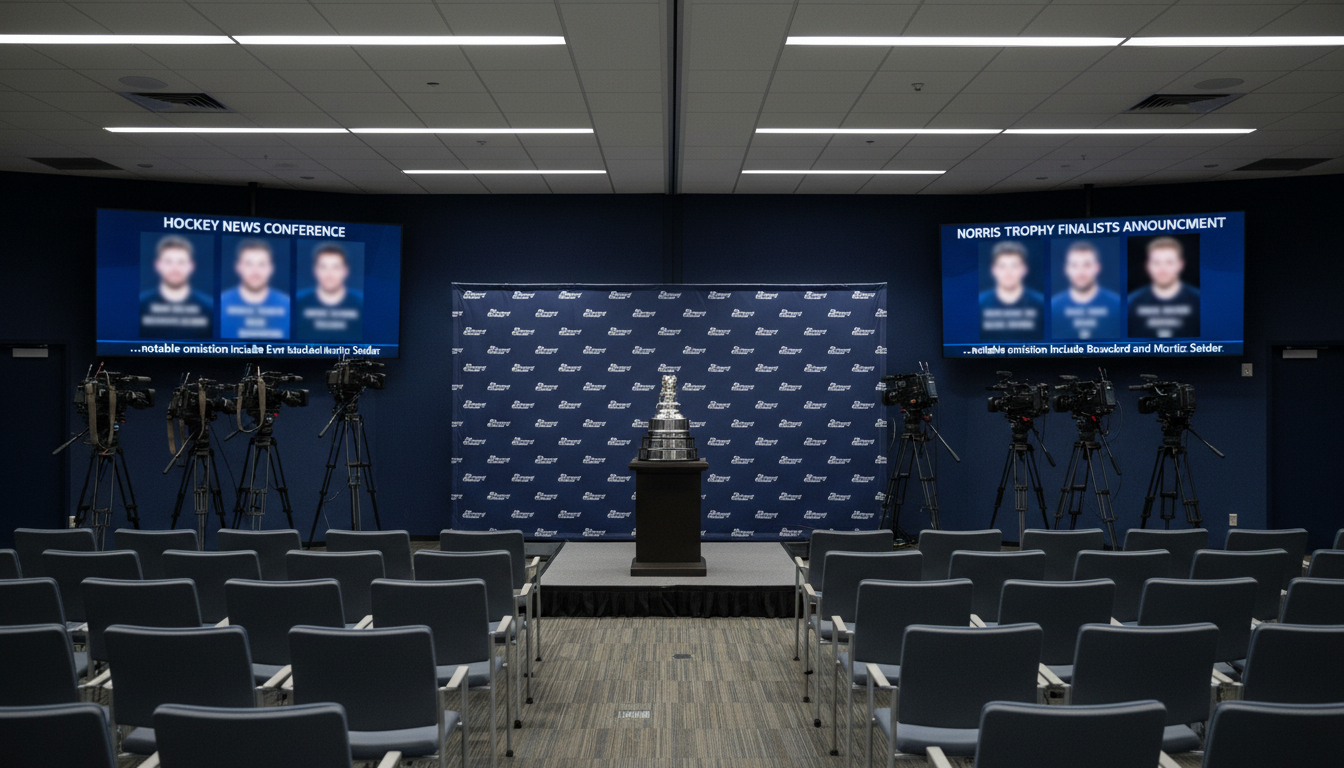
Norris Trophy finalists narrowed to Dahlin, Makar and Werenski as Bouchard and Seider are left off
Edmonton’s Evan Bouchard and Detroit’s Moritz Seider were notably absent when the NHL announced the 2026 Norris Trophy finalists, a decision that has generated debate over voting criteria and season narratives. The Professional Hockey Writers Association named Rasmus Dahlin, Cale Makar and Zach Werenski as the three finalists on May 7, 2026, leaving two high-profile defenders off the shortlist. (nhl.com)
NHL names Dahlin, Makar and Werenski as Norris finalists
Rasmus Dahlin of the Buffalo Sabres, Cale Makar of the Colorado Avalanche and Zach Werenski of the Columbus Blue Jackets make up the final trio for the James Norris Memorial Trophy. The league’s official announcement emphasized all-around ability at the position when presenting the finalists on May 7, 2026. (nhl.com)
Dahlin has been a central figure for Buffalo’s transition and earned widespread recognition for his two-way impact this season. Makar, a two-time winner, arrives at the final stage with an established reputation for offensive production and elite transition play. Werenski’s nomination reflects a late-season surge that helped Columbus climb the standings. (nhl.com)
Bouchard led NHL defensemen in scoring yet missed the shortlist
Evan Bouchard finished the regular season as the NHL’s highest-scoring defenseman, posting one of the most productive offensive campaigns by a blueliner in recent memory. That scoring output, which placed him ahead of all other defensemen in raw points, prompted immediate questions about why he was not included among the three finalists. (statmuse.com)
Supporters noted Bouchard’s minutes, power-play production and role as a primary puck-mover for the Oilers, arguing those factors traditionally weigh heavily in Norris voting. Critics countered that turnovers and defensive lapses at key moments diluted his case in the eyes of some writers, underscoring the multifaceted standard the award seeks to measure. (sportingnews.com)
Seider enjoyed a career season but was omitted
Moritz Seider delivered what many analysts described as a career year in Detroit, combining heavy minutes, strong defensive metrics and a team-leading presence from the back end. Statistical summaries show Seider compiled high totals in assists, blocks and overall defensive impact, fueling expectations he would at least appear on the finalists’ list. (en.wikipedia.org)
Despite that, Seider’s omission underscored the tension between traditional defensive value and the scoring-focused narrative that often dominates Norris conversations. Observers pointed to his consistency in shut-down minutes and penalty-kill work as examples of contributions that are harder to quantify in simple point tallies. (en.wikipedia.org)
PHWA voting patterns and award criteria shape outcomes
The Norris Trophy is voted on by members of the Professional Hockey Writers Association, and historical voting patterns show a tendency to reward high-impact, possession-driving defensemen who generate offense. That trend helps explain why offensive outputs and highlight-reel plays frequently sway final ballots, even when other candidates offer stronger traditional defensive metrics. (nhl.com)
Writers also weigh narratives — team success, media visibility and marquee moments — when filling out ballots, which can advantage candidates like Makar and Dahlin who combine elite skill with consistent national exposure. The result is a recurring debate: whether Norris voters should prioritize scoring and transitional influence or place greater emphasis on one-on-one defense and reliability. (sportsnet.ca)
Immediate reactions from teams, analysts and fans
Reaction was swift across social media and in club circles, with several writers and outlets expressing surprise at Bouchard’s absence and calling Seider’s omission a talking point in award-season analysis. Edmonton’s fanbase and some analysts highlighted Bouchard’s leading offensive numbers for defensemen as evidence he deserved at least a finalist nod. (yardbarker.com)
Detroit commentators and supporters raised similar concerns on Seider’s behalf, arguing his all-around play and minutes against top opponents should have factored more heavily into voting. Pundits on national broadcasts debated the definition of “greatest all-around ability,” pointing out that the award’s intent allows for differing interpretations from year to year. (thehockeynews.com)
Narrowed field leaves established stars favored for the trophy
With Makar, Dahlin and Werenski remaining, the Norris race centers on a mix of proven winners and rising leaders whose styles differ markedly. Makar’s prior victories and offensive dynamism make him an obvious contender, while Dahlin’s two-way influence and Werenski’s late-season performance present viable alternative narratives for voters. (nhl.com)
The finalists’ profiles mean voters will choose among elite playmakers and a defender who has shifted his club’s trajectory, rather than reward raw scoring alone. That dynamic keeps the outcome open but also reaffirms the recurring reality that Norris voting frequently balances reputation, production and perceived defensive reliability. (nhl.com)
The NHL’s award ceremony in June will decide the winner from the three finalists, and the debate over Bouchard and Seider’s exclusion is likely to continue until votes are publicly revealed. Voters and observers alike will watch whether the Professional Hockey Writers Association again privileges offensive impact or moves to elevate defenders whose contributions are less visible on the scoresheet.
