
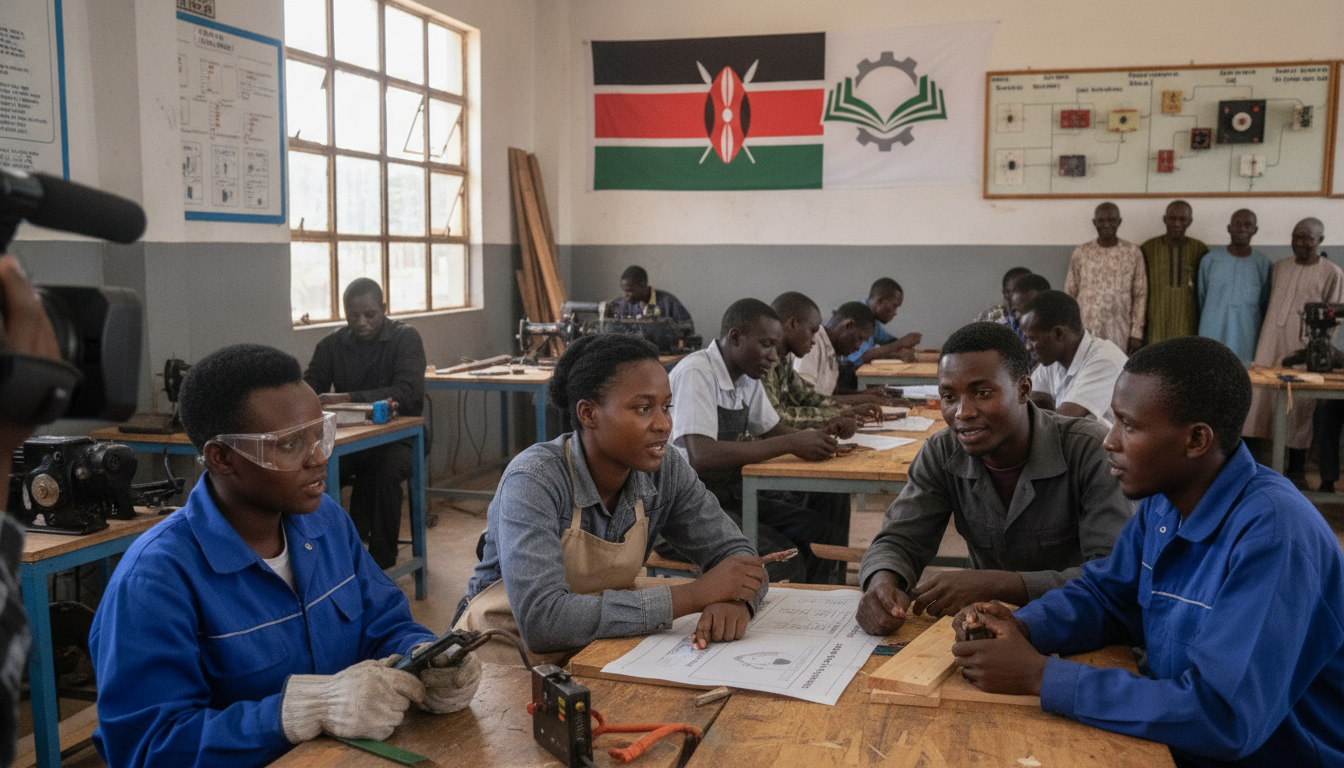
Mother-tongue instruction boosts comprehension and job prospects at Kenyan technical colleges
Mother-tongue instruction in Kenyan technical colleges helps adult learners gain skills, confidence and jobs while preserving English for wider economic opportunities.
When Lona Chepkemoi returned to formal learning at a technical college in Kericho in 2023, she found that mother-tongue instruction made complex concepts accessible again. The use of Kalenjin alongside Kiswahili and English allowed Chepkemoi and other adult learners to follow lessons they had struggled to understand in earlier, English-only classrooms. Their experience highlights a growing focus on multilingual teaching in Kenya’s vocational institutions and the broader debate over language, learning and opportunity.
Kericho students credit mother-tongue instruction for renewed access
Many adults at the Kericho technical college say instruction that includes their home language transformed their classroom experience. Students who left school early or missed national exams reported greater confidence and faster comprehension when instructors repeated key points in Kalenjin. This practical shift helped learners like Chepkemoi pursue trades such as tailoring and masonry after years away from school.
The change has immediate economic effects for learners and their families. Students who grasp skills more quickly move into paid work sooner, while those who had been excluded by language barriers now see vocational training as a realistic route to income.
Teachers adapt with multilingual lessons in technical colleges
Instructors at the college described deliberately switching between languages to ensure understanding across a linguistically diverse cohort. Where teachers did not speak every local language, they repeated lessons in Kiswahili and English or encouraged peer translation so no student was left behind. That pragmatic approach meant theory and hands-on practice meshed more effectively during trades training.
Students and instructors said the method promoted inclusion, with members from different tribes reporting they felt involved rather than sidelined. Graduates credit this multilingual instruction for both mastering technical skills and for remaining motivated to pursue further learning.
Policy framework and practical gaps in Kenyan classrooms
Kenya’s official policy supports mother-tongue instruction in the early primary years, typically to grade three, before English and Kiswahili become dominant in higher grades. In practice, implementation varies with regional language profiles, teacher training and available materials, producing inconsistent transitions for many learners. UNESCO monitoring has warned that a substantial share of learners worldwide are taught in languages they do not fully understand, a challenge mirrored in parts of Kenya’s education system.
Technical and vocational institutions face additional hurdles: they draw older students from multiple language backgrounds and must prepare trainees for workplaces where English is often the lingua franca. That creates a practical tension between using local languages to teach craft skills and ensuring learners develop English proficiency for certification and wider mobility.
Students weigh English for opportunity against comprehension needs
For many graduates, English remains essential for advancing into higher education, formal employment and international work opportunities. Several students reported practising English daily after college to prepare for future exams or jobs abroad, acknowledging its role in formal sectors. At the same time, they emphasised that initial learning in a familiar language was what enabled them to grasp technical concepts in the first place.
This trade-off shapes personal decisions: learners must balance immediate comprehension in their mother tongue with the longer-term requirement to function in English-dominated environments. Educators say a staged, multilingual strategy can bridge that gap without sacrificing either objective.
Employers and educators call for balanced language training
Leaders in technical training warn against framing the issue as an either-or choice between local languages and English. The national chairperson of a body representing technical institutions argues the solution lies in calibrated use of languages, with English introduced progressively while lower-level instruction remains accessible. Employers, meanwhile, are calling for graduates who can both perform skilled tasks and communicate effectively in formal workplaces.
Addressing the gap will require investment in teacher preparation, curriculum materials in local languages and clear pathways to build English skills alongside vocational competencies. Stakeholders say coordinated policy and funding could scale the classroom practices that have already helped learners in places such as Kericho.
The experience of adults returning to education in Kericho illustrates a simple but powerful principle: when learners understand the language of instruction, they learn faster and more confidently, and that can translate into livelihoods.
