
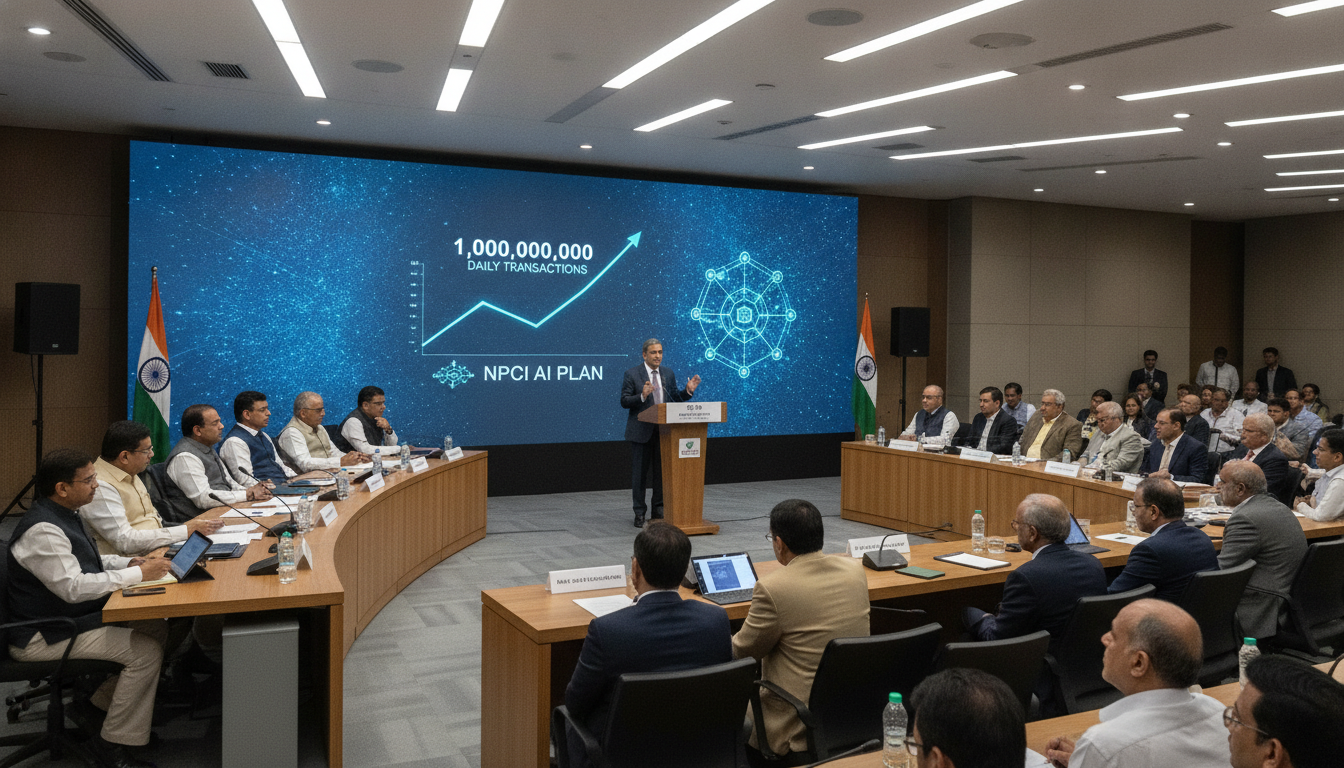
NPCI says AI will drive UPI toward 1 billion daily transactions
NPCI’s Dilip Asbe says AI will help UPI reach 1 billion daily transactions, boosting fraud detection, voice onboarding and credit for users and merchants.
UPI growth target and AI’s role
Dilip Asbe, managing director and CEO of the National Payments Corporation of India, told attendees at Mumbai Tech Week that AI will be central to driving the next phase of UPI growth. The payment system already processes more than 750 million daily transactions, and NPCI aims to push UPI beyond the billion-transactions-a-day mark. Asbe said AI will help attract new users, secure existing ones, and extend services such as credit to merchants and customers who leave digital footprints.
Asbe framed the approach as a coordinated effort involving NPCI, the Reserve Bank of India and government partners. He argued that careful deployment of AI-driven tools could expand inclusion while managing systemic risks that come with rapid scale.
Voice interfaces and multilingual onboarding
NPCI has explored voice-based features previously, including a voice assistant released in 2023, but Asbe said adoption has not yet accelerated. He emphasized that voice and multilingual solutions could simplify onboarding for users who find text-based apps challenging. For voice to scale, models must reach higher levels of accuracy in Indian languages and dialects, he said, pointing to the need for use cases that deliver clear value.
The emphasis on audio interfaces reflects a broader industry view that voice can lower friction for first-time digital-payments users, particularly in rural and underserved regions. NPCI expects incremental improvements in speech models and localized design to make voice features more viable in the coming years.
AI for fraud detection and transaction safety
A central part of NPCI’s AI strategy is reducing fraud and dismantling mule networks that facilitate illicit transfers. Asbe said machine learning systems can monitor transaction patterns, flag anomalies and help investigators trace coordinated misuse. He also stressed that governance must allow post-event reconstruction so regulators can verify whether instructions and consent were properly given to automated agents.
The push for algorithmic safeguards is intended to preserve public confidence as UPI expands into new categories such as voice-driven payments and AI-assisted financial agents. NPCI plans to combine automated detection with human review and regulatory oversight to balance speed and accuracy.
Credit distribution and merchant underwriting
Beyond fraud controls, Asbe highlighted AI’s role in widening access to credit across the UPI ecosystem. By analyzing transaction histories and digital footprints, models could supply targeted underwriting to merchants and users who lack formal credit records. NPCI envisions AI enabling microcredit and merchant financing tied to on-platform activity, which could create new revenue channels for fintechs and banks.
Asbe warned that commercial models will be important to bring new players into the market and to diversify where credit and payment services are provided. Clear rules on data use and consumer protection will be needed to ensure fair lending practices.
Homegrown language models and FIMI deployment
NPCI is exploring smaller, task-specific language models tailored to payments, rather than relying solely on large, general-purpose systems. Asbe said India’s payment ecosystem has rich datasets that could power focused models with deterministic outputs for dispute resolution and mandate cancellations. Last year NPCI launched FIMI, a payments-focused model, which it now says serves more than a million users for tasks such as cancelling mandates and resolving basic disputes.
The strategy favors localized models that can operate with transparency and fit regulatory expectations. NPCI believes such models will differentiate based on the quality and specificity of available datasets.
Concentration risks and market-share limits
Market concentration among UPI apps is a persistent concern for regulators and NPCI alike. Data indicates that two large players account for the majority of volumes, while NPCI has long advocated for healthy competition across apps. India’s regulator set a 30% cap on any single app’s market share, a rule currently slated to take effect on December 31, 2026, unless the deadline is adjusted.
Asbe noted that switching costs on UPI are low and core features are widely shared, but acquiring scale requires viable commercial models and significant investment. He suggested that if alternative apps find sustainable monetization strategies within the fintech ecosystem, market shares will naturally rebalance over time.
BHIM and sovereign alternatives
In a bid to foster competition, NPCI spun off its BHIM UPI app into a separate entity in 2024 to make it more commercially agile. BHIM’s transaction volume has climbed since the spin-off, but its overall market share remains modest at roughly 1 percent. Asbe said NPCI does not seek a specific market share for BHIM but intends for it to serve as a sovereign, secure alternative in the ecosystem.
The BHIM initiative is part of a broader effort to offer choices to users and to signal that public-sector solutions can coexist with private fintech offerings.
India’s UPI network now stands at a crossroads: sustaining rapid adoption will require both technological innovation and regulatory clarity. NPCI’s focus on pragmatic, task-specific AI tools and localized language models seeks to balance growth, inclusion and safety as the system pursues the next half-billion users and the ambition of a billion daily transactions.
