
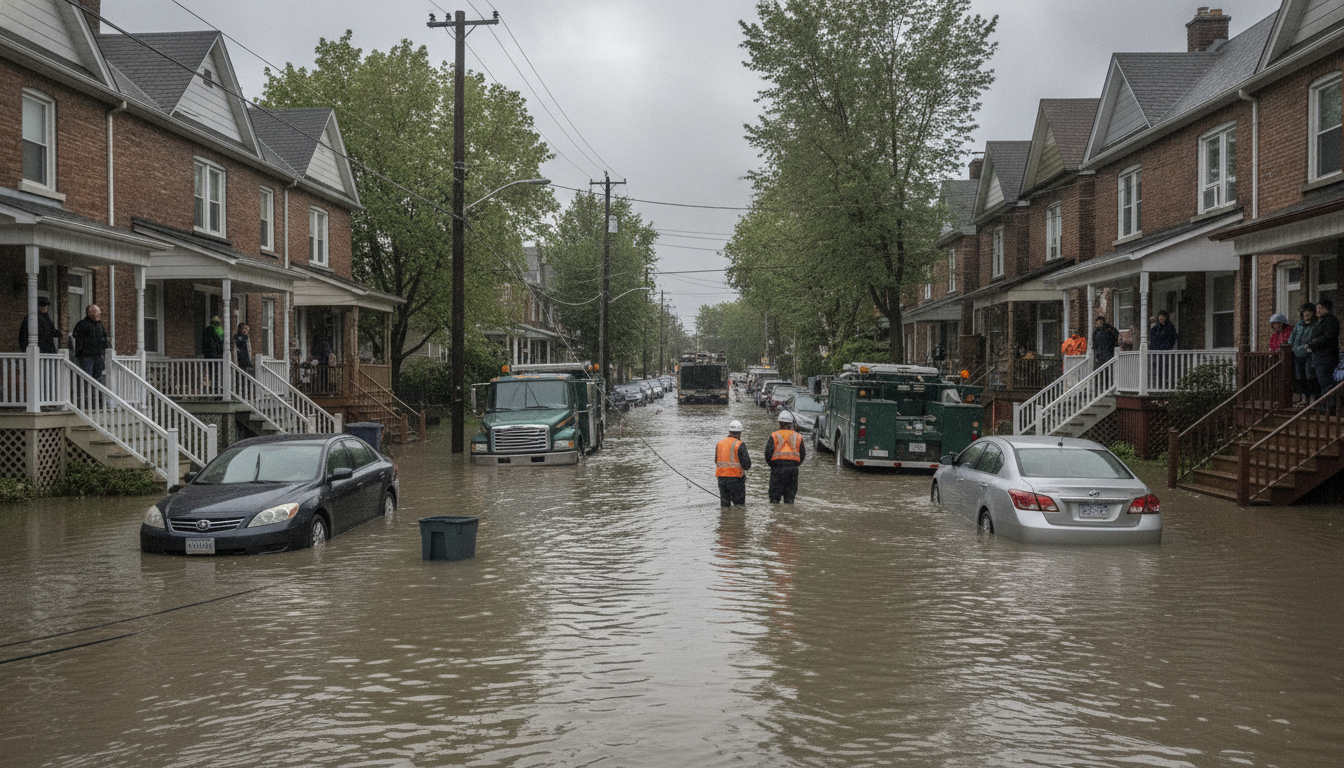
Montreal flooding: Torrential storms swamp West Island neighbourhoods, 16,500 lose power
Heavy overnight rain and flash flooding in Montreal’s West Island left streets submerged, forced evacuations and cut power to about 16,500 Hydro-Québec customers after storms on June 20–21, 2026.
West Island streets submerged
Torrential rainfall late Saturday, June 20, 2026, overwhelmed drainage systems in Dollard-des-Ormeaux and Pierrefonds‑Roxboro, leaving multiple streets impassable and neighbourhoods under water. Vehicles were stranded and water levels rose quickly enough in some areas to submerge roadways and front yards within minutes. Police blocked key arteries including boulevard Pierrefonds, rue Fredmir, avenue Anselme‑Lavigne and boulevard Jacques‑Bizard to protect drivers and allow emergency crews to operate.
Residents reported scenes of deep flooding along residential streets and local media documented water pooling at intersections and in low-lying blocks. Local emergency services received a surge of calls, prompting responders to prioritize rescues and road closures. No serious injuries were reported late Saturday, according to municipal emergency dispatchers.
Emergency response and evacuations
Montreal firefighters deployed inflatable rescue boats to evacuate motorists and residents trapped by rapidly rising waters, using marine‑capable equipment to reach cars and doorways. The Service de sécurité incendie de Montréal (SIM) coordinated with Montreal police to assist people in vehicles and to check homes at risk of flooding. By late evening more than 600 calls to 911 from the West Island area stretched resources as crews worked through multiple incidents.
Police and firefighters worked block by block to ensure residents were moved to safety and to prevent further entrapments on flooded roads. Evacuations focused on the most vulnerable locations where water rose above vehicle thresholds and where basement flooding posed immediate risk. Officials urged people to stay away from affected streets and to follow directions from emergency personnel.
Power outages and airport impacts
Shortly after 2 a.m. on Sunday, June 21, Hydro‑Québec reported roughly 16,500 customers without electricity in the Montreal area, primarily across the West Island. Some outages were ordered proactively at the request of emergency services to reduce electrical hazards in flooded neighbourhoods. Hydro‑Québec crews remained on alert to isolate hazards and restore service as conditions permitted.
The storm also disrupted operations at Montréal‑Trudeau International Airport, where numerous departures were delayed due to weather and its effects on ground handling. Airport authorities advised travellers with scheduled flights to check the status of their departures before travelling to the terminal, citing ongoing delays and safety precautions.
Environment Canada issues thunderstorm watches
Environment Canada issued thunderstorm watches for much of southern Quebec late Saturday, including Montreal, the Laurentides, Montérégie, Outaouais and Estrie, warning that conditions remained favorable for repeated heavy showers and thunderstorms through Sunday morning. The agency highlighted the risk of localized flooding where soil was already saturated, and advised motorists not to attempt driving on flooded roads.
Meteorologists warned that multiple rounds of rain and embedded thunderstorms could produce intense downpours in short periods, increasing the likelihood of swift water flows into streets and basements. Residents were urged to stay informed through official updates and to avoid unnecessary travel while the watches remained in effect.
South Shore communities declare emergency and close roads
Flooding was not limited to the island; several South Shore municipalities also reported significant impacts, with road closures and infrastructure damage. Saint‑Édouard announced the closure of chemin Saint‑Édouard after finding “significant damage” to the roadway and infrastructure, and said inspections would follow once water levels returned to normal. Municipal crews prepared to assess repairs and clean up affected corridors.
The City of Saint‑Constant declared a municipal state of emergency and closed five roads, including chemin Saint‑François‑Xavier, to protect public safety and to manage the response. Officials there asked residents to reduce water use where possible to limit the risk of basement backups and sanitary system overflows while crews worked to stabilize the situation.
Government coordination and public guidance
Quebec’s Minister of Public Security, Ian Lafrenière, said provincial authorities were closely monitoring the floods and maintaining direct contact with affected municipalities to coordinate support. Provincial teams stood ready to assist local emergency services with resources as needed, the minister wrote on social media early Sunday. Municipal emergency management offices activated response plans and liaised with provincial partners to prioritize the most urgent needs.
Local officials reminded residents to avoid driving over standing water, to move vehicles off low‑lying streets where possible, and to report outages and emergencies through official channels. Property owners were cautioned about electrical hazards in flooded homes and instructed to wait for confirmation from utility crews before re‑entering or using electrical systems.
Communities began damage assessments Sunday as crews worked to clear debris, reopen critical routes and restore essential services across the region. The full extent of infrastructure and property damage will become clearer as floodwaters recede and municipal teams complete inspections and repairs.
