
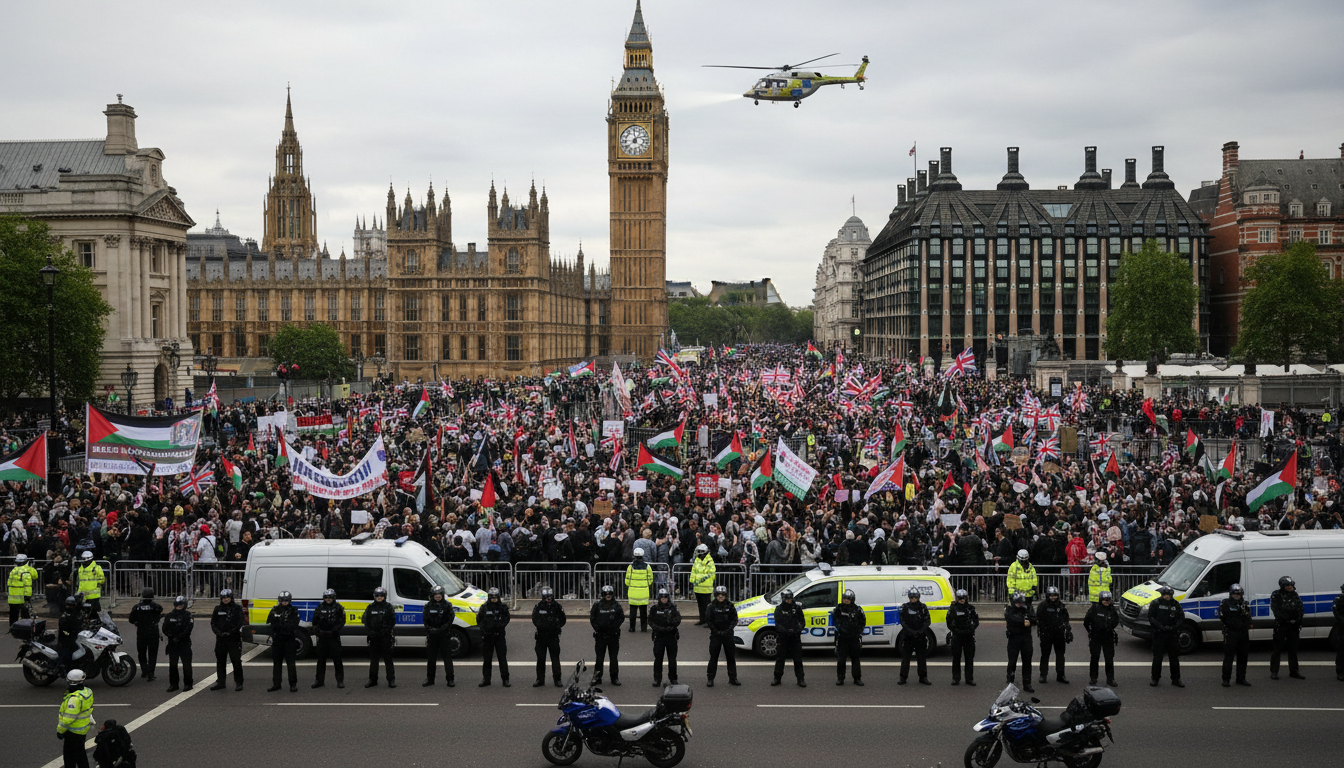
London protests draw tens of thousands as police mount 4,000-officer security operation
Thousands joined London protests: a pro‑Palestine Nakba march and Tommy Robinson’s far‑right Unite the Kingdom rally on May 16 amid a 4,000‑officer security operation.
Tens of thousands of people marched through central London on May 16, 2026, in two separate London protests — a pro‑Palestine march linked to Nakba Day commemorations and a far‑right "Unite the Kingdom" rally led by Tommy Robinson. The Metropolitan Police described the response as its largest public order operation in years, deploying thousands of officers and specialist resources to keep rival groups apart. Authorities said the operation was designed to prevent disorder and protect the public amid heightened tensions.
Mass police operation in London
The Metropolitan Police mobilised roughly 4,000 officers for the day, including reinforcements brought in from outside the capital, and said the operation would be the most assertive use of its powers in years. Armoured vehicles, police horses, dogs, drones and helicopters were stationed across march routes and staging areas to monitor crowds and respond quickly to incidents.
Officials estimated the policing bill at about £4.5 million for the day, reflecting the scale of the deployment and specialist assets. Police spokespeople warned of a zero‑tolerance approach to offences and said plans had been drawn up to separate rival groups to reduce the risk of clashes.
Two rival marches and turnout estimates
Authorities expected a combined turnout of at least 80,000 people, forecasting about 50,000 at the far‑right "Unite the Kingdom" rally and roughly 30,000 at the pro‑Palestine demonstration. The pro‑Palestine march was organised in part by Stand Up to Racism and combined an antifascism element with Nakba Day commemorations.
Tommy Robinson, whose legal name is Stephen Yaxley‑Lennon, was the principal organiser of the far‑right rally. Robinson drew a much larger crowd last September, when organisers said about 110,000 people attended a central London event that later produced clashes with police and injuries to officers. Online platforms and political figures have played visible roles in past gatherings, adding to concerns about scale and coordination.
Conditions, arrests and legal scrutiny
Metropolitan Police reported 11 arrests shortly after the marches began, with charges covering a range of alleged offences. Police had imposed a series of conditions on both rallies — including set routes and timings — intended to keep rival participants apart and reduce opportunities for disorder.
Prosecutors were instructed to assess whether particular placards, chants or speeches could amount to criminal offences or incitement, a step the Crown Prosecution Service framed as a protection rather than a restriction on expression. Stephen Parkinson, director at the CPS, said the guidance was aimed at preventing hate crime and protecting the public, particularly during a period of heightened tensions.
Organisers held legally responsible and new policing tools
For the first time, the police said organisers could be held legally responsible for ensuring invited speakers did not contravene hate speech laws, effectively making event hosts accountable for the conduct of their platforms. The move drew attention from civil liberties groups and legal experts, who noted it marked a shift in how public order responsibility is assigned.
The Met also confirmed it used live facial recognition technology during the protests, describing the tool as part of its toolkit to identify individuals wanted for arrest or subject to restrictions. The decision to deploy facial recognition for the event was among the more controversial aspects of the day’s policing strategy and is likely to prompt further scrutiny and legal challenge.
Government bans and political response
The UK government moved to bar a number of foreign nationals from entering Britain to attend the far‑right rally, citing concerns about public order. Right‑wing figures reported as blocked included Polish politician Dominik Tarczynski, Belgian politician Filip Dewinter, Colombian‑American commentator Valentina Gomez and Dutch activist Eva Vlaardingerbroek among a total of 11 names the government said it had prevented from travelling.
Prime Minister Keir Starmer warned ahead of the protests that anyone who sought to "wreak havoc" or intimidate people on the streets would face the full force of the law. Starmer, under internal pressure in the wake of recent local election gains by Reform UK, accused organisers of peddling hatred and division while urging police and prosecutors to act decisively.
The government’s travel bans and policing changes reflect an effort to curb the internationalisation of far‑right networks and to deter the importation of extremist figures who might inflame tensions on UK soil.
Police and community leaders said they would continue to monitor the situation throughout the day and into the evening, with officers prepared to make further arrests if laws were broken.
The events in London on May 16 underscored the challenges facing authorities in policing large, ideologically opposed assemblies that can attract both domestic and international participants, and highlighted an intensifying balance between protecting public safety and safeguarding lawful protest.
