
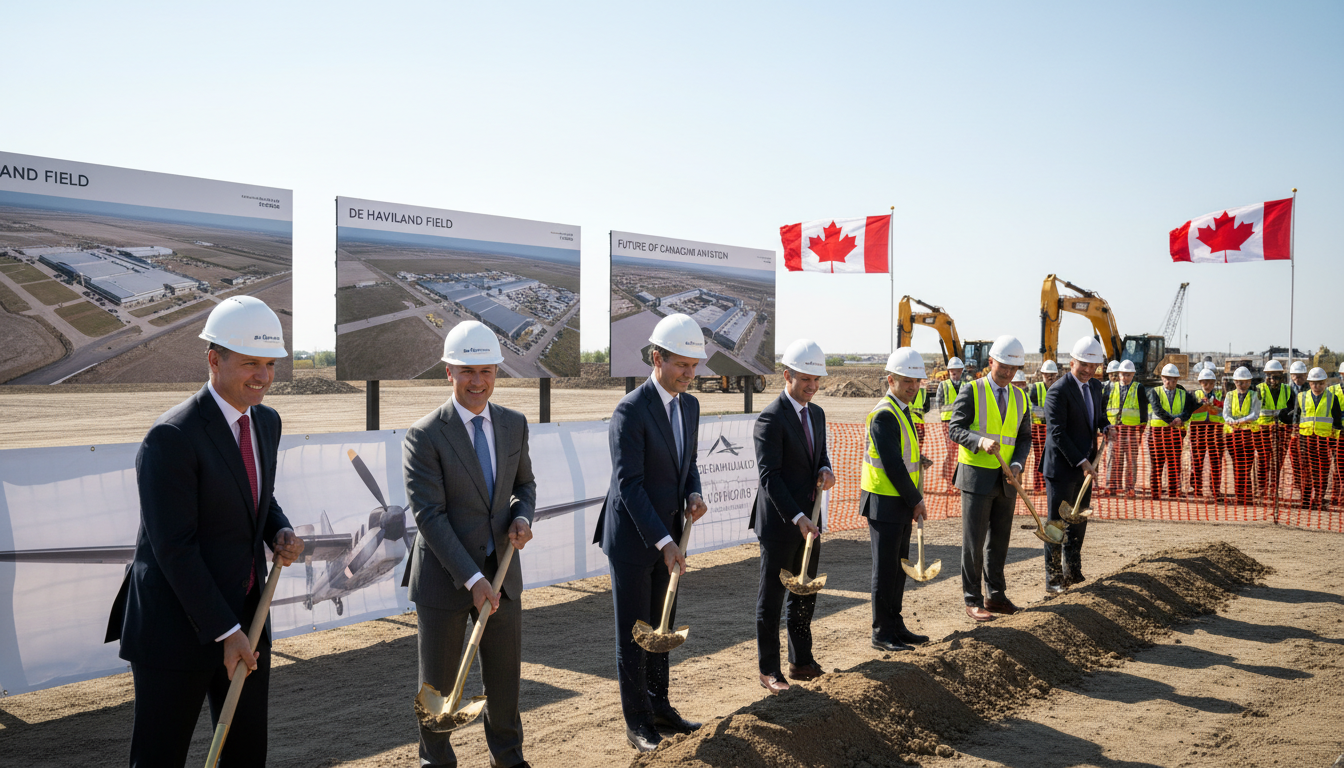
De Havilland Canada groundbreaking hailed as key step in rebuilding national aircraft manufacturing
De Havilland Canada groundbreaking at a new manufacturing site was framed by company leaders as a pivotal moment in rebuilding the nation’s aviation industry, with promises of significant economic investment and job creation.
Brydson frames project as rebuilding Canada’s aviation industry
At a ceremonial groundbreaking, Brydson told a crowd of De Havilland employees that the project represents a concrete effort to “rebuild Canada’s aviation industry.”
He said the initiative answers the prime minister’s call to “build Canada better,” adding that the company’s work will bring new manufacturing capacity to the country.
Brydson emphasized the workforce’s role, saying employees are “an important part of rebuilding the Canadian economy,” and framed the work as national renewal rather than a narrow corporate expansion.
Company highlights scale of promised investment
During the ceremony Brydson said the project will inject “literally billions of dollars into the Canadian economy,” a figure he presented as evidence of long-term commitment.
The executive described the funding as both direct investment in facilities and broader spending spread across suppliers, service providers and regional communities.
De Havilland’s remark positions the investment as a catalyst intended to revive domestic manufacturing capacity and strengthen the aviation supply chain across multiple provinces.
Workforce expansion and skills development central to pitch
Company leaders addressed employees directly, stressing that new hiring and training will be central to the project’s success.
Brydson framed current staff as the foundation for future growth and said expanded operations will create opportunities for technicians, engineers and production workers.
The statement underscored a pledge to scale the workforce while developing the skills needed for advanced aircraft manufacturing and maintenance.
Alignment with federal priorities underscored at the event
Brydson explicitly linked the De Havilland project to the federal call to “build Canada better,” presenting the company’s plans as aligned with national industrial policy.
He made clear the comment was not intended as a political message, but rather as confirmation that the company and government share objectives around revitalizing manufacturing.
That positioning signals De Havilland’s intent to work in concert with public policy aims and to attract support that facilitates domestic production and supply-chain resilience.
Local and regional economic ripple effects anticipated
Company statements at the groundbreaking emphasized that investment will be distributed beyond the immediate project site into suppliers, contractors and local service businesses.
Brydson’s remarks suggested a broad regional uplift, with new contracts for parts manufacturers, logistics firms and other service providers in adjacent communities.
Observers say such ripple effects are typical of large-scale manufacturing projects and can bolster employment and tax revenues in affected areas.
Industry experts point to supply-chain and export implications
Analysts note that expanding domestic aircraft manufacturing capacity could reduce reliance on foreign suppliers and strengthen Canada’s position in global aerospace markets.
A more robust local supply chain may also help producers respond to demand fluctuations and support export-oriented growth for Canadian-made aircraft and components.
How De Havilland’s plans will interact with existing domestic suppliers and international customers will be watched closely by industry stakeholders.
Final steps now focus on translating promises into construction, hiring and production timelines, with company leaders tasked with delivering the investments and workforce commitments announced at the groundbreaking.
Those outcomes will determine whether the De Havilland Canada groundbreaking becomes a turning point for the country’s aviation sector or another high-profile pledge that requires additional follow-through to meet expectations.
