
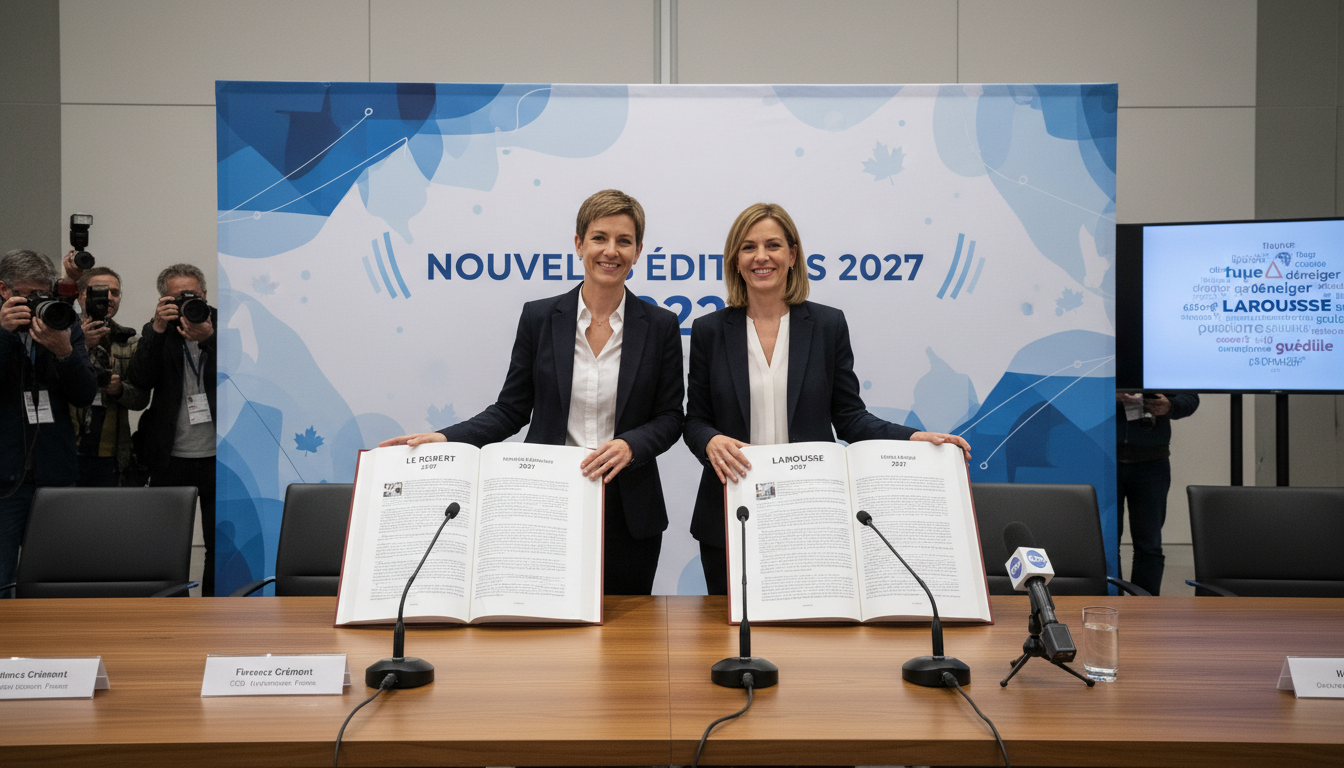
Le Robert and Larousse 2027 editions add Quebec names, AI terms and everyday vocabulary
French dictionaries Le Robert and Larousse release their 2027 editions with new entries reflecting Quebec culture, technology and AI terminology.
France’s two most widely used French-language dictionaries have unveiled their 2027 volumes, and the revisions include a mix of proper names, regional expressions and technology-driven vocabulary. The Le Robert and Larousse 2027 updates recognise several Quebec personalities and everyday terms, while also adding entries that mark the growing influence of artificial intelligence on language. Publishers say the additions document contemporary usage and cultural shifts across the francophone world.
Quebec personalities entered in Le Robert 2027
Le Robert’s 2027 edition incorporates several figures connected to Quebec’s cultural and historical life. The comic-book author Michel Rabagliati and the playwright and director Wajdi Mouawad are listed alongside Jeanne Mance, the 17th-century nurse and cofounder of Montreal, reflecting both contemporary and historical presences.
The dictionary also includes names tied to notable events and public memory, such as Gisèle Pelicot, named in the context of the Mazan rape case, and the papal figure Léon XIV. The inclusion of these proper names signals Le Robert’s intention to broaden its coverage of francophone individuals who shape public discourse.
New vocabulary in Le Robert highlights social and domestic trends
Le Robert’s additions extend well beyond proper names, registering terms born of internet culture, social movements and changing household habits. Entries such as découvrabilité and instavidéaste reflect online practices and content discovery, while incel is defined as the subculture of men who describe themselves as involuntarily celibate.
At the domestic level, the “friteuse à air chaud,” commonly called an airfryer, was added as the appliance becomes standard in many kitchens. The dictionary also recognises regional forms like faque (also written fak), a colloquial Quebec expression, and defines tintamarre as the festive Acadian procession marked by noisy celebration.
Le Robert launches Dis‑moi Robert, an AI language assistant
To mark its 60th anniversary, the Le Robert group introduced Dis‑moi Robert, an AI-powered conversational agent designed to answer questions about French usage. The publisher says the assistant draws exclusively from Le Robert’s own databanks, including Dico en ligne Le Robert, and provides sourced, transparent responses.
Charles Bimbenet, director of Le Robert, is quoted by the publisher as stressing the tool’s constraints and neutrality, noting it will indicate when it cannot answer a query. The launch reflects a broader trend in lexicography toward digital assistance while attempting to preserve editorial control over authoritative linguistic content.
Larousse 2027 adds ‘prompter’ and terms for self‑assertion
The Petit Larousse 2027 also expands its lexicon, introducing words that capture evolving social dynamics and technological practices. Among the new entries are assertivité, referring to the ability to assert oneself respectfully, and prompter, which denotes the act of sending a prompt to a generative AI system to obtain a targeted response.
Bernard Cerquiglini, scientific advisor to the Petit Larousse, said each dictionary entry is “a sign of the times,” and the 2027 millésime contains terms that reflect inclusion, contemporary maladies and a widening cultural outlook. Larousse’s additions underline how lexicographers are documenting both interpersonal behaviours and the technical vocabulary emerging around AI.
Dictionaries reflect francophone diversity and culinary culture
Publishers note that many of the new entries underscore an openness to francophone diversity and the cross-pollination of culinary and cultural terms. From regionalisms like tintamarre and faque to household vocabulary such as airfryer, the updates chart how local practices and global trends reshape everyday language.
Both Le Robert and Larousse emphasise editorial criteria based on documented usage and frequency, signalling that words are selected when they have demonstrable presence in spoken or written French. The 2027 editions therefore serve not only as repositories of definition but as contemporary snapshots of how francophone societies communicate.
The parallel additions also demonstrate converging priorities: recognition of regional identities, attention to digital-era practices and responsiveness to the linguistic impact of artificial intelligence. By formally recording these terms, the dictionaries lend legitimacy to expressions and concepts that users have already put into circulation.
The appearance of Quebec names and expressions in these major French dictionaries is likely to be welcomed by Canadian francophones as affirmation of their cultural contribution to the francophone world. At the same time, the formal inclusion of AI-related vocabulary and services such as Dis‑moi Robert highlights how quickly language must adapt to technological change.
