
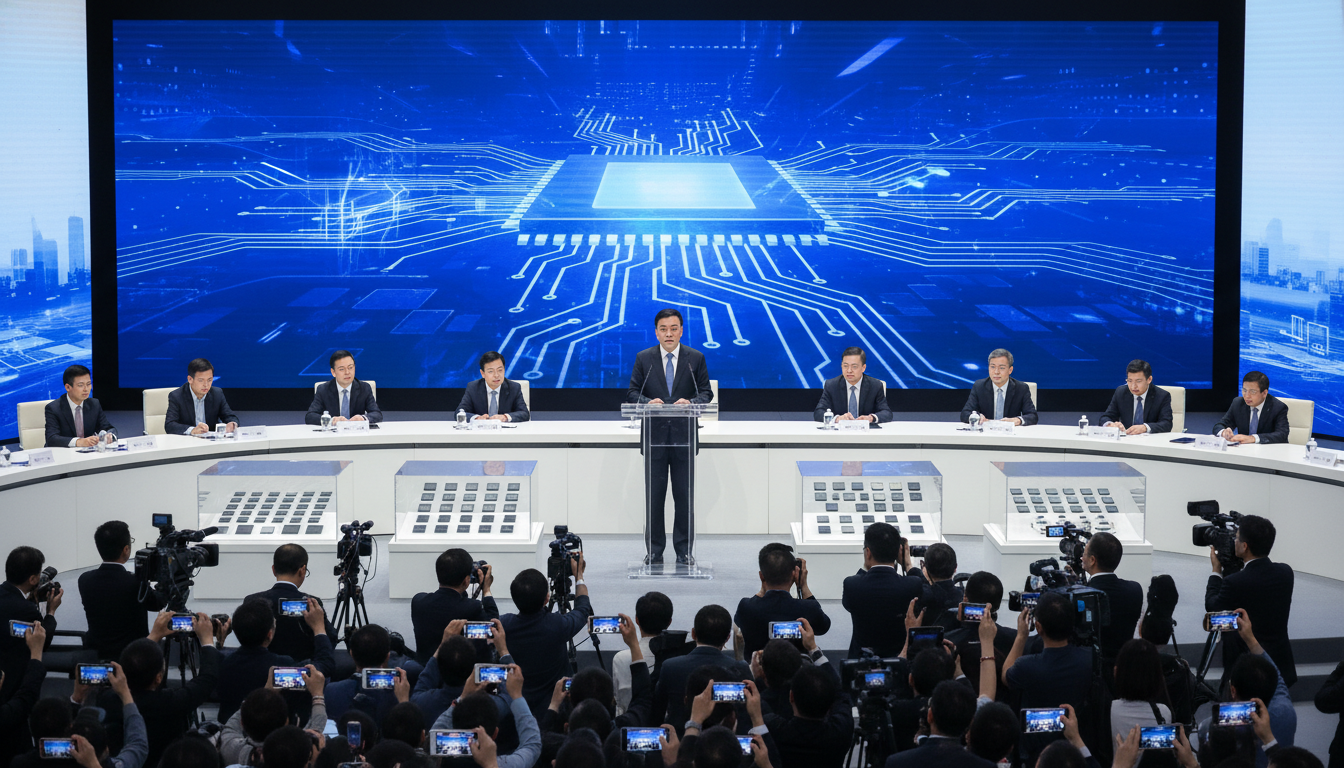
Huawei 1.4-nanometer chip push: company says it designed 381 chips for smartphones and AI
Huawei says it designed 381 chips in six years while pursuing a 1.4-nanometer chip process expected to mark global leadership in chipmaking by decade’s end.
Huawei announced it has designed 381 chips over the past six years as it advances toward a 1.4-nanometer chip process, positioning the technology for smartphones and artificial intelligence applications. The company highlighted its internal design output but has not published independent performance benchmarks for those chips. Industry observers say a 1.4-nanometer process would represent the cutting edge of chip fabrication if it reaches volume production by the end of the decade. The announcement underscores Huawei’s continued focus on vertical integration for mobile and AI hardware despite limited external verification.
Huawei reports 381 in-house chip designs over six years
Huawei said the 381 chip designs were developed under its in-house program and have moved into series production, according to the company’s statement. The portfolio, the company added, spans components intended for smartphones and AI workloads. Huawei framed the disclosure as evidence of sustained engineering investment and a broadening of its semiconductor capabilities. The figure was presented without accompanying third-party performance or comparative metrics.
Company has not released independent performance benchmarks
Independent performance data for the claimed chips were not provided by Huawei, a gap noted by analysts and industry watchers. Without standardized benchmarks or third-party validation, it is difficult to assess how those chips compare with contemporary industry leaders on measures such as power efficiency, throughput, and AI inference performance. Huawei’s disclosure, therefore, serves more as a progress report than a proof point for competitive parity. Market participants said independent testing will be necessary to evaluate real-world impact.
1.4-nanometer process seen as next global peak
The company tied its design program to a longer-term push toward a 1.4-nanometer chip process, which industry forecasts have identified as a potential global leading node by the end of the decade. A 1.4-nanometer process node would represent an incremental advance in transistor density and power-performance scaling compared with current mainstream nodes. If realized at scale, the process could enable denser integration for mobile SoCs and AI accelerators, improving energy efficiency and performance per watt. Observers caution, however, that node names alone do not guarantee superiority — manufacturing yield, packaging, and system-level design remain crucial.
Potential impact on smartphones and AI deployments
Huawei emphasized that the chips are intended for consumer smartphones and AI services, areas where efficiency and integration can drive product differentiation. For smartphones, more advanced process technologies can allow longer battery life, smaller form factors, or greater on-device AI capability. In AI deployments, denser process nodes can increase model throughput and lower inference latency for edge devices. Industry analysts believe widespread adoption would require both proven chip performance and reliable supply chains.
Industry hurdles and manufacturing realities
Reaching a 1.4-nanometer production target will demand substantial investments in fabrication equipment, materials, and process development, experts say. Advanced nodes typically require highly specialized lithography, packaging solutions, and close collaboration between design teams and foundries. Yield improvements and cost reductions are frequently iterative and can take years of ramp-up before volume economics are achieved. Observers also note that ecosystem partners — from EDA tool providers to OS and hardware integrators — play a key role in turning a process node into commercial advantage.
Huawei’s disclosure that it has designed hundreds of chips is a notable data point in the company’s long-term semiconductor strategy, but it leaves several questions unanswered. Independent performance verification, details about production partners, and timelines for 1.4-nanometer commercialization were not supplied in the announcement. Industry attention will likely shift to third-party benchmarks and concrete manufacturing milestones to determine whether Huawei’s claimed progress translates into competitive products.
