
Mayor Farkas Proposes Pausing Green Line Downtown Alignment to Push LRT Further South
Calgary Mayor Jeromy Farkas says the city could pause the Green Line downtown alignment and extend the LRT farther south first while officials resolve a contentious downtown routing and consider an elevated option.
Mayor Proposes Delaying Downtown Segment
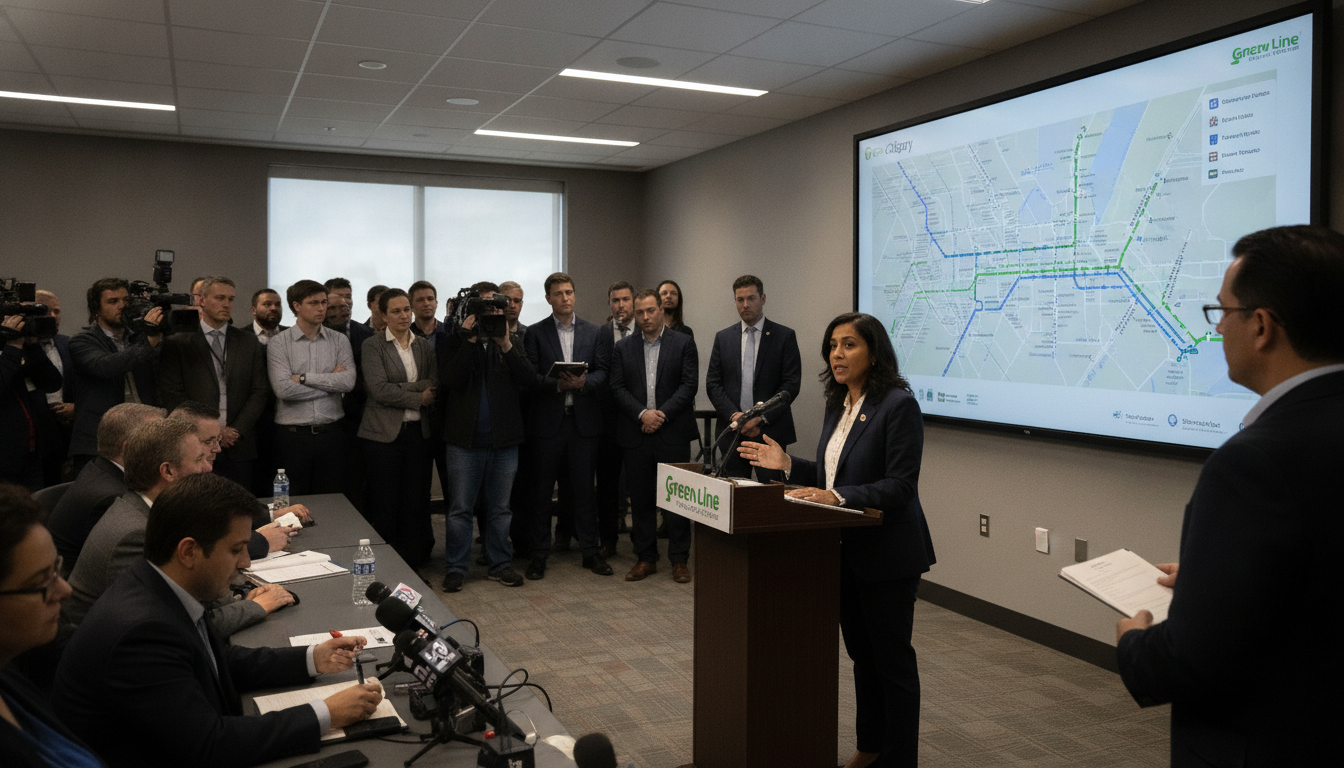
Mayor Jeromy Farkas told reporters this week he is considering temporarily stopping the Green Line short of Calgary’s central core and allocating savings to extend the route into suburban areas first.
He framed the proposal as a way to buy time to resolve disputes over how the line should traverse the downtown while keeping overall momentum on construction.
Farkas specifically suggested parking some of the most contentious downtown sections and using cost savings to push the LRT further south, a move he said would also provide breathing room to study alternatives.
The mayor said buses could serve as an interim connector between the Green Line’s southern terminus and the city’s central transit spine, allowing riders to transfer to existing rapid bus routes.
Farkas tied the idea to ongoing discussions with other levels of government, noting the potential for a federal partnership on a future downtown tunnel if costs and alignment questions can be settled.
He stressed the approach would not halt the project overall, but would sequence work differently to reduce immediate conflict and keep construction moving in other areas.
Province Conditions Funding on Elevated Alignment Above 10 Avenue S
Alberta has signalled its contribution to the Green Line is contingent on a provincial preference for an elevated alignment through parts of downtown, officials confirmed this week.
The provincial proposal would run track above 10 Avenue S in the Beltline, then cross north over the CPKC rail corridor to 2 Street S.W., terminating above 7 Avenue S.W. in the central core.
The province has tied a roughly $1.5 billion commitment to that elevated concept, positioning it as a non-negotiable condition for maintaining its share of the $6.2 billion project budget.
Alberta Transportation Minister Devin Dreeshen said the government remains open to refinements to the downtown route, but reiterated that a tunnel under downtown is not under consideration as part of the province’s offer.
A downtown tunnel had previously been studied and funded in part, but the province removed support when the southern reach of the initial stage was shortened amid rising costs.
The provincial stance has sharpened the debate at City Hall, with councillors and stakeholders weighing the trade-off between visual and community impacts from an elevated guideway and the cost and complexity of underground options.
Council to Debate Alternate Routing Through Core
City councillors will formally debate whether to explore alternate alignments through the downtown after a committee voted to endorse investigating other routes.
The council discussion follows sustained complaints from downtown businesses and residents concerned about disruption, sightlines, and long-term impacts of an elevated or at-grade alignment.
Councillors said they need time to examine more routing options and weigh the technical, financial and neighbourhood effects before committing to a precise downtown solution.
Some members of council argue the alignment has already been exhaustively studied and that changing course now risks undermining project timelines and northern expansions.
Ward 3 Councillor Andrew Yule told reporters residents in the north-central part of the city feel stalled, warning that shifting focus back to downtown deliberations could delay promises to communities awaiting future Green Line phases.
Council faces a difficult choice: proceed with the province’s preferred elevated route, pursue a tunnel that would likely require new funding partners, or accept an interim arrangement that delays a permanent downtown train connection.
Transit Experts Say Options Are Narrow
Consultants involved in Green Line planning have repeatedly said the range of viable downtown options is limited by technical and geometric constraints.
Leading Mobility principal David Cooper noted an at-grade alignment through downtown is largely infeasible because train lengths and block patterns do not accommodate surface operation without major impacts.
Cooper added that with the province excluding a tunnel, the city’s practical choices narrow to elevated structures or creative interim measures such as bus connections between rail segments.
He also highlighted that the southern extension to areas like Seton is physically feasible due to a protected right-of-way, making the mayor’s suggestion to push south operationally possible.
Experts caution, however, that any change in sequencing or downtown design must consider future capacity, rider convenience and the ability to integrate with other transit services like the MAX Green bus line.
The technical work completed to date — including detailed studies and alignment options — will still be a major input into whatever path councillors choose next.
Financial Stakes and Prior Studies
City officials told councillors this week that about $244 million has already been spent on studying and preparing for a downtown tunnel, a figure that underscores how far planning for an underground option had progressed.
The Green Line program overall carries a price tag estimated at $6.2 billion for the full build-out, with multiple funding partners and phased construction intended to spread costs and risks.
Alberta’s conditional $1.5 billion contribution reflects both the province’s interest in a solution and its appetite for a particular engineering outcome, which complicates municipal decision-making.
A decision to pause or reconfigure the downtown segment would require reassessing budgets, procurement timelines and agreements with contractors and senior governments.
City staff have signalled that phasing the project so that construction continues on the southeast leg — currently under way with a terminus planned in Shepard — would keep significant work moving even if downtown plans are deferred.
Any reallocation of capital to push the line further south would need detailed cost comparisons to ensure the city is not simply shifting costs or reducing system functionality in the long term.
Community Concerns and Interim Transit Measures
Downtown businesses and residents have raised persistent concerns about the visual impact of elevated structures, potential loss of street-level vitality, and prolonged construction disruptions.
Those voices have been influential in prompting councillors to ask for further analysis and public engagement before locking in a downtown solution that could shape the core for decades.
Farkas suggested that, if the train stops short of the central core temporarily, shuttle buses could bridge the gap between the Event Centre Station and the MAX Green bus spine on Centre Street.
That interim approach would require careful scheduling and fare integration to limit inconvenience for passengers transferring between modes, planners said.
City transportation officials say any bus bridging strategy would need to be resilient to demand spikes and coordinated with existing route planning to preserve transit advantages for riders.
Stakeholders urged the city to map out clear transition plans so that a future tunnel or permanent downtown rail connection could be constructed without forcing repeated, disruptive changes to the network.
Potential Impact on Northern Extensions and Long-Term Network
Some councillors warned that renewed debate over downtown routing could have downstream effects on proposed northern extensions and on communities that have been promised future service.
Residents in north-central Calgary, represented by Councillor Yule, described being in a “purgatory of transit” as they await clarity on when the Green Line will reach their neighbourhoods.
Officials caution that changing downtown plans could ripple through project sequencing, procurement windows and contractor commitments tied to later phases.
Proponents of maintaining the current alignment argue that sticking to the studied route minimizes risk and preserves the ability to extend the system into new areas without delay.
Opponents contend that a poorly executed downtown crossing could reduce long-term ridership and undermine the system’s utility for central-area users and businesses.
The council must weigh short-term political and community concerns against the systemwide benefits of a consistent, well-integrated LRT spine across Calgary.
Next Steps and Timelines for Decision-Making
Council is expected to debate the motion to explore alternative downtown routes in the coming weeks, with staff directed to prepare technical assessments and engagement plans.
Any move to pause freight-later segments or shift capital southward would require formal amendments to project delivery schedules and joint funding agreements.
City planners will continue consultations with the province, stakeholders and transit experts to evaluate the feasibility, cost implications and service impacts of each pathway.
Officials have emphasized that construction on the southeast portion of the Green Line continues, with work already underway and the current plan to build the terminus at Shepard progressing.
If council opts to defer the downtown segment, staff will be asked to model interim service options and to identify how future integration with a tunnel or permanent downtown alignment could be achieved.
The decision process will likely involve public hearings, engineering reviews, budget analyses and negotiations with Alberta and potential federal partners before a final route is confirmed.
Calgary faces a consequential choice that will define the Green Line’s role in the city for generations, balancing immediate progress against the need for a downtown solution acceptable to residents, businesses and senior governments.
