
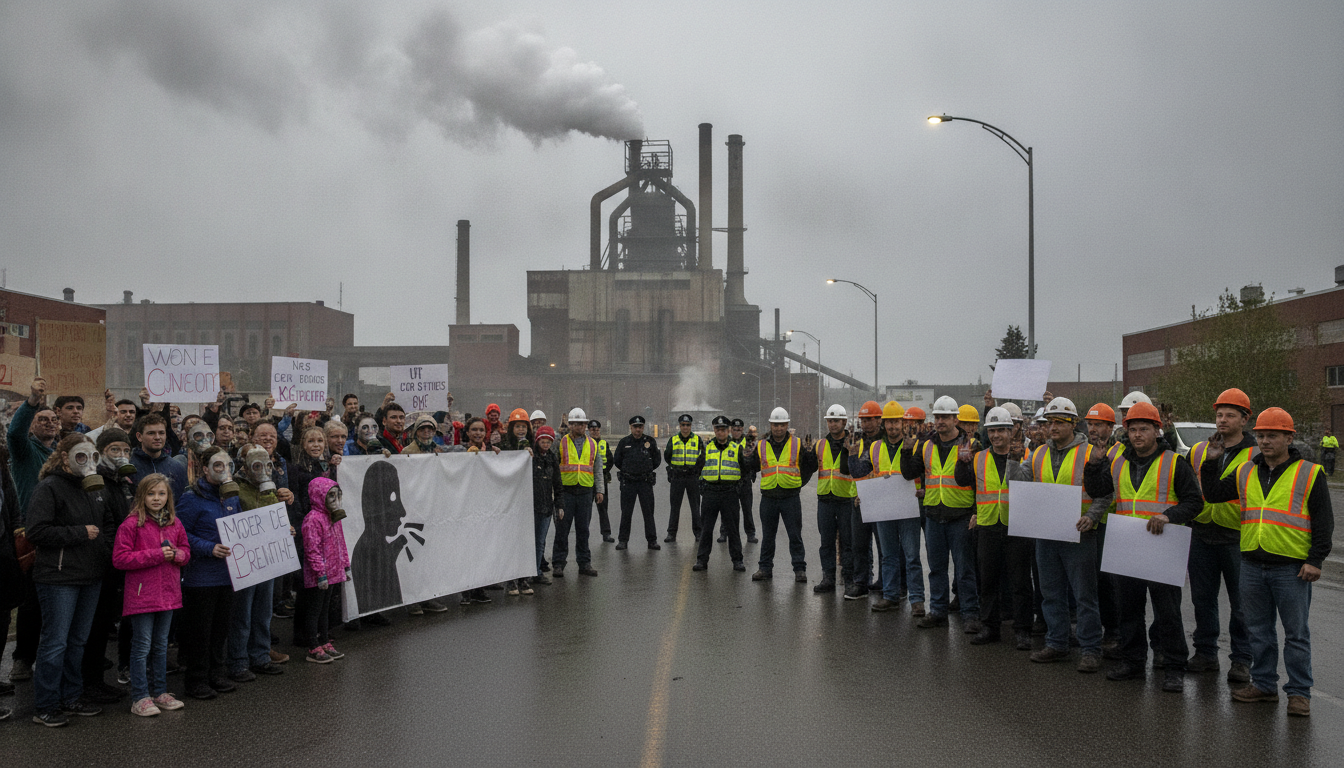
Fonderie Horne controversy deepens as workers leave and residents press for lower arsenic targets
A split has opened in Rouyn‑Noranda over the Fonderie Horne as workers report mass departures and residents renew calls for faster arsenic reductions. The dispute over emissions, public health readings and municipal support for Glencore has intensified community tensions and pushed local public health officials to outline interim targets.
Workers report mass departures and exhaustion
Union leaders say the smelter has lost dozens of staff in recent months, straining daily operations and forcing extended overtime. Shawn Smith, president of the workers’ union, reported that 56 employees left the plant over an eight‑month span and warned the roster is getting dangerously thin. He described workers as committed but physically and mentally exhausted, and said morale has been undermined by persistent anxiety about the plant’s future.
The staffing shortfall has practical consequences for the operation of the Noranda reactor and the maintenance of pollution‑control systems, the union contends. Smith urged patience for emission reduction plans but insisted the industry cannot afford further attrition in critical furnace and capture teams. For many employees, concern for household stability and their health is now central to decisions about staying.
Residents recall health studies and elevated arsenic readings
Community anxiety traces back to a 2019 public health study that flagged elevated arsenic exposure among children in the Notre‑Dame neighbourhood. Local activists and families say that study shifted public perception and amplified scrutiny of air emissions around the Horne smelter. The report and ensuing media coverage have left some residents feeling betrayed and fearful about long‑term health consequences.
Public health figures cited by community groups point to measured arsenic concentrations around the plant that remain well above provincial guidance. The regional authority notes an aim to approach the Quebec guideline of 3 ng/m3, while reporting site readings near the smelter averaged 40.9 ng/m3 in 2025, compared with 39.1 ng/m3 in 2024. Officials warn that prolonged exposure to arsenic and other contaminants raises risks for chronic disease and call for expedited reductions.
Municipal council backs Glencore, fueling public backlash
On February 9, 2026, Rouyn‑Noranda council announced official support for Glencore, the owner of the Fonderie Horne, in its effort to delay or soften provincial reduction targets. The decision was framed by municipal leaders as a pragmatic move to avoid plant closures, investment pauses and economic shock to the city. Mayor Gilles Chapadeau defended the stance by noting historical peaks in emissions and urging continued investment to modernize the operation.
The council vote, however, deepened rifts across the community and prompted impassioned interventions during public meetings this winter. Dozens of workers and residents addressed elected officials to express frustration, fear for livelihoods and concern that municipal backing undercuts public confidence. Opponents argued the move sidelined citizen input and heightened mistrust toward both local government and the company.
Mères au front and other groups press for accountability
Citizen groups, notably Mères au front, have made environmental health and transparency central to their activism in recent years. Members such as Céline Lafontaine and Johanne Alarie say they joined the movement out of concern for children’s health and a sense that risks were not clearly communicated when families settled in the area. Their activism has included public demonstrations, report reviews and sustained pressure at council meetings.
Those activists voiced particular anger after the February council session and said the vote left many feeling vulnerable and ignored. They also acknowledged the suffering of plant workers while insisting that the community’s right to clean air should not be discounted by economic arguments. For group leaders, the aim is to reclaim a decision‑making role for citizens and press for concrete, enforceable reductions.
Public health urges rapid interim reductions and sustained monitoring
Regional public health officials have emphasized both the evidence linking arsenic exposure to long‑term harms and the limits of current regulatory ceilings. Dr. Omobola Sobanjo, director of public health for Abitibi‑Témiscamingue, said her team has consistently recommended lowering emissions toward the provincial benchmark of 3 ng/m3. Given the practical challenges of reaching that standard immediately, she has advocated for a faster move to an interim limit of 15 ng/m3 as a nearer‑term priority.
Dr. Sobanjo stressed that silence or absence from public discussion has sometimes been misread as inaction, and she framed health‑sector involvement as continuous and evidence‑based. Her office cautioned that the jurisdictional ceiling of 45 ng/m3 currently cited in some regulatory contexts is not protective and that shortening the population’s exposure window is urgent. Public health officials are calling for joint monitoring, transparent reporting and timelines for measurable emission declines.
Calls for a locally negotiated arsenic target and economic planning
Despite entrenched positions, some local actors — including union leadership and several councillors — say a negotiated path is possible if trust can be rebuilt. Shawn Smith and some municipal representatives have proposed a community process to set a new arsenic target tailored to Rouyn‑Noranda’s realities, with a goal below 15 ng/m3. Proponents argue a local framework could balance worker protections, economic resilience and public health improvements.
Others on council, such as Vicky Brazeau and François Gagné of Parti virage, emphasize broader economic planning alongside environmental demands. They say future projects should account for housing, childcare and social infrastructure rather than relying solely on job counts. The councillors urged diversification of the local economy and support for families in the buffer zone created to protect residents nearest the smelter.
The future of Rouyn‑Noranda’s relationship with the Fonderie Horne will depend on whether municipal leaders, the company, public health agencies and citizen groups can move beyond rhetoric to a shared, enforceable plan. Restoring confidence will require transparent targets, credible monitoring and measures that protect both community health and regional livelihoods.
