
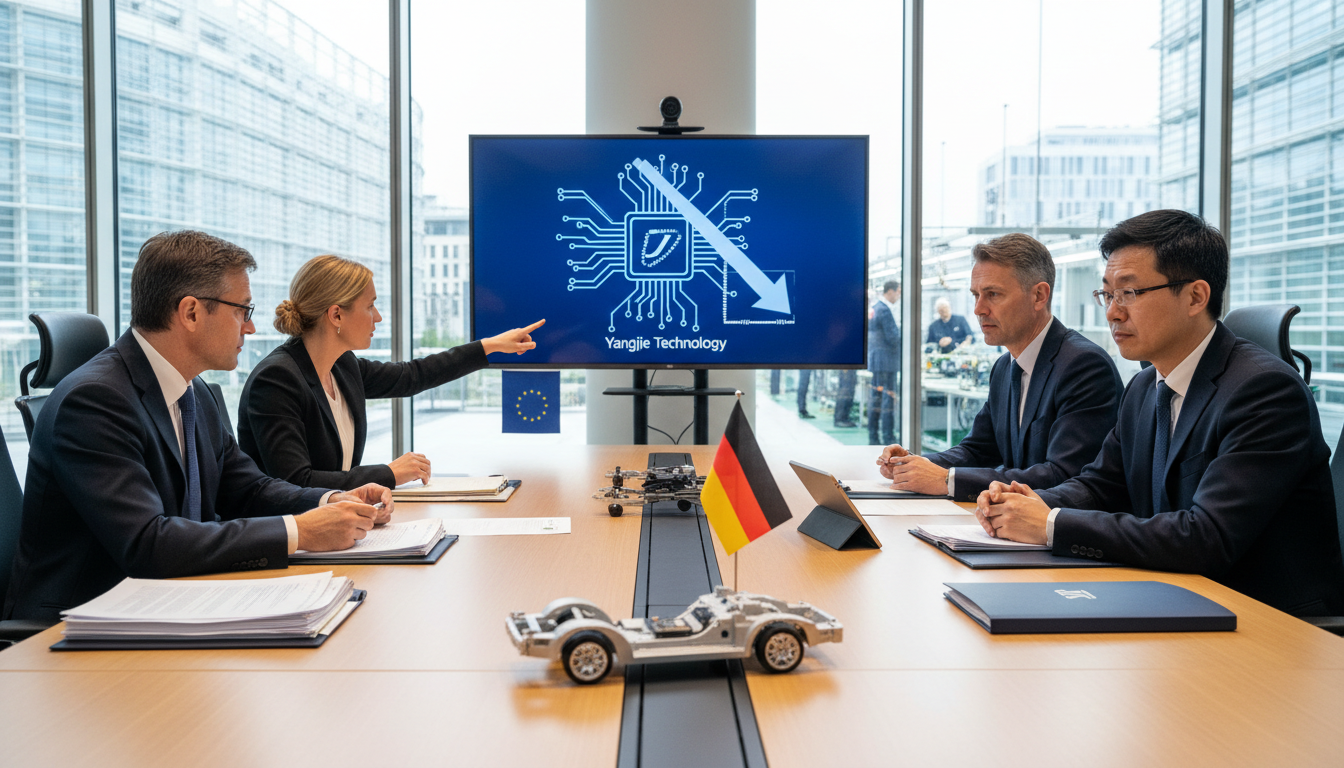
EU moves against Yangzhou Yangjie, raising new chip supply risks for German automakers
Brussels has targeted Chinese chipmaker Yangzhou Yangjie, a move that threatens to tighten chip supply for Germany’s auto industry and other European manufacturers.
Germany’s auto sector faces renewed pressure after the European Union announced measures against Chinese chipmaker Yangzhou Yangjie, disrupting a recent trend of diversifying semiconductor suppliers. The decision by Brussels comes as many automakers and tier‑one suppliers had begun sourcing from newer Chinese entrants to ease earlier shortages. With the EU action now in place, procurement teams must reassess contracts and inventories to avoid production bottlenecks.
EU announces measures against Yangzhou Yangjie
Brussels said it was taking targeted steps against Yangzhou Yangjie, citing risks linked to certain technologies and supply relationships. Officials framed the move as part of a broader effort to secure critical supply chains while asserting regulatory oversight over sensitive semiconductor flows. The action increases compliance requirements for companies that purchased chips or components tied to the firm.
Legal and administrative consequences for Yangzhou Yangjie may include restrictions on exports or market access, depending on how member states implement the EU measures. For European buyers, the practical effect is immediate uncertainty about delivery timelines and contractual obligations with suppliers that integrated Yangjie components.
Immediate effects on German automakers’ chip supply
German automakers are particularly exposed because car production relies on a wide range of semiconductors, from power management to sensor controllers. Several manufacturers that recently expanded their supplier lists to include lower‑cost or readily available chips from new Chinese producers now face potential shortages or rerouting delays. Assembly plants that run on tight just‑in‑time schedules could see production schedules compressed if replacement parts are not secured quickly.
Procurement teams are already reviewing inventories and pushing suppliers for clarity on where affected parts were sourced. Short‑term responses will include stockpiling critical items where possible and accelerating qualification of alternative components, though those measures carry cost and lead‑time implications.
Suppliers’ scramble for alternative sources
Tier‑one suppliers and contract manufacturers are evaluating alternative chip vendors in Europe, North America and other parts of Asia to replace affected lines. Firms expect a surge in demand for chips from established global manufacturers, which may in turn push up prices and extend delivery lead times. Smaller suppliers that relied heavily on Yangjie for specific components face the most immediate challenge in finding drop‑in replacements.
Requalification of different components can take weeks to months, particularly for safety‑critical systems in vehicles. As a result, many suppliers are prioritizing components that affect vehicle safety and emissions systems for immediate replacement efforts, while less critical parts may be deferred or adapted in design.
Brussels’ stated reasons and legal tools
EU authorities framed the action as a measure to protect strategic supply chains and ensure the integrity of critical technologies within the single market. The legal framework invoked by Brussels allows for restrictions when companies or technologies pose risks to security, economic resilience or regulatory compliance. The exact legal instruments and scope of restrictions will determine how broadly companies across Europe are affected.
Member states will play a role in enforcement and interpretation, meaning the impact could vary across national markets. Firms operating in multiple EU countries must therefore prepare for a patchwork of procedural requirements while also monitoring guidance from EU regulators.
Market analysts warn of production slowdowns
Industry analysts warn that the EU move could lead to near‑term slowdowns in automotive production if alternative sourcing cannot be secured swiftly. Some analysts predict localized disruptions at assembly plants that carry limited stock of impacted chips. The broader concern is that increased scrutiny and compliance costs will slow the pace at which manufacturers diversify suppliers, limiting flexibility in times of shortage.
Financial effects are likely to be uneven: large automakers with deeper supplier networks and procurement teams can adapt faster, while smaller suppliers and niche manufacturers may face greater strain. Investors will watch inventory and order‑fulfillment metrics for early signs of strain across supply chains.
Next steps for industry and policymakers
Automakers, suppliers and trade bodies will be engaging with EU institutions to seek clarity on timelines, exemptions and ways to minimize disruption. Industry lobbying is expected to focus on carve‑outs for critical automotive components and transitional arrangements that allow existing supply contracts to be honored while alternatives are qualified. At the same time, companies are likely to accelerate investments in supplier diversification and near‑shoring where feasible.
Policymakers will weigh the strategic rationale for restrictions against the immediate economic consequences for European manufacturing. The episode is likely to intensify discussions about semiconductor resilience, including incentives for domestic production and strategic stockpiling initiatives to cushion future shocks.
The EU action against Yangzhou Yangjie highlights how geopolitical and regulatory developments can rapidly reshape industrial supply chains, underscoring the need for flexible procurement strategies and closer collaboration between industry and regulators to keep factories running.
