
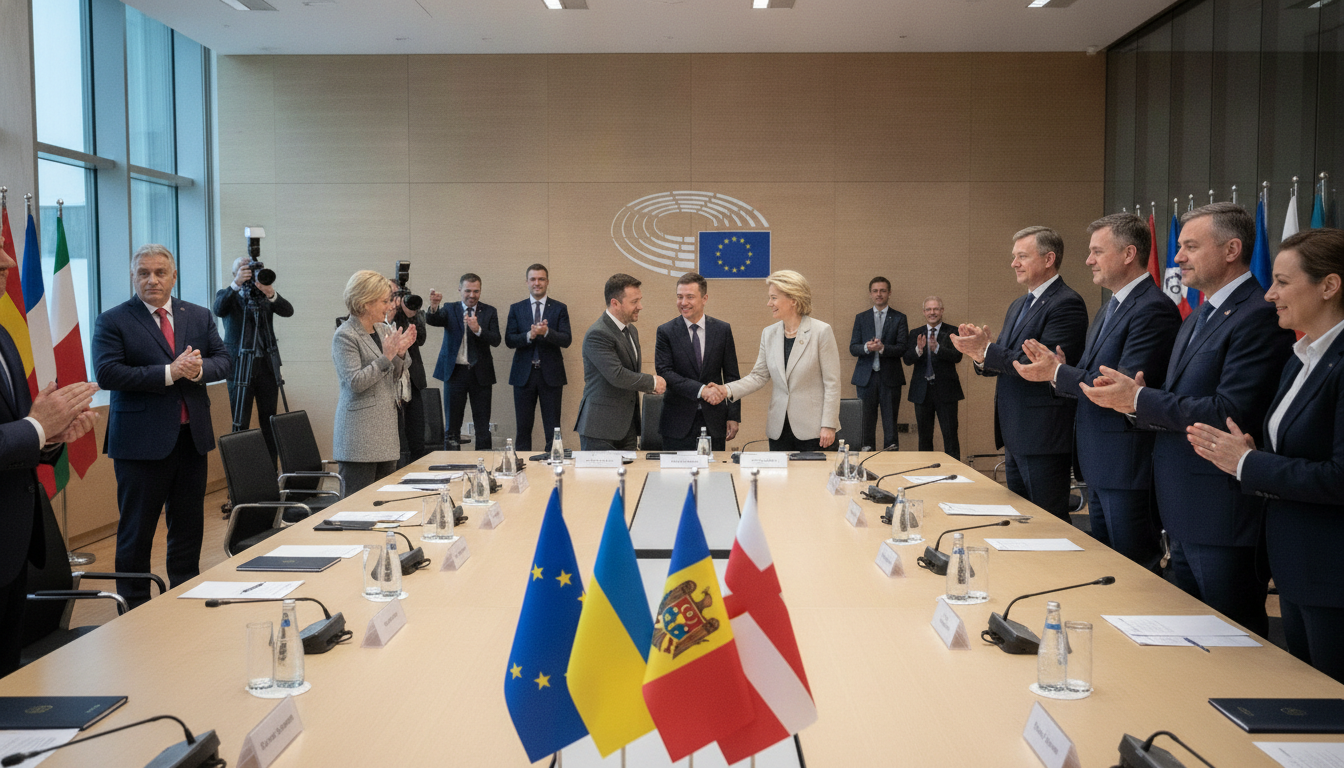
EU accession talks with Ukraine and Moldova to start after Hungary lifts veto
EU accession talks with Ukraine and Moldova will begin after Hungary’s new government withdrew its veto, clearing the way for formal negotiations. The move, announced on June 14, 2026, sets a path toward membership discussions that Kyiv and Chișinău say would bolster their security against Russian aggression. Brussels will now open structured accession talks that will focus on political and economic reforms as both countries press for a clearer timetable.
Hungary withdraws veto and paves the way
Hungary’s new government removed its objection to opening accession negotiations, ending a months‑long impasse that stalled EU deliberations. The unanimity requirement among member states had given Budapest an effective veto, and its decision now allows the European Council to authorise formal talks.
EU officials said the withdrawal was the decisive step needed to move from candidate status to structured negotiations for both Ukraine and Moldova. The announcement came after behind‑the‑scenes diplomacy in which Brussels, member states and Hungarian representatives engaged on outstanding concerns.
Scope of the accession talks in Brussels
Brussels will use the accession framework to assess reforms across rule of law, public administration, and economic governance. Negotiations traditionally proceed chapter by chapter, with benchmarks and screening reports guiding progress and opening specific policy areas for discussion.
European Commission teams are expected to begin technical screenings and set conditionalities that Kyiv and Chișinău must meet to move forward. Financial assistance, judicial reform, anti‑corruption measures and market alignment with EU rules are likely to dominate early rounds.
Security rationale behind Ukraine and Moldova’s push
Both governments have argued that EU accession talks strengthen their security posture amid ongoing regional tensions with Russia. For Ukraine, membership is framed as a long‑term guarantee of political and economic alignment with the West following the 2022 invasion and years of conflict.
Moldova has cited concerns about Russian influence, including the unresolved status of Transnistria, and sees closer EU ties as a stabilising force. Officials in Kyiv and Chișinău have repeatedly linked deeper European integration to deterrence and greater access to collective economic and political support.
Political dynamics inside Hungary and the EU
The veto lift reflects a shift in Budapest’s posture driven by electoral change and a new governing coalition, which signalled willingness to cooperate with EU partners. Hungary’s prior blockade underscored how individual member states can shape enlargement timelines, making unanimity a powerful lever in EU decision‑making.
Across the EU, governments reacted to the development with cautious relief, noting that accession talks still require hard work and that membership remains conditional on reforms. The outcome illustrates the balance between national politics and collective EU foreign policy goals.
Practical timetable and likely hurdles ahead
Opening accession talks is a procedural milestone, not a fast track to membership; the negotiation process typically takes many years and depends on measurable progress. Kyiv and Chișinău will face rigorous monitoring, and the European Commission will publish periodic assessments to determine whether chapters can be opened or closed.
Key hurdles include aligning legal frameworks with the acquis communautaire, demonstrating durable judicial independence, and implementing anti‑corruption reforms. External factors such as security developments, economic pressures and domestic politics in member states will also affect the pace of negotiations.
International and domestic reactions to the decision
Leaders in Kyiv and Chișinău welcomed the decision as a victory for their pro‑European agendas and a step toward greater integration with the EU. Western capitals and institutions broadly praised the move, framing it as consistent with the EU’s stated commitment to enlargement and support for democratic reforms.
Some analysts cautioned that enthusiasm must be matched by concrete reforms and that both countries will need sustained political will and international backing to meet EU conditions. Opposition voices within various EU capitals also stressed that enlargement should proceed only when criteria are fully met.
The launch of accession talks marks a pivotal moment in the EU’s engagement with its eastern neighbours and underscores the strategic dimension of enlargement policy. While the process ahead will be long and demanding, Brussels and the prospective members now have a formal mechanism to translate political ambitions into concrete benchmarks and reforms that could eventually lead to full membership.
