
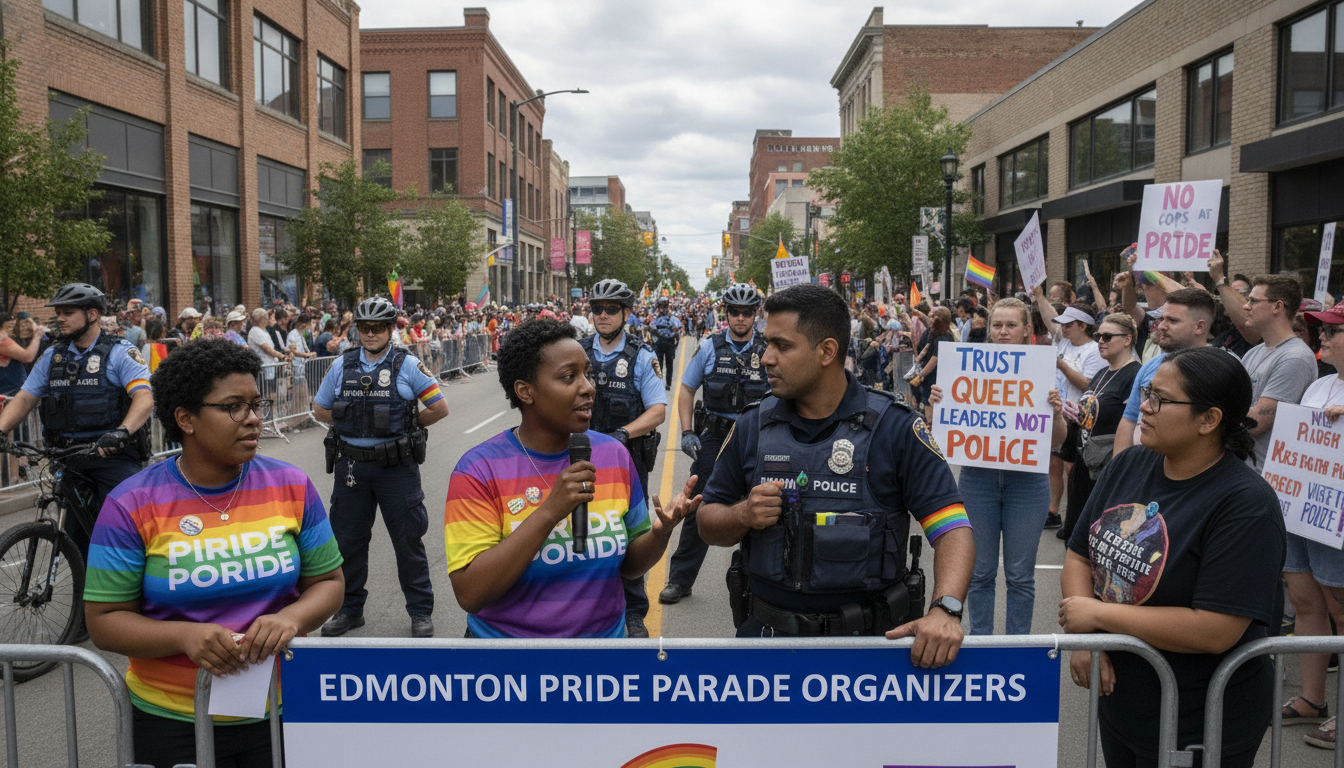
Edmonton Pride parade: Organizers defend police presence as community groups withdraw ahead of Aug. 22 procession
Organizers of the Edmonton Pride parade say a planned police presence is a safety precaution after recent attacks, even as several community groups, including RaricaNow, have announced they will withdraw from festival activities ahead of the Aug. 22, 2026 event.
Strong opening paragraph summarizing the news event
Organizers of the Edmonton Pride parade are maintaining a scheduled police presence at the city’s weekend procession, saying it is necessary to protect attendees after recent violent incidents in other cities.
The decision has prompted a number of community organizations to sever ties with the festival, citing concerns about the presence of uniformed officers and the marginalization of historically excluded groups.
The parade is set for Saturday, Aug. 22, 2026, and tensions between festival leadership, participant groups, and activists have resurfaced as the event approaches.
Organizers defend police presence for Edmonton Pride parade
Festival leadership announced additional security measures earlier this week and described the increased police presence as a precautionary step intended to keep participants safe.
Trevor Watson, the festival’s lead producer, said festival organizers weighed risks following attacks at recent events elsewhere and opted for uniformed officers as one element of a broader safety plan.
Organizers have framed the presence of police as temporary and operational, emphasizing crowd management, first-response capability, and the safe dispersal of attendees at the end of the parade route.
Festival officials say the security plan also includes private security personnel, coordinated crowd-control measures, and liaison arrangements designed to limit potential confrontations.
The announcement noted recent violent incidents at public events — including attacks reported at a cultural celebration in Vancouver and at Pride festivities in Europe — as factors that influenced the decision to adjust security arrangements.
Organizers stressed that the measures were adopted after consultation with municipal safety officials and that the intention was to ensure attendees could leave the parade and associated events without fear for their personal safety.
Groups, including RaricaNow, cut ties over policing
Several community organizations have publicly declared they will no longer participate in festival programming because of the planned police presence, citing longstanding concerns about policing and community harm.
RaricaNow, a nonprofit focused on advocacy for queer and racialized people, announced it would withdraw from the festival and encouraged other groups to reconsider their participation.
Adebayo Chris Katiiti, founder of RaricaNow, said in a social media statement that welcoming uniformed police undermines the history of Pride and fails to acknowledge the harms some community members have experienced at the hands of law enforcement.
Those who have stepped away argued that policing at Pride events can re-traumatize survivors and deter marginalized people from engaging with public celebrations.
Some organizations also pointed to a broader failure, they say, by festival leadership to transparently consult with affected communities when making security decisions.
Festival organizers counter that decisions were made with attendee safety as the foremost priority and that logistical realities required a layered approach to security for a street-level event of this scale.
Edmonton’s policing history and 2019 apology recalled
The debate over police at Pride in Edmonton is rooted in the city’s own history of contentious interactions between law enforcement and LGBTQ+ communities.
Advocates and historians frequently point to a notorious police operation in 1981 that targeted a downtown bathhouse frequented by gay men; that raid has become a reference point in discussions about policing and queer safety.
The Edmonton Police Service issued a formal apology in 2019 that acknowledged past mistreatment of LGBTQ+ people and recognized the lasting impact of those incidents on trust between the service and the community.
That 2019 apology was framed as a step toward reconciliation, but for many activists it did not erase the memories of discriminatory practices or the institutional changes they say are still needed.
Critics of police involvement at Pride events argue that apologies must be followed by concrete reform and by opportunities for affected communities to lead discussions about public safety.
Organizers who support a police presence counter that today’s officers operate under different policies and that their role at public events is intended to protect, not to intimidate.
Parade returns after seven-year hiatus amid renewed tensions
The Edmonton Pride parade returned to the city calendar last year after a multi-year pause, a reinstatement that followed previous disputes over law enforcement engagement and criticisms that some community voices had been sidelined.
That return was touted by some as a renewal of public celebration, but it also reopened questions about who is welcomed into planning decisions and how safety is managed for diverse participants.
Last year’s procession reflected both the appetite for visible Pride in the city and the fragility of partnerships that had lapsed during the hiatus.
Organizers say restoring an annual parade required complex negotiations with municipal authorities, property owners, and community stakeholders, and that safety planning was a central component of those negotiations.
For groups that withdrew this week, the reconstituted festival has not sufficiently addressed structural concerns they say persist beneath surface-level programming.
The current schism highlights the ongoing challenge facing many Pride organizations: balancing the logistical demands of large public gatherings with the movement’s activist roots and commitments to marginalized community members.
Security measures and what to expect on Aug. 22, 2026
Festival officials have outlined a set of operational measures for Saturday’s procession that extend beyond the presence of uniformed police, including staged medical support, designated safe spaces, and stewards trained to address incidents on the route.
City permits and logistical approvals require a documented safety plan for street closures and crowd sizes, and organizers say their approach is intended to meet those municipal requirements while minimizing risks.
Police presence, according to organizers, will focus on visible deterrence in high-traffic areas and rapid response capability in the event of a serious incident.
Community groups that oppose uniformed officers at Pride have proposed alternative security models that emphasize trained, unarmed stewards, on-site mental-health supports, and negotiated protocols for responding to threats.
Organizers say there was not sufficient time or infrastructure this year to adopt an exclusively non-police model for a parade of this scale, though they indicated willingness to review alternatives in future planning cycles.
Festival spokespeople urged attendees to be aware of on-site resources, to use designated reporting channels for concerns, and to follow any guidance posted by organizers for route access and post-parade dispersal.
Debate over police at Pride extends beyond Edmonton
Edmonton’s dispute over police at Pride reflects a broader national and international conversation in which activists, organizers, and municipal authorities are reassessing the role of law enforcement at LGBTQ+ events.
In recent years, other Canadian cities have seen similar debates about whether uniformed officers should march, monitor, or be excluded from Pride activities, and those discussions frequently intensify after incidents of violence or confrontation.
Supporters of an active policing role argue that uniformed officers provide rapid emergency response and deter potential attackers, while opponents argue that visible policing can suppress participation by those who have experienced state violence.
The tension is compounded by differing perspectives within LGBTQ+ communities themselves, where age, race, gender, and immigration status can shape how individuals experience safety and policing.
Many organizers across the country are now trying to develop hybrid models that incorporate community-led safety teams, formal agreements with police for restricted roles, and comprehensive harm-reduction strategies.
Those experiments vary widely in scope and success, and they often require substantial time, funding, and trust-building to implement effectively.
Looking ahead: dialogue, accountability and planning for future festivals
The coming weeks are likely to see calls for new conversations between the Edmonton PrideFest Association, community organizations that withdrew, and civic authorities to reassess how safety decisions are made.
Advocates who have stepped away from this year’s programming say they will press for inclusion in governance and for commitments to alternative safety models before re-engaging with festival operations.
Organizers have signaled an openness to post-event reviews and to exploring revised approaches in future years, but they have also emphasized the immediate need to ensure this weekend’s procession proceeds without incident.
Accountability measures that community groups often request include transparent crisis-response protocols, independent oversight of event security, and formal avenues for marginalized voices to shape festival priorities.
Festival leadership and civic officials face the practical challenge of reconciling those demands with the short timelines and regulatory requirements tied to public street events.
The outcome of discussions that follow this weekend could influence not only next year’s Edmonton Pride parade but also how other cities navigate similar disputes between safety, trust, and inclusion.
Organizers have maintained that the primary objective for Saturday, Aug. 22, 2026, is to allow communities to gather and celebrate while minimizing the risk of harm, even as some community members continue to question whether that approach adequately honors the history and aims of Pride.
The dispute underscores how public celebrations that once focused primarily on visibility now grapple with complex questions of governance, trauma, and public safety in cities across Canada.
As the parade approaches, both sides say they hope for a peaceful event, while planning for longer-term dialogue about how Pride in Edmonton can reconcile safety needs with calls for transformative change.
