
Edmonton councillor proposes renaming 99th Avenue to "Forever Canadian Avenue" near legislature
Edmonton councillor Michael Janz has applied to rename 99th Avenue adjacent to the Alberta legislature to "Forever Canadian Avenue," a move tied to a federalist petition and public debate over separatism.
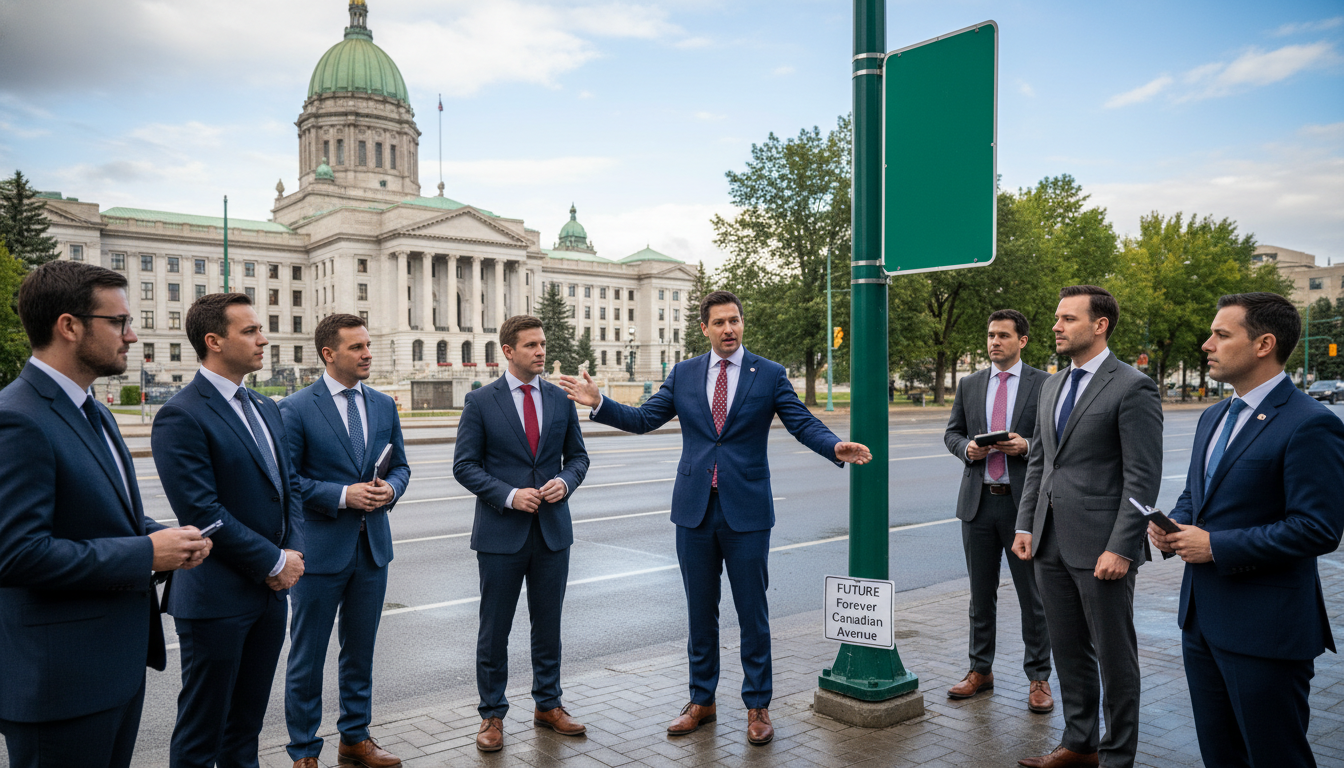
Edmonton councillor Michael Janz on Sunday unveiled a mock red-and-white sign and announced plans to apply to rename the stretch of 99th Avenue that borders the Alberta legislature to Forever Canadian Avenue. The proposed name is intended to recognize a petition that collected hundreds of thousands of signatures supporting Alberta remaining in Canada, and to give tourists and school groups a visible symbol of federalist sentiment in the city.
Janz presented the sample bilingual sign, which features a maple leaf and a reference to Treaty 6, at a small gathering where petition organizer and former deputy premier Thomas Lukaszuk was on hand. Janz said the site is a high-traffic tourist destination and argued the name would reinforce pride in Canadian unity for visitors and residents alike.
Janz told reporters many constituents helped gather signatures for the petition and that he plans to submit his formal application to Edmonton’s naming committee within days. He said he will cover any sign replacement costs through fundraising and personal funds if the committee grants approval.
Proposal unveiled outside legislature
The mock sign presented by Janz on Sunday was intentionally styled in red and white and included both English and French text alongside Treaty 6 symbolism. The councillor said the visual intent is to create an unmistakable statement of federalist support immediately adjacent to Alberta’s seat of government.
Janz framed the move as civic commemoration rather than a partisan intervention, noting the name would mark the site where visitors come to learn about the legislature and the ongoing civic conversation. He emphasized the educational value for school groups that regularly tour the area.
At the event, Janz handed the sample sign to Thomas Lukaszuk, who led the petition drive that registered more than 400,000 verified signatures with election officials. The presentation drew a small group of supporters and media attention to a municipal process that typically receives few high-profile proposals.
Origins of the Forever Canadian petition
Thomas Lukaszuk, a former deputy premier, organized the Forever Canadian petition in response to growing public discussion about Alberta’s place in Confederation. The petition asked whether Albertans agree that the province should remain within Canada and gathered signatures across the province.
Election officials verified just over 400,000 of those names in December, placing the petition among the largest federalist initiatives in recent years in Alberta. Lukaszuk has described the effort as a grassroots movement to affirm federal ties at a time of heightened regional tensions.
Janz said many of his own constituents were engaged in collecting signatures and volunteer work around the petition, which he presented as evidence of local support for a symbolic municipal recognition. He suggested the proposed street name would memorialize that civic engagement.
Court ruling and the wider political context
Janz’s announcement came days after a court threw out a separate separatist petition launched by a group called Stay Free Alberta. A judge found that petition had been incorrectly issued under a provincial law and also criticized the provincial government for failing in its duty to consult Indigenous groups.
The judicial decision, and the legal questions that prompted it, have intensified political debate in Alberta about whether and how separation-related questions should be presented to voters. Premier Danielle Smith has said she supports Alberta remaining in Canada while also arguing Albertans deserve avenues to register discontent with federal policies.
Stay Free Alberta and the provincial government have indicated plans to appeal the ruling, meaning litigation and political maneuvering may continue through the summer and into the fall. Meanwhile, an all-party committee of MLAs is weighing whether the Forever Canadian petition question should be placed on a provincial ballot or handled within the legislature.
Opposition MLAs and petition proponents have urged the committee to act quickly, while government members have defended the pace of its work. Those procedural disputes have underscored the highly charged atmosphere surrounding questions of provincial identity and federal relations.
Edmonton’s naming committee and criteria
Edmonton’s street naming policy assigns final review of such proposals to a citizen-based naming committee rather than elected officials. The committee evaluates submissions against a set of criteria that include connections to Indigenous history and culture, significant contributions to the city or nation, and reflecting the diversity of the community.
Applicants are also expected to demonstrate public support and supply background information about the proposed name’s significance. Janz said he will submit letters of support with his application and hopes to align the timeline so that, if approved, the new signage could be in place by Canada Day.
The city’s rules also make the applicant responsible for the cost of new signs and any related installation, a point Janz acknowledged and prepared to address through fundraising. The use of bilingual text and reference to Treaty 6 on the mock sign will be part of the committee’s review, because Indigenous recognition and language considerations are explicit factors in Edmonton’s naming policy.
Local reactions and stakeholder perspectives
Supporters at Sunday’s event described the proposed Forever Canadian Avenue name as a unifying symbol and a way to acknowledge Albertans who signed the petition. They argued it would project a message of national cohesion to visitors and provide a counterbalance to separatist rhetoric.
Critics and some observers have questioned whether municipal street naming is the appropriate venue for settling broader constitutional or political disputes. They warned that symbolic gestures can inflame local debate and risk politicizing civic space near the legislature.
Economic concerns have also been raised by Janz and others who say ongoing separatist talk can undermine investor confidence and long-term planning. Janz framed the renaming as a modest civic act intended to reduce uncertainty and reassure those considering investment in the city or province.
Indigenous perspectives will be central to the naming committee’s review because the mock sign includes Treaty 6 language and a maple‑leaf motif. City policy requires consideration of Indigenous history and consultation where appropriate, and committee members will likely scrutinize whether the proposed design and wording meet that standard.
Process, timing and possible outcomes
Janz plans to submit his formal application to the naming committee this week, accompanied by letters of support he has sought from community groups and residents. The committee’s schedule and workload will determine how quickly it can assess the proposal and whether it will hold public consultations.
If the committee approves the name, the city would move to replace or augment existing signage, a process dependent on logistical planning and the applicant’s funding. If the committee rejects the application, the decision could be appealed within the city’s naming framework or revisited with a revised submission.
Even with municipal approval, the proposal could remain politically sensitive if opponents choose to challenge the decision in public or political forums. Conversely, a smooth committee process and modest public reaction could allow the renaming to proceed without further incident.
The timing is also relevant to broader provincial developments, including any scheduled referendum activity or court appeals related to separatist petitions. Janz’s expressed goal of celebrating Canada Day on a street called Forever Canadian Avenue ties the municipal application to a symbolic national holiday, which could amplify public attention.
Implications for civic symbolism and federal-provincial relations
A municipal street name near a provincial legislature is a visible and enduring symbol, and proponents say it offers a low-cost way to register local sentiment on national unity. The Forever Canadian Avenue proposal illustrates how civic space can become a canvas for broader political conversations.
Opponents argue that such gestures can polarize municipal life and risk aligning public infrastructure with contested political positions. They caution that street names traditionally honour people, places or historical events, and that using municipal signage to endorse a petition may stretch those conventions.
The inclusion of Treaty 6 language on the mock sign also raises questions about how Indigenous recognition intersects with contemporary political messaging. Naming decisions that touch on treaties and Indigenous identity require careful consultation and sensitivity to avoid unintended consequences.
Municipal officials and citizens will need to balance the symbolic value of the proposed name against the committee’s naming criteria and the broader public interest. The outcome of the application will likely be read as a gauge of how Edmonton manages civic expression in a politically charged moment.
Next steps for councillor and committee
Janz will assemble supporting materials and letters for the naming committee and has indicated he will cover sign costs if necessary. The committee, made up of members of the public, will evaluate the application against established criteria and may seek additional input from Indigenous organizations or affected stakeholders.
Public consultation is possible depending on the committee’s process and the level of interest from residents. If the committee approves the name, city staff will coordinate production and installation of signage in consultation with transportation and heritage departments.
Should the committee decline the request, Janz could revise the proposal or pursue alternative forms of recognition for the petition and its supporters. Either outcome will contribute to an ongoing public discussion about the symbols and spaces that represent civic identity in Edmonton.
The municipal decision will arrive against a backdrop of provincial legal appeals and continued debate about Alberta’s place in Canada, so its political resonance may extend beyond the city limits. Observers in other jurisdictions are likely to watch how Edmonton’s naming committee reconciles local naming rules with a proposal rooted in provincial and national politics.
The application process is expected to play out over several weeks to months, depending on committee timelines and any required consultations. A final decision before Canada Day would fulfill Janz’s stated objective, but the committee’s calendar and procedural steps will ultimately determine whether that target is feasible.
The question of whether a street name can serve as a durable expression of federalist sentiment will be tested through this municipal process. Edmonton’s naming committee will assess the proposal on its merits and within the policy framework designed to balance history, diversity and public interest.
The proposed Forever Canadian Avenue, if approved, would be one of several recent examples across Canada where municipal naming has intersected with larger political debates. How Edmontonians respond to the committee’s decision may shape local norms around civic symbolism and the role of municipal government in accommodating politically charged proposals.
The naming committee’s deliberations and any resulting public consultation will offer a clearer picture of support, opposition and the practical considerations that will guide the city’s final decision. For now, the proposed renaming has brought renewed attention to the intersection of municipal governance, provincial politics and national identity.
If the city approves the name, the physical replacement of signs and any associated ceremonies would follow, and the site would become a visible marker of the petition’s reach. If the committee rejects the proposal, proponents may pursue other ways to commemorate the petition and its message, while critics will likely continue to press for municipal neutrality in civic naming.
The outcome will not resolve broader constitutional debates or legal challenges to separatist initiatives, but it will determine whether Edmonton’s civic landscape includes a formal, permanent nod to a high-profile petition supporting Alberta’s place in Canada.
Public interest in the committee’s decision is expected to remain steady in the coming weeks, and municipal officials will monitor reactions as they move through the established naming process.
The renaming application highlights how local decisions about signage and place names can carry symbolic weight far beyond their size, and Edmonton’s approach will be watched as a case study in managing civic symbolism amid ongoing provincial debate.
