
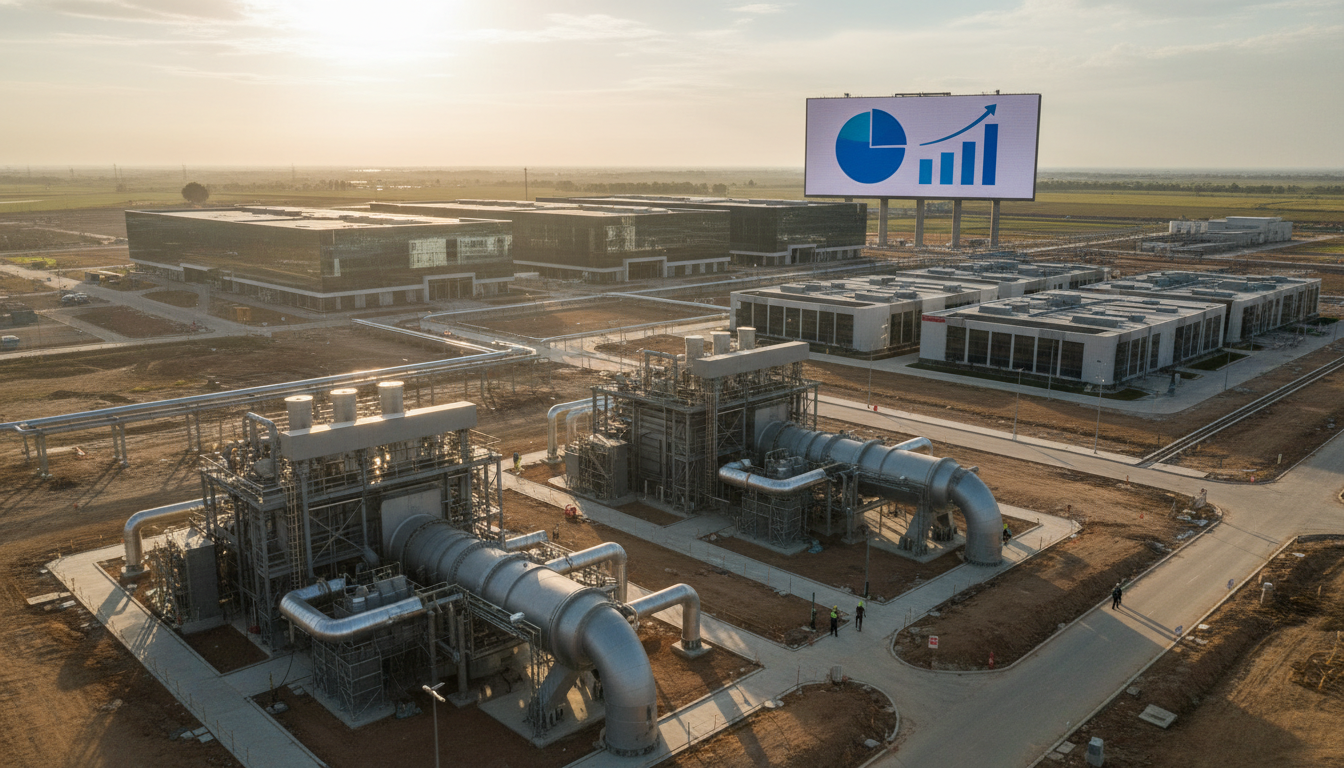
Natural gas power plant costs surge 66% as tech data centers drive fresh scramble
Build costs for natural gas power plants jumped 66% since 2023, extending schedules and straining turbine supply as data centers seek on-site generation.
Rising construction costs reshape power-build economics
The cost to build a combined cycle natural gas power plant climbed sharply over the past two years, rising from under $1,500 per kilowatt in 2023 to roughly $2,157 per kilowatt last year. That 66% increase is altering project economics for companies and utilities weighing new gas-fired capacity. Developers now face higher capital requirements and greater uncertainty when forecasting returns on projects that once looked routine.
Longer lead times have compounded the price pressure, with new plants taking about 23% longer to complete than in recent years. Those delays increase financing costs and expose projects to further market swings in labor, materials, and regulatory conditions. Together, the cost and timing shifts are forcing some firms to revisit procurement strategies and contingency plans.
Turbine shortages and equipment price spikes
A key driver of the build-cost spike is a constrained market for gas turbines, which can account for up to 30% of a plant’s capital expense. Manufacturers have limited capacity and specialized production techniques that do not scale quickly, producing supply bottlenecks and extended waitlists for new units. Industry observers expect turbine prices and lead times to remain elevated, with some estimates showing equipment costs several times higher than in 2019.
The turbine crunch ripples through the supply chain, pushing up prices for ancillary components and increasing competition for installation crews. Projects that rely on fast delivery windows are being postponed or canceled, while developers with early purchase agreements for turbines gain a significant advantage. The result is a market where timing and vendor relationships are as critical as raw capital.
Data centers emerge as a dominant driver of demand
Large-scale data centers are one of the fastest-growing sources of electricity demand, prompting many tech firms to secure dedicated generation. Forecasts suggest data center load could expand from roughly 40 gigawatts today to more than 100 gigawatts within the next decade-plus, driven in part by artificial intelligence and increasingly power-hungry computing. The average size of new facilities is also rising, with more sites planned above the 100-megawatt threshold.
This surge has prompted some operators to pursue on-site or contracted generation rather than rely solely on grid-sourced renewables. Policymakers and regulators have encouraged firms to ensure reliability, and in some cases officials have urged larger purchasers to “bring their own power.” Those dynamics have accelerated interest in building new gas-fired plants despite environmental and community concerns.
Utilities, customers and community pushback
Utilities responding to the demand surge often pass through the costs of new generation to ratepayers, a practice that has drawn scrutiny and local opposition. Communities near proposed facilities have raised concerns about emissions, noise, and changes to land use, while consumer advocates warn of higher bills. Public resistance has already slowed or complicated several permitting and siting processes for generation projects.
The political and regulatory backdrop further complicates planning for developers, who now must navigate public hearings, environmental assessments, and tighter scrutiny of long-term climate impacts. In some jurisdictions, heightened oversight has added months to approval timelines and increased the likelihood of conditional permits or mitigation requirements.
Renewables paired with long-duration storage present an alternative
Not all tech companies and utilities are turning to fossil-fuel generation. Some large corporate operators are exploring renewable energy backed by long-duration storage as an alternative to gas-fired plants. New storage technologies, including iron-air batteries designed to discharge over multiple days, are being piloted to provide sustained output during extended demand periods or low renewable generation.
Falling costs for solar panels and lithium-ion batteries have made renewables-plus-storage progressively more competitive in many markets. For organizations concerned about both cost volatility and carbon footprints, pairing renewables with multi-day storage offers a pathway to meet reliability needs without committing to long-lived fossil infrastructure. However, the commercial scale-up of long-duration storage remains an open question for many planners.
What the near-term outlook means for developers and buyers
Higher build costs and strained equipment supply are likely to reconfigure where and how new capacity is developed in the next several years. Some developers will accelerate projects where they have early equipment orders or favorable financing, while others may delay until supply and pricing normalize. Buyers facing urgent load growth may have to choose between paying a premium for faster delivery or adopting alternative strategies such as demand management, grid upgrades, or storage deployment.
Regulators and market operators will also play a pivotal role in shaping outcomes through permitting timelines, incentive design, and interconnection policies. If gas-fired builds proceed at current cost levels, rate impacts and public opposition could push more municipalities and corporations toward cleaner alternatives. Conversely, persistent turbine constraints could lock in higher prices and elongate transition timelines.
Higher construction costs, stretched manufacturing capacity, and accelerating electricity demand from data centers have combined to create a volatile market for new generation. How industry, policymakers, and large electricity buyers respond in the next 12 to 36 months will determine whether natural gas remains the immediate fallback for reliability or whether renewables and long-duration storage seize a larger share of new capacity development.
