
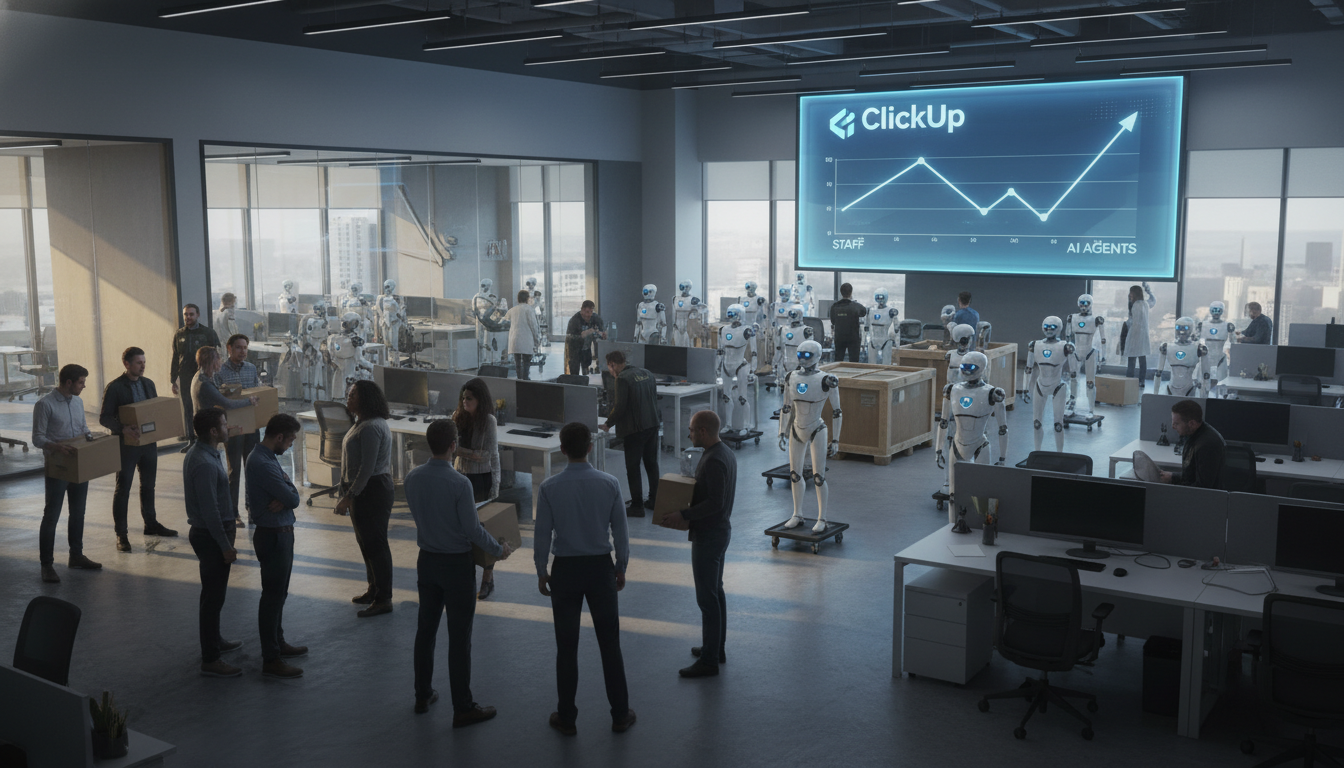
ClickUp layoffs: CEO frames 22% reduction as AI-driven shift toward a "100x" organization
ClickUp layoffs: CEO Zeb Evans says the company cut 22% of staff as it deploys 3,000 internal AI agents to boost productivity and create a ‘100x’ organization.
ClickUp has cut 22% of its workforce while the company accelerates internal deployment of AI agents, a move its CEO says will transform operations and reward employees who adopt automation. The announcement frames the reduction not as routine cost-cutting but as a strategic pivot to an AI-first operating model that, the company says, will deliver major productivity gains. Employees who remain are being asked to supervise and direct automated agents; the company has signaled new pay bands and outsized compensation for staff who generate disproportionate value through AI. The decision has intensified debate over whether AI-driven efficiency justifies headcount reductions across the tech sector.
ClickUp announces 22% workforce reduction
ClickUp confirmed a staff reduction affecting roughly one-fifth of its employees, a significant cut for the collaboration software startup. Leadership characterized the move as part of a broader reorganization tied to AI adoption, rather than simple belt-tightening.
The company’s public statements emphasize that savings from the change will be redirected to retained staff and product development. Executives say the strategy is aimed at building a more leverageable organization through automation.
CEO frames cuts as AI-driven transformation
CEO Zeb Evans has publicly described the layoffs as a deliberate shift toward an AI-native company structure. Evans has outlined plans to elevate pay for employees who demonstrate outsized impact through the use of AI, including the introduction of higher salary bands.
That framing positions the layoffs as a reallocation of resources to fuel AI initiatives and reward talent that can amplify output with automation. Observers note this message is intended to reassure remaining staff while signaling long-term changes to job design and performance metrics.
Deployment of roughly 3,000 internal AI agents
The company has rolled out an estimated 3,000 internal AI agents tasked with automating complex workflows and augmenting employee work. Staff are now expected to instruct these agents and validate their outputs, shifting roles toward oversight and quality control.
ClickUp executives say the internal agents are already producing measurable efficiencies and will inform product features offered to customers. The company intends to package some of these agent-driven capabilities as sellable services, integrating internal learnings into its roadmap.
Gartner survey and industry implications
The move by ClickUp comes amid broader industry trends showing automation can correlate with workforce reductions. A recent Gartner study found a high percentage of firms using autonomous technologies have implemented layoffs, though it also cautioned that cuts do not always translate into improved financial performance.
Analysts say the Gartner findings suggest a pattern in which some companies adopt unproven AI systems and use automation as justification for downsizing without clear returns. That nuance has fed skepticism among investors and labor advocates about whether AI-driven reorganizations reliably boost long-term productivity.
Debate over token consumption and productivity metrics
Within tech circles, companies have begun measuring “token” consumption to track AI usage, a practice critics label “tokenmaxxing.” Proponents argue token metrics reveal who is actually integrating AI into their work; detractors counter that token-focused incentives can encourage wasteful AI calls rather than meaningful value creation.
ClickUp’s leadership rejects token-counting as an end in itself, saying the firm will instead reward time saved and value delivered. Still, the emergence of token-based measurement systems has sparked a debate on how companies should evaluate AI adoption and whether usage is an appropriate proxy for performance.
Startups pushing the extremes of automation
The ClickUp case is not unique in highlighting extremes of automation. Some startups have pursued models that dramatically shrink headcount by building operations around AI agents, with high-profile examples of firms operating with minimal staff while offering broad services.
One recently funded startup operating with a single operator has drawn attention for demonstrating how automation can reshape businesses at small scale. Such examples show the potential upside of AI for efficiency, but they also raise questions about sustainability, oversight, and the social consequences of displacing human labor with software.
The broader conversation now turning to governance and measurement centers on whether the economics of AI-driven productivity will create broadly shared benefits or simply concentrate gains. Skeptics warn that short-term cost cuts dressed as innovation may erode employee trust and fail to deliver promised growth.
ClickUp’s leadership insists the company aims to channel efficiency gains into higher compensation for top performers and enhanced product offerings for customers. How that model unfolds will likely influence other firms weighing similar transitions and shape employer-employee dynamics in AI-enabled workplaces.
