
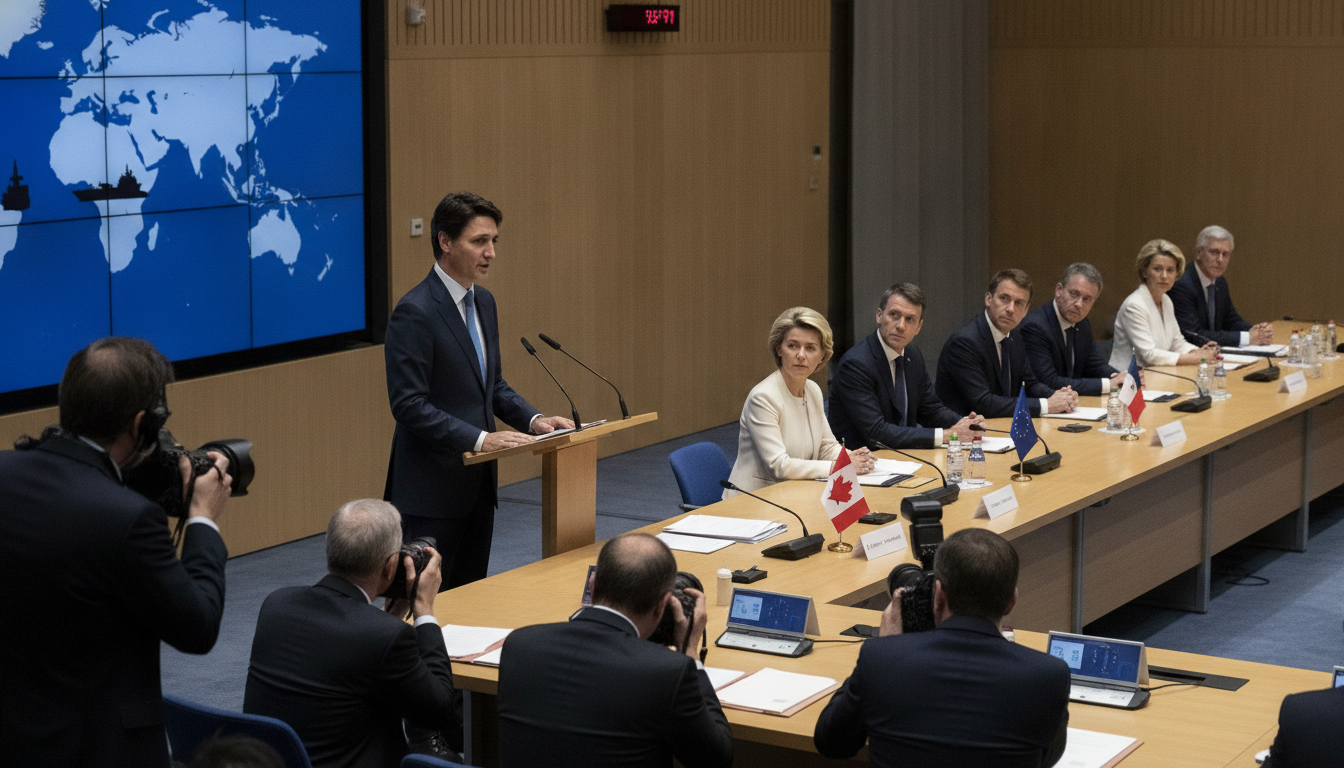
Mark Carney at G7 summit presses EV limits, backs new sanctions on Russia as Canada-U.S. trade talks stall
Mark Carney at G7 summit pressed leaders on electric vehicles and helped announce fresh sanctions on Russia, while Canada–U.S. trade negotiations head toward a July 1, 2026 deadline.
Mark Carney used his presence at the G7 summit in Évian-les-Bains to raise Canada’s electric-vehicle policy in a brief exchange with U.S. President Donald Trump and to join allies in unveiling a package of sanctions aimed at weakening Russia’s maritime and financial capacity.
His interventions came amid stalled Canada–U.S. trade discussions and a looming July 1, 2026 deadline to begin a formal review of the Canada–United States–Mexico Agreement.
The summit, which runs June 15–17, 2026, saw Carney combine targeted diplomacy on trade and industry with coordinated measures on Ukraine and energy security.
Private exchange on electric vehicles during leaders’ table
During the leaders’ roundtable, Carney briefly spoke with President Trump about Canada’s approach to electric-vehicle imports, noting that recent policy shifts had translated into a limited share of the domestic market.
Officials in the room captured the moment as Carney referenced import volumes in the tens of thousands and framed them as a modest proportion of Canadian vehicle sales.
The exchange underscored Ottawa’s effort to balance market openness with industry protections while using bilateral contacts to clarify intentions with the United States.
Impasse in Canada–U.S. trade talks and the July 1, 2026 deadline
Trade officials continue to report slow progress in talks between Ottawa and Washington, with negotiators under pressure to agree on terms for a review of the ACEUM framework.
Under the agreement’s timeline, the three parties must commit to a process of review and renewal by July 1, 2026, or face an automatic one-year extension of the pact unless a withdrawal is declared.
Canada has signaled readiness to press its priorities in sectoral talks, while ministers and trade representatives plan follow-up meetings to try to close outstanding issues before the statutory deadline.
Canada announces targeted sanctions against Russian networks
At a high-profile session that included Ukrainian President Volodymyr Zelensky, the Canadian government unveiled a package of sanctions aimed at crippling elements of Russia’s war apparatus.
Ottawa said its measures focus on a mix of individuals, companies and vessels tied to military logistics, energy revenue streams and state-aligned disinformation operations.
Officials described the actions as calibrated to disrupt the financing and transport nodes that sustain Russia’s military campaign.
Allied measures and the focus on Russia’s “phantom” fleet
Alongside Canada, other G7 members announced steps aimed at curbing the use of so‑called phantom or shadow fleets—vessels registered, reflagged or hidden to evade sanctions and move oil and gas.
The United Kingdom detailed a separate set of measures that will include restrictions on tankers and recently reallocated methane carriers tied to Arctic liquefied natural gas projects.
Ukrainian authorities and allied leaders emphasized the need for coordinated maritime enforcement to cut off revenue and logistics channels supporting the war effort.
U.S. response and energy sanctions considerations
President Trump signalled willingness to reintroduce restrictions on Russian oil exports if global market conditions permit, linking any move to recent shifts in petroleum supply and prices.
Washington had earlier eased some energy-related sanctions in response to supply disruptions and spikes in global prices, and officials said any reimposition would be undertaken with economic impacts in mind.
The strategic debate at the summit reflected competing goals: to pressure Moscow without unduly harming allied energy markets or domestic consumers.
Carney’s bilateral outreach and diplomatic follow-through
Beyond plenary sessions, Mark Carney held a string of bilateral meetings with leaders and senior officials from Italy, the United Arab Emirates, India and South Korea to advance both economic and security items.
Canada’s minister responsible for Canada–U.S. trade matters was scheduled to meet U.S. Trade Representative Jamieson Greer to continue technical negotiations, but no formal meeting between the Canadian prime minister and President Trump was on the agenda during the summit.
Officials said those side discussions were intended to sustain momentum on trade and to coordinate implementation of sanctions packages agreed at the multilateral level.
The G7 discussions in Évian have combined immediate responses to the conflict in Ukraine with longer-term negotiations over trade and industrial policy, leaving Ottawa to juggle market access, domestic industry protection and allied security priorities as officials return to bilateral workstreams.
