
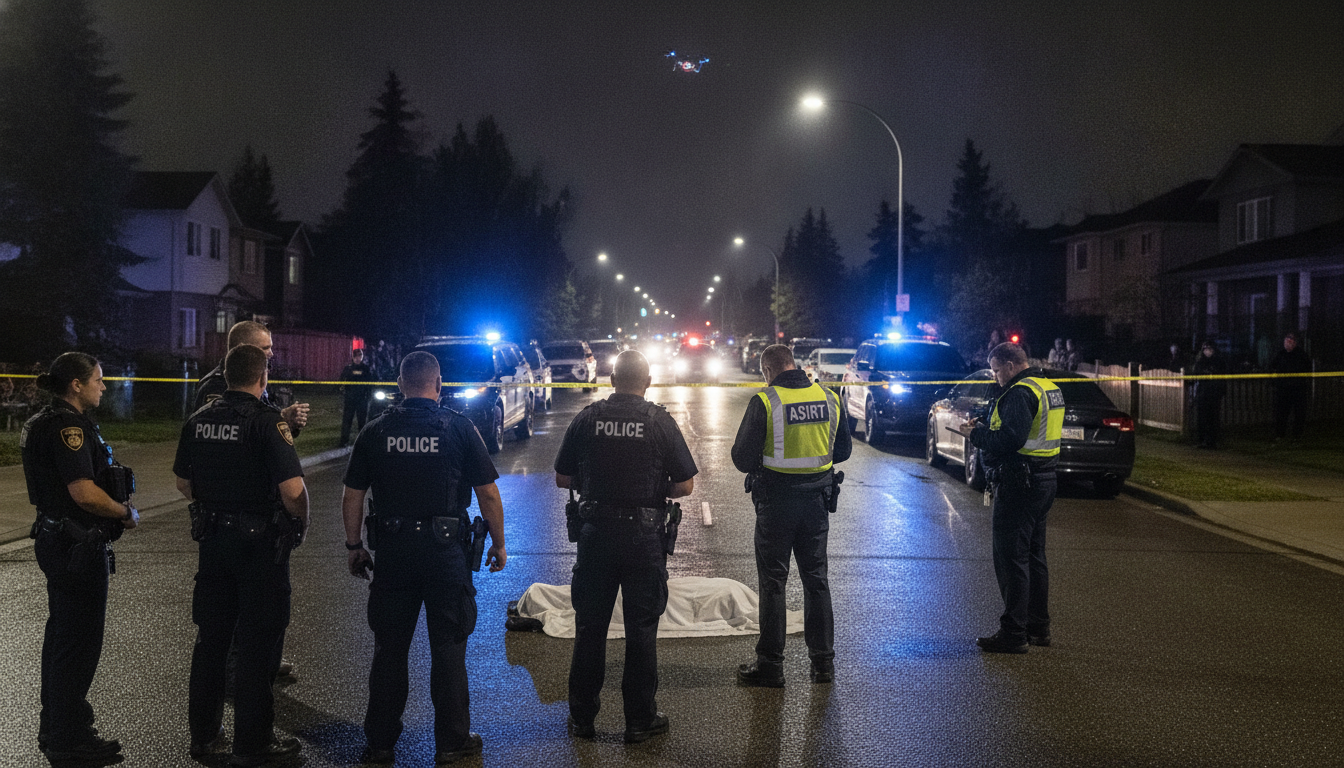
Officer-involved shooting in Calgary near Deerfoot Meadows leaves woman dead; ASIRT launches Level 1 probe
Police release new details about a June 21 officer-involved shooting in Calgary near Deerfoot Meadows that left a woman dead and prompted an ASIRT Level 1 investigation.
Officials say an officer-involved shooting in Calgary occurred on June 21, 2026, when police responded to reports of a dangerous driver near the Deerfoot Meadows shopping centre and later engaged with the driver on Deerfoot Trail. The encounter, which unfolded in the early evening, ended after officers used multiple less-lethal tools and one officer fired a rifle; the woman was transported to hospital in life-threatening condition and later died. The Police Review Commission has directed the Alberta Serious Incident Response Team to investigate the matter as a Level 1 case, which covers incidents involving serious injury or death.
Officer-involved shooting on Deerfoot Trail
The incident took place on June 21, 2026, at approximately 5:30 p.m. in the northbound lanes of Deerfoot Trail between Memorial Drive and 16th Avenue N.E. Officers had been responding to several calls reporting what was described as a dangerous driver in the area near Deerfoot Meadows shopping centre. Police used their vehicles to bring the SUV to a stop in the far left lane and then established a perimeter that included blocking traffic on adjacent 16th Avenue. After a standoff lasting roughly 20 minutes, officers took further action that culminated in the use of force and the recovery of a knife at the scene.
Sequence of police actions and tactics
According to the Police Review Commission release, officers initially attempted to control the situation without immediately removing the driver from the vehicle. The front passenger-side window was broken and chemical irritant was deployed into the SUV in an effort to gain compliance. At the point the driver exited the vehicle and moved toward officers, police reported employing a projectile launcher and a conducted energy weapon commonly known as a Taser. One officer discharged a police rifle during that interaction; investigators will assess the timing, justification and sequence of those actions.
Weapons recovered and force used
Police reported a knife was recovered at the scene, and officials said investigators will examine the role any weapon played in officers’ threat assessments and decisions. The release noted the deployment of a projectile launcher, the use of a Taser, and the single rifle discharge as part of the force continuum applied during the encounter. Forensic teams will document the location and condition of all items recovered and match those findings to witness statements and officer reports. The independent inquiry will determine whether each use of force complied with policy and training.
Medical response and hospital care
Emergency responders and police rendered medical care on scene before paramedics transported the woman to hospital in life-threatening condition. Hospital staff later confirmed the patient died; officials have not released personal identifying information pending family notification and investigation protocols. The timing of medical interventions, the nature of injuries sustained, and whether any delay occurred during transfer to hospital will be part of the inquiry. Investigators often rely on medical records and emergency services logs to establish a timeline of care in incidents that result in serious injury or death.
ASIRT investigation and Level 1 designation
The Police Review Commission has directed the Alberta Serious Incident Response Team to investigate the shooting as a Level 1 matter, the highest classification used for incidents that involve death or serious injury. Level 1 designations require ASIRT to conduct a full criminal investigation into the actions of officers and to determine whether charges are warranted. ASIRT will interview witnesses, examine body-worn camera footage and other video, analyze physical evidence, and review officers’ statements and training records. The findings will be reported publicly according to established timelines and legal constraints once the investigation is complete.
Traffic disruption and immediate community impact
The tactical stopping of the SUV and subsequent police activity forced temporary closures of both northbound and southbound traffic on 16th Avenue, causing delays during the evening commute. The use of police vehicles to block lanes on Deerfoot Trail also created a significant traffic bottleneck on one of Calgary’s busiest arterial routes. Local businesses near Deerfoot Meadows reported hearing a disturbance as officers worked to secure the scene and assist emergency crews. Neighbourhood residents and drivers in the area will likely seek updates as ASIRT progresses with its inquiry.
Statements from oversight bodies and next steps
The Police Review Commission release provided the initial public account and confirmed ASIRT’s involvement, a standard procedure in cases of serious injury or death involving police. ASIRT investigators will be the primary source of future public updates once their enquiries reach milestones that can be disclosed without compromising the investigation. The Calgary Police Service typically cooperates with ASIRT and provides access to records and personnel as required, while refraining from public comment on investigative details during that period. Members of the public who witnessed the incident or nearby events are being asked to share any information with investigators.
Context within broader policing and oversight frameworks
Incidents that result in fatalities during police interactions prompt scrutiny of tactics, training and accountability mechanisms across Alberta and Canada. Independent civilian oversight bodies exist to ensure investigations into use-of-force incidents are handled external to the police service involved. ASIRT’s mandate is to investigate and, if warranted, lay criminal charges; it operates separately from local police to preserve impartiality. The Police Review Commission’s role in directing ASIRT to investigate reflects the procedural steps designed to maintain public confidence in the oversight process.
Public information and family notifications
Authorities have withheld the woman’s identity pending official family notification and the completion of investigative steps that could affect privacy and legal proceedings. Family members are ordinarily given information as investigations progress, and support services are often provided or referenced through police liaison units. ASIRT will notify the family of the investigation’s status and any significant developments, in line with its protocols. Media and community members are asked to respect family privacy while the inquiry continues.
Potential legal and policy questions to be examined
Investigators will assess whether each use of force adhered to the applicable statutes, departmental policy and accepted training standards. Key issues typically examined in such cases include whether alternatives to force were reasonably available, the proportionality of the response to the perceived threat, and whether officers gave clear directions that could have de-escalated the situation. Evidence such as body-worn camera audio and video, witness interviews, and forensic analysis will inform the legal determination. Any departure from policy could result in administrative or criminal consequences depending on the investigation’s findings.
Community response and calls for transparency
Local advocacy groups and community leaders frequently call for timely, transparent updates in officer-involved death investigations to build trust and address public concern. While investigative integrity requires some confidentiality, oversight bodies commonly provide periodic public statements to inform residents about process and progress. Public meetings, statements from elected officials, or requests for independent reviews sometimes follow high-profile use-of-force incidents. Civil society organizations may monitor the ASIRT investigation and advocate for reforms based on its conclusions.
What witnesses and commuters reported about the scene
People in the area described an extended police presence and heavy traffic disruption as crews secured the scene and conducted initial inquiries. Witness accounts often play a pivotal role in reconstructing dynamic incidents that involve moving vehicles, crowding and rapid decision-making by officers. Investigators will compare those accounts with recorded footage and officer narratives to reconcile differing perspectives. Forensic analysts will map the scene and document trajectories, positions and timing to create a detailed sequence of events.
The Alberta Serious Incident Response Team will now lead a comprehensive probe into the officer-involved shooting, examining evidence, interviewing witnesses, and determining whether any criminality occurred. The Police Review Commission’s release and the initial details provided by police establish the basic facts of the incident, but many questions remain about the decisions made in the moments before the shooting. Members of the public with information are encouraged to contact ASIRT as investigators build their case, and officials have reiterated commitments to a transparent and thorough review. The findings of this investigation will determine next steps, including whether charges are recommended and what policy changes, if any, might be advised to prevent similar tragedies in the future.
