
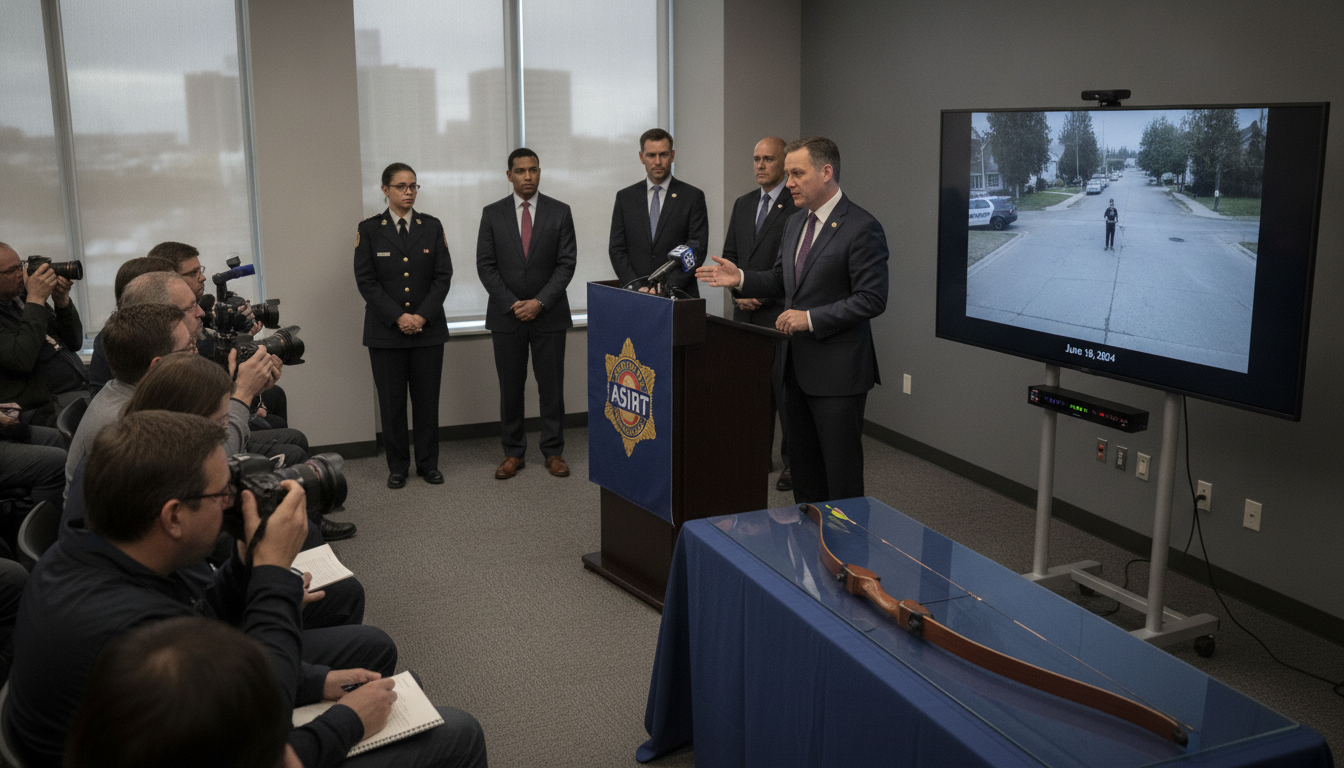
ASIRT details July 30 Calgary police shooting in Bridlewood after bow-and-arrow reports
ASIRT details July 30, 2026 Calgary police shooting in Bridlewood after reports of a man with a bow and arrow; officers used less‑lethal rounds and a pistol.
The Alberta Serious Incident Response Team has released a detailed account of a Calgary police shooting that unfolded shortly before 2 a.m. on July 30, 2026, in the Bridlewood neighbourhood. The Calgary police shooting began after officers responded twice to a home where a man reportedly was shooting a bow and arrow in the backyard, and the man later exited the residence armed with a bow and arrow. ASIRT said officers deployed a police service dog, fired a 40-millimetre less‑lethal impact weapon and then a service pistol in quick succession, and the person was transported to hospital.
ASIRT provides timeline of the Bridlewood encounter
ASIRT’s public summary places the initial police contact on the evening of July 29 and a subsequent response shortly before 2 a.m. on July 30, 2026. The agency said it is withholding specific details about the earlier call to the same address while it continues to gather evidence and interview witnesses.
According to ASIRT, when officers arrived on the second call they located a man inside the home who, by ASIRT’s account, was not permitted to be at the residence and was not supposed to possess weapons. Officers engaged with the person for about an hour, repeatedly asking him to come outside without weapons before he eventually exited through the front door.
ASIRT reported the man left the house carrying a bow and arrow and moved toward officers who were in the driveway, a sequence that led to the deployment of force. The agency’s timeline frames the use of a police service dog and less‑lethal munitions followed by a firearm discharge as actions taken within moments of one another as officers confronted the advancing individual.
Police tactics and weapons used in the confrontation
ASIRT’s account states that officers released a police service dog and then fired a 40‑millimetre less‑lethal impact weapon, a tool often used to stop or distract an advancing subject without resorting immediately to lethal force. The agency said a service pistol was fired in close succession to the less‑lethal round, indicating a rapid escalation of force during the incident.
The sequence described by ASIRT suggests officers used a graduated response, employing canine and less‑lethal tools before discharging a firearm, though ASIRT did not release video or detailed ballistic information in its initial summary. The agency is responsible for independently assessing whether those tactics complied with criminal law and policing standards in Alberta.
ASIRT’s report also notes that officers administered first aid at the scene after the discharge of weapons, actions consistent with emergency medical response protocols that prioritize life‑saving measures. Paramedics transported the injured man to hospital, and ASIRT said the person’s condition was later upgraded from critical to stable.
Injuries, medical care and separate criminal charges
Calgary emergency services transferred the man to hospital in critical condition following the shooting, and ASIRT confirmed health-care teams later upgraded his condition to stable. ASIRT’s summary did not provide identifying details about the man or specify the nature of his injuries beyond the change in medical status.
Separately, Calgary police are pursuing criminal charges against the individual in relation to the circumstances that led to the shooting, ASIRT said, noting that the charges are part of a distinct investigation from the civilian-led probe into the use of force. The existence of parallel investigations—one criminal, one independent civilian review—is typical in Alberta when officers’ actions result in serious injury.
ASIRT will determine whether criminal charges should be recommended against any officer involved, while Calgary police’s criminal case will be handled through the ordinary prosecutorial process if charges proceed. Both inquiries are likely to rely on witness statements, physical evidence and any available recordings from police body cameras or nearby surveillance.
ASIRT’s mandate and the role of independent investigations
The Alberta Serious Incident Response Team is a civilian‑led agency established to independently investigate incidents involving police that result in serious injury or death, or where the actions of officers could constitute criminal offences. ASIRT operates separately from the police service under review to provide an external assessment of the lawfulness of officer conduct.
When ASIRT opens an investigation it assumes control of the scene, conducts interviews, secures potential evidence and will ultimately publish findings or refer matters for charges if warranted. The agency’s involvement in the Bridlewood case means that any conclusions about the use of force will come from a process designed to avoid conflicts of interest inherent when a police service investigates its own officers.
ASIRT’s summary in this matter is an early, public update intended to provide transparency about the sequence of events while the agency completes its full investigation. Further releases from ASIRT can be expected as interviews are completed, forensic work is finished and legal considerations allow more detailed disclosure.
Outstanding questions about the earlier call and threat assessment
ASIRT said officers had attended the same home earlier on the evening of July 29 but did not provide details about that first response, leaving several key questions unanswered. Public interest in the case is likely to focus on what prompted the initial call, what steps were taken during that first contact and whether those actions influenced events in the early hours of July 30.
The presence of a bow and arrow as the reported weapon adds a particular dimension to the inquiry, raising questions for investigators about how officers assessed the level of threat posed by such a weapon and how they planned their response accordingly. Bow-and-arrow incidents are less common in urban policing and can complicate threat assessments because they involve a ranged weapon that is neither a typical firearm nor a blunt instrument.
Investigators will also examine whether de‑escalation options were attempted or remained available during the hour of contact described by ASIRT, and whether communication between officers and the individual met departmental standards for managing armed subjects. Those findings will inform any conclusions about the appropriateness of the tactical choices made on scene.
Community response, transparency and next procedural steps
News of the shooting prompted concern in Bridlewood and among civil‑liberties advocates who regularly call for robust independent oversight of police use of force. Residents and community leaders often press for timely transparency, including the release of body camera footage and full investigative findings, though legal and privacy considerations can delay publication.
ASIRT’s role is to ensure that the investigative record is developed independently and that any criminal or disciplinary questions are resolved through established legal channels. The agency will interview officers, witnesses and first‑responders, and will submit its findings to prosecutors if it determines criminal conduct may have occurred.
Calgary police will continue to pursue criminal charges related to the events that preceded the shooting, according to ASIRT, while the independent probe focuses specifically on the lawfulness of the officers’ actions. Observers can expect a multi‑stage process: evidence collection, interviews, forensic analysis, legal review and then either closure with findings or referral for charges.
Final updates about the case will depend on the pace of ASIRT’s investigative work and on prosecutorial decisions in the separate criminal matter, timelines that can span weeks or months in complex incidents involving multiple forms of force. Community stakeholders have said they will monitor the process closely and advocate for the fullest possible disclosure consistent with legal requirements.
ASIRT’s initial summary of the July 30, 2026 Bridlewood incident indicates a rapid escalation from a prolonged on‑scene contact to the use of canine, less‑lethal and lethal force. The Calgary police shooting prompted immediate medical intervention and an independent review that will examine whether officers’ actions met legal and professional standards. As both ASIRT’s investigation and Calgary police’s criminal proceedings move forward, officials have pledged to provide updates when appropriate and to follow established procedures to determine any further accountability.
