
Calgary traffic safety: Councillor seeks $6M to expand rapid beacons and crosswalk upgrades after recent pedestrian deaths
Ward 8 councillor Nathaniel Schmidt is proposing $6 million from the city’s operating surplus to expand RRFBs, crosswalk upgrades and traffic calming as Calgary traffic safety concerns rise.
Calgary’s rising number of fatal collisions has prompted a Ward 8 councillor to push council for an immediate injection of funds aimed at pedestrian safety. Nathaniel Schmidt’s notice of motion requests $6 million from the 2026 operating surplus to pilot strategic traffic-safety measures across the city. The proposal comes as Calgary records more than 10 fatal collisions this year and faces the prospect of surpassing last year’s total of 38 road deaths.
Councillor’s $6-million motion
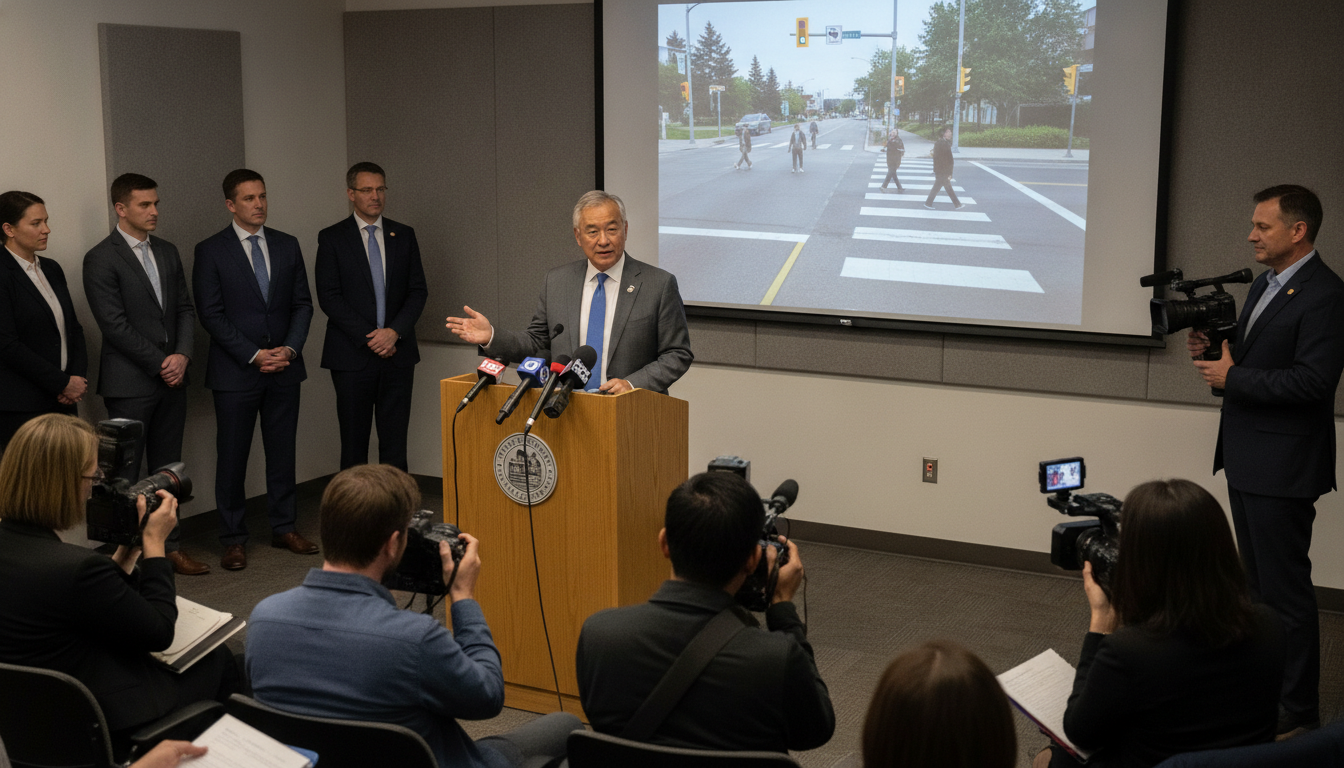
Schmidt told reporters he will ask the executive committee to direct administration to allocate the funds to a suite of pedestrian and street-safety investments. He said the amount was chosen to roughly align with net revenue from traffic enforcement fines and would be distributed equally among Calgary’s 14 wards. The motion asks administration to begin a pilot program immediately and to report back with detailed costs and expected outcomes by September.
The notice of motion also seeks an analysis on redirecting parking enforcement revenue into the city’s five-year safer mobility plan. Schmidt framed the proposal as a near-term response ahead of the broader budget discussions scheduled for November. He argued urgent action is warranted because the city appears to be moving away from the 2024–28 safer mobility plan’s target of cutting serious traffic incidents by 25 per cent year over year.
Details of proposed safety measures
Under the proposal, funds would expand rectangular rapid flashing beacons (RRFBs) at high-use crossings and increase the number of marked crosswalks. The package could also finance speed cushions, curb extensions and crosswalk bump-outs designed to shorten crossing distances and slow vehicles. Schmidt said part of the money would support public education campaigns to improve driver and pedestrian behaviour at intersections.
The motion envisions splitting investment across all wards to allow local priorities to guide installations and to ensure equity in distribution. Officials would be asked to prioritize sites using data on collisions, pedestrian volumes and proximity to schools and transit. Schmidt signalled he wants quick wins that can reduce fatal and serious-injury collisions while longer-term engineering and policy work continues.
Recent fatal collision on Bow Trail
The call for faster action intensified after a collision on Friday at the intersection of Bow Trail and 37th Street S.W. A commercial truck turning into a marked crosswalk struck a woman in her 30s shortly before 3:45 p.m.; she was later pronounced dead in hospital at about 9:30 p.m. Police say the driver, a man in his 60s, remained at the scene while investigators examined the circumstances.
That incident formed part of a cluster of pedestrian collisions over four consecutive days that involved six people, underscoring councillors’ concerns about a worsening pattern. Schmidt said the Bow Trail case — where initial findings indicate neither impairment nor excessive speed — reinforced the view that some intersections are inherently dangerous and need engineering fixes. He noted the combination of high pedestrian use and fast-moving traffic at certain crossings elevates the risk of severe outcomes.
City data and trends driving urgency
Calgary recorded 29 fatal collisions in 2024, including 13 pedestrians, the highest toll since 2013 at the time, and the momentum has continued into 2026. With more than 10 fatalities already this year, the city is tracking toward potentially exceeding last year’s total of 38 deaths on the roads, which included 15 pedestrians. Those numbers have prompted councillors and safety advocates to press for accelerated investment and new enforcement tools.
Councillors point to several contributing factors: rapid population and traffic growth, evolving street use patterns, and changes to enforcement regimes such as the loss of photo radar. Schmidt said reduced street-level enforcement has diminished deterrence and that engineering upgrades must be paired with education and targeted enforcement for maximum effect. City staff have also been developing analytical tools, including an artificial intelligence platform that uses predictive modelling to identify high-risk crosswalks and intersections before incidents occur.
Council timeline and next steps
Schmidt’s notice of motion is slated for a technical review by council’s executive committee on Tuesday, June 9, 2026, with the first formal council consideration scheduled for the regular meeting on June 30, 2026. Meanwhile, council’s community development committee is due to receive an update on Wednesday, June 10, 2026, about the AI platform intended to help target safety investments. If the executive committee approves moving the motion forward, administration will be asked to begin the pilot and prepare the September report detailing costs, benefits and expected outcomes.
The proposal’s rapid timeline reflects a desire among some councillors to act before the municipal budget cycle later this year. However, any reallocation of surplus funds and shifts in enforcement revenue will require staff analysis and council approval. Officials will need to balance short-term interventions with the longer-term Safer Mobility Plan, which sets multi-year targets for reducing serious collisions across the city.
Calgary now faces a choice between incremental measures and a more accelerated, citywide safety push; the coming committee and council meetings will determine whether the $6-million pilot proceeds. The proposal aims to pair targeted engineering upgrades with data-driven site selection and public education, while the city’s work on predictive tools continues to evolve. The final decision will shape immediate investments at intersections across Calgary and could signal whether council is prepared to use surplus funds to tackle a growing traffic-safety crisis.
