
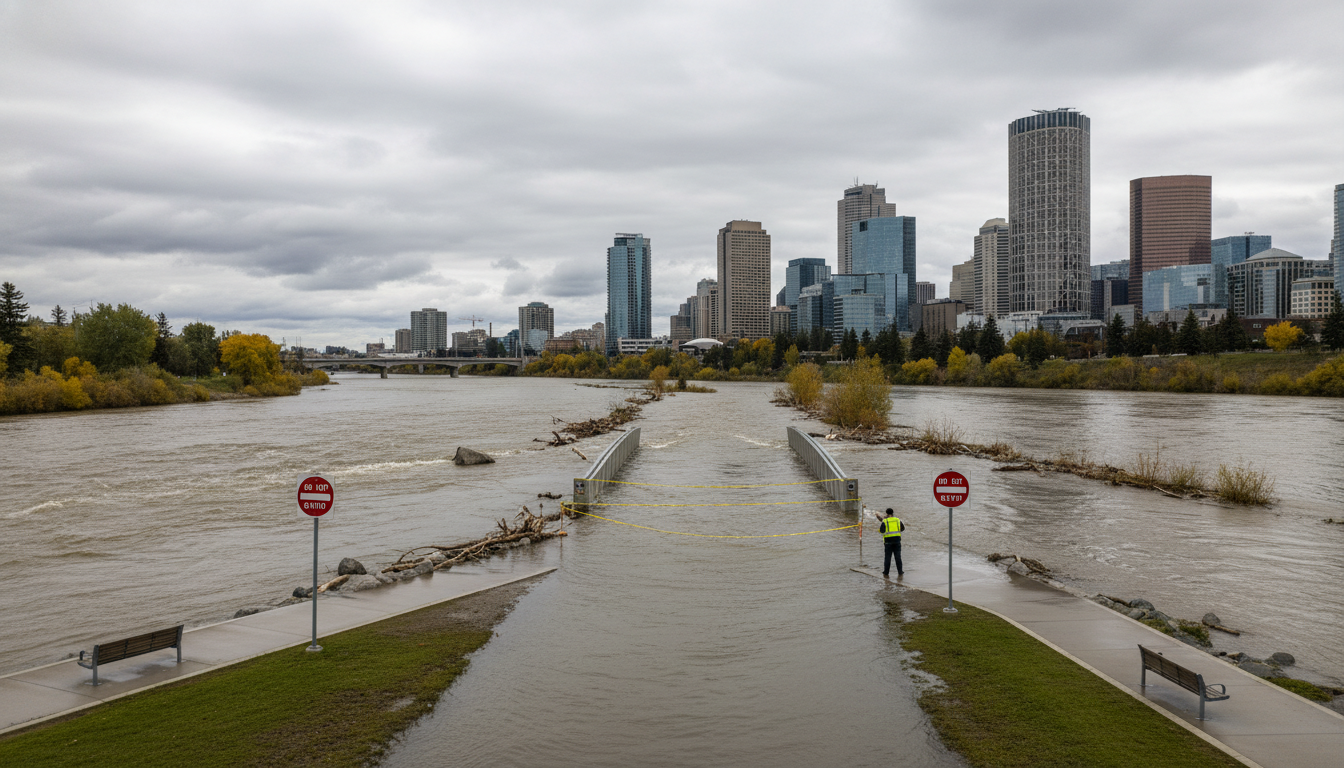
Calgary river levels to crest Tuesday as city warns of fast, cold flows
Calgary river levels are expected to crest Tuesday as crews monitor heavy rain; boating advisory and pathway closures active while reservoirs reduce flood risk.
Rivers forecast to crest Tuesday
Calgary river levels are projected to peak sometime Tuesday as municipal crews continue to track rainfall and streamflow data across the Bow and Elbow River catchments. City officials say the current weather system has produced significant precipitation since Saturday and that flows will continue to rise into the day.
Forecasters reported between 40 and 80 millimetres of rain across the city and upstream watersheds, with localized totals higher in some catchments. The city warned that an additional 70 millimetres of rain could fall through mid-day Tuesday in parts of the region, contributing to the expected crest.
The municipal update notes cooler temperatures in the mountains have slowed snowmelt, and precipitation at higher elevations has fallen as snow. That mix of rain and reduced snowmelt is moderating streamflow increases compared with a pure rain-and-melt event.
Rainfall, snowpack and flow dynamics
Meteorological officials and city hydrologists emphasize that both precipitation intensity and snowpack condition determine river response. Rain that falls on saturated soils or on a melting snowpack can rapidly convert to runoff, but colder alpine temperatures have kept some precipitation as snow this round.
Lower-elevation catchments received steady rain, while higher elevations recorded cooler conditions that limited melt contribution to streamflow. The combined effect has reduced the velocity and volume of runoff compared with scenarios when heavy rain overlays rapid snowmelt.
City hydrology teams are using continuous monitoring of river gauges and weather stations to model the expected crest and to update response plans. Those models incorporate reservoir operations and recent changes in watershed storage to refine peak flow estimates and downstream impacts.
Boating advisory issued as flows exceed safety threshold
The City of Calgary has issued a boating advisory and urged the public to avoid rivers, citing dangerous currents, cold water and visible erosion along riverbanks. Public safety personnel stressed that the rivers are not safe for recreation while flows remain elevated and turbid.
Under city policy a boating advisory is triggered when river flows exceed 280 cubic metres per second, and recent measurements have recorded flows above 360 cubic metres per second. Fire and rescue officials warned that swift currents and debris make self-rescue unlikely and complicate professional rescue operations.
Calgary Fire Department public information officers urged residents to stay off river pathways and to keep a safe distance from fast-moving water. They also reminded the public that if someone unexpectedly ends up in the water, the appropriate response is to call 911 immediately and let trained crews handle the rescue.
Pathway and bridge closures across the city
As a precaution, municipal crews have closed multiple riverfront pathways and underpasses along both the Elbow and Bow Rivers. Closures include the 25 Avenue underpass, the CNR Bridge underpass, sections of MacLeod Trail, and several north bank underpasses and bridges on the Bow River.
City staff also closed pathways at Bowmont Park, the north channel bridge and the north bank at the Calgary Zoo, citing erosion and unsafe footing near river edges. Some north-side pathways at St. Patrick’s Island and other low-lying recreation routes have also been restricted to public access.
Officials said the closures are preventative measures to limit public exposure to unsafe conditions and to protect corridors where riverbank erosion or debris could undermine infrastructure. The city will continue to assess and reopen pathways as water levels recede and inspections confirm they are safe.
Reservoir operations and infrastructure lowered the risk
Municipal authorities highlighted the role of reservoir operations in reducing flood risk during this weather event. The Glenmore Reservoir and TransAlta’s Ghost Reservoir were lowered to expand storage capacity ahead of the crest, a tactical move designed to attenuate downstream flows.
City statements said the forecasted river flows from the current event are not expected to produce widespread overland flooding and will remain well below the peaks seen in 2013. Officials estimate anticipated flows are less than a quarter of the peak volumes recorded during the 2013 floods.
Since 2013, governments at the federal, provincial and municipal levels invested more than $1.3 billion in flood resilience measures, according to the city. That program includes new reservoir storage, pumping stations, community-scale flood barriers, stormwater outfall gates and riverbank protection works.
What has changed since 2013 and why it matters
City engineers pointed to major projects completed since 2013 that have materially reduced Calgary’s exposure to the sort of extensive damage seen in that historic event. Investments in forecast and monitoring technology, as well as hard infrastructure, were specifically designed to limit both chance and consequence of large floods.
Officials say more than 70 per cent of the damage potential that existed in 2013 has been eliminated through these combined measures. The improvements, they add, allow for more proactive operations of reservoirs and targeted deployment of temporary barriers if conditions were to worsen.
Those measures do not eliminate risk entirely, but they change the range of plausible outcomes and provide emergency managers with more options. The city emphasized that continued monitoring, preparedness and public cooperation remain critical during each spring runoff and heavy rain season.
Emergency response, rescues and public guidance
Fire crews responded to a water-related incident Monday afternoon at Harvie Passage along the Bow River after receiving a call about kayakers in the water. Officials reported that although crews were dispatched, the group did not require rescue and were able to get to safety.
Authorities reiterated that river conditions are unsuitable for most recreational uses and that kayaks, canoes and small craft face heightened risk in cold, murky, fast-moving water. Public information officers stressed that the recreational benefits of river use are outweighed by the hazards during elevated flows.
Residents are being asked to avoid riverbanks, obey posted signs and respect closures, and to report any dangerous conditions to the city. Emergency services encouraged people to plan alternate outdoor activities away from the river and to keep pets and children well clear of waterfront areas.
Short- and longer-term outlook for Calgary waterways
City hydrologists expect river levels to begin falling after the crest passes, provided no additional heavy precipitation occurs and upstream storage operations hold. The timing and pace of the fall will depend on ongoing rainfall, temperature trends and reservoir management decisions in the coming days.
Officials cautioned that even after peak flow, the rivers will remain cold, fast and turbid for some time, and erosion-scarred banks may present hazards that persist beyond visible high water. Ongoing inspections of bridges, underpasses and pathways will determine when it is safe to reopen public access.
Longer-term, city planners said the current event underscores the value of investments in flood infrastructure, monitoring and community preparedness. They urged residents to remain informed about municipal alerts and to sign up for official notifications that will provide updates as conditions evolve.
Calgary’s emergency management teams said they will continue to coordinate with provincial utilities and reservoir operators to manage flow and storage. Municipal authorities stressed that their planning assumes the possibility of escalating conditions, and that contingency measures remain on standby.
The city’s public messaging emphasized common-sense precautions: stay away from riverbanks, respect closures, call 911 in an emergency and avoid attempting rescues yourself. Officials said these steps reduce risk to both the public and first responders and enable emergency services to focus resources where they are most needed.
Municipal crews will continue to monitor river gauges and weather forecasts throughout the week and will issue public updates as new information becomes available. The city reiterated that while widespread flooding is not expected from this event, localized hazards and erosion remain real and require caution.
Community organizations and park staff are coordinating to assess trail and infrastructure damage once flow rates decline. Inspection teams will prioritize high-use recreational corridors and critical crossings before reopening them to the public.
Residents seeking the latest information were reminded to rely on official city channels for closures, advisory updates and safety guidance. City officials said that transparent, timely updates help residents make safe choices while municipal teams manage operations on the ground.
While the current crest is expected to be manageable, emergency managers said they will maintain heightened readiness through the remainder of the weather event. That readiness includes boats and water rescue teams positioned for rapid deployment should conditions unexpectedly deteriorate.
Public safety messages reflected a simple, repeated theme from officials: the rivers are hazardous now and the safest course is to avoid them. Calgary residents and visitors were urged to heed that advice to protect both themselves and emergency responders.
