
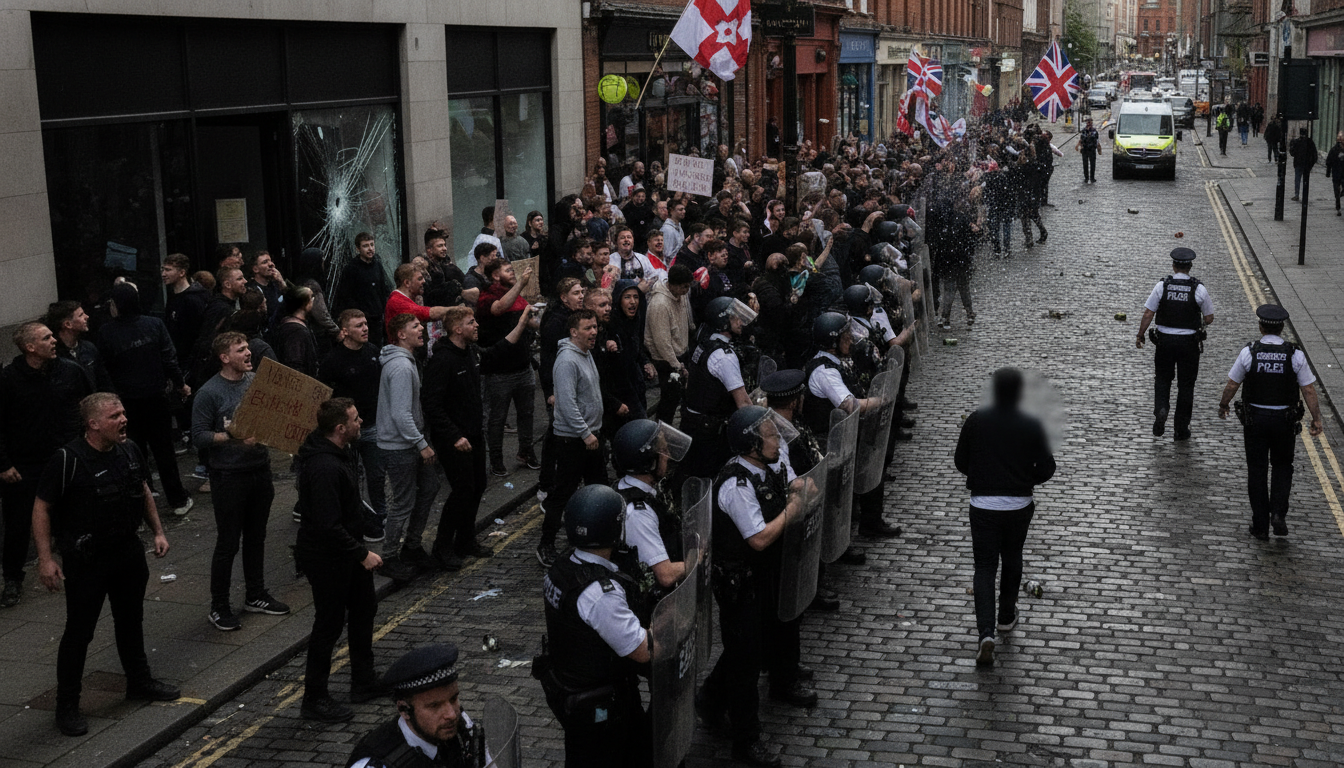
Belfast anti-immigration protests spark riots after knife attack, prompting arrests and national backlash
Belfast anti-immigration protests erupted this week after a violent knife attack, leading to arson, road blockades and mass evacuations as authorities sought to restore order. The unrest has reignited debates over asylum policy and online radicalization while police investigate the assault and subsequent disorder. Officials warned against racist intimidation and urged communities to resist attempts to inflame tensions.
Violence erupts in east Belfast after knife attack
Hundreds of people, many with their faces covered, took to streets late Tuesday in east Belfast, blocking roads and setting cars and some buildings alight. Police ordered evacuations in neighbourhoods near the disturbances as emergency services worked to secure the area and clear debris.
The unrest followed a stabbing on Monday in which a man in his 40s suffered repeated slash wounds to his head and neck and was left seriously injured. Officers declared a critical incident as they arrested a suspect and moved to disperse gatherings that had become violent.
Suspect charged and immigration status disclosed
A 30-year-old man has been charged with attempted murder, possession of an offensive weapon in public and making threats to kill in connection with the assault. Authorities said he was detained shortly after the attack and remains in custody pending further court action.
Police and the UK Home Office confirmed the suspect arrived in the United Kingdom in 2023 via routes through Paris and Dublin, and held a legal residence permit that authorities say runs until 2028. Officials have emphasised that the investigation is ongoing and cautioned against drawing broader conclusions about migrants from a single criminal case.
Police response and public-safety measures
The Police Service of Northern Ireland (PSNI) increased patrols across affected communities and worked overnight to restore public order after confrontations with masked demonstrators. Officers urged people to avoid sharing graphic footage of the stabbing, citing public safety and the need to protect the investigation.
Authorities also warned that social media was being used to coordinate further protests and to amplify violent content, complicating efforts to calm the situation. Local emergency services described a difficult night as firefighters and ambulances navigated blocked streets and burning vehicles.
Political leaders condemn violence, far-right voices press for answers
Northern Ireland’s first minister called the riots “nothing less than disgusting cowardice,” denouncing racially motivated intimidation and violence. Other politicians from across the spectrum demanded answers about the attacker’s status and urged that the criminal justice process take its course.
At the same time, prominent anti-immigration figures and some populist commentators seized on the incident to criticise national asylum policy, while overseas voices and influencers amplified the coverage. Government ministers warned that political opportunism and external interference risked deepening divisions at a fragile moment.
Online amplification and organised agitation
Officials and academics pointed to the rapid spread of incendiary material on platforms such as X and other channels as a key factor that transformed local anger into street-level disorder. Several accounts linked to hard-right activists circulated footage and calls to protest, and public figures reposted material that further inflamed sentiment.
Northern Ireland’s justice minister blamed “bad faith actors” who had encouraged people to take to the streets and said the violence represented a deliberate attempt to weaponise legitimate community concerns. Experts cautioned that even a relatively small, determined minority online can mobilise real-world harm when targeting vulnerable communities.
Surge in racially motivated incidents across Northern Ireland
Human rights groups have warned for months about rising race-related hostility in the province, documenting an increase in incidents and crimes linked to ethnicity. Amnesty International reported thousands of racist incidents and a significant number of race-hate offences in the year to late 2025, stressing that each statistic represented a person or family left living in fear.
The spike in hate incidents has coincided with political debates over immigration and has been seized upon by parties on the hard right in recent local elections. Critics say inflammatory rhetoric and misinformation have contributed to a climate in which migrants and minority communities are being scapegoated for wider social problems.
Troubles-era divisions and local vulnerabilities resurfacing
Scholars warn that the current unrest cannot be separated from Northern Ireland’s historical sectarian divide and its legacy of conflict. Areas with entrenched economic deprivation, high unemployment and deep social fractures are seen as particularly susceptible to flare-ups when triggered by a high-profile crime.
Academics also note that narratives blaming the border with the Republic of Ireland as a corridor for migrants are resurfacing long-standing identity tensions between unionist and nationalist communities. Without concerted political leadership and community-level outreach, experts say, the conditions exist for further episodes of intimidation and targeted violence.
Community leaders and policing officials have stressed the need for restraint as investigations continue and court proceedings move forward. They urged politicians, the media and civic groups to avoid inflammatory language and to prioritise the safety of vulnerable residents while the criminal justice system addresses the stabbing and its aftermath.
The police investigation remains active and security operations continue across Belfast as authorities seek to prevent further disorder, support the injured and hold those responsible to account.
