
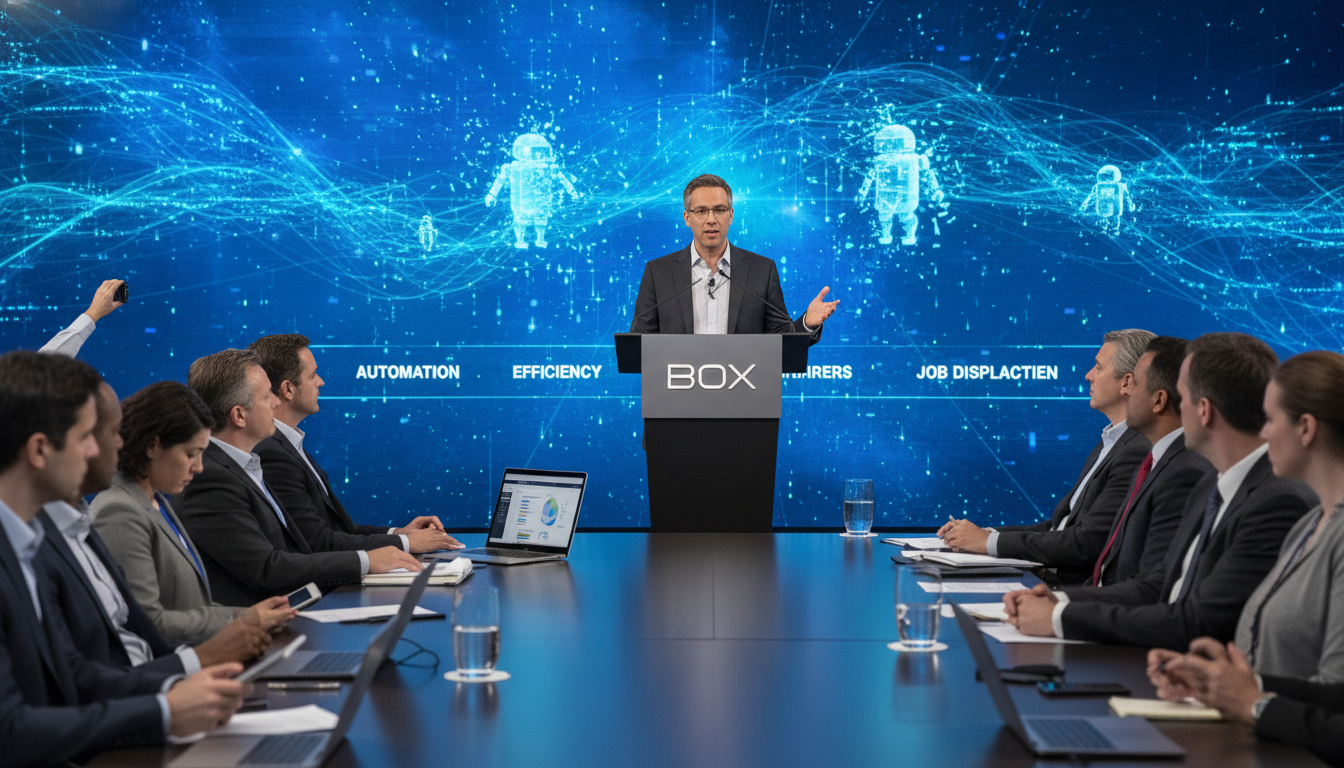
AI layoffs escalate as leaders clash over whether automation can replace jobs
Box founder Aaron Levie warns of "AI psychosis" as AI layoffs accelerate; ClickUp cuts 22% while DuckDuckGo installs climb and Waymo rolls out a robotaxi.
The debate over AI layoffs has sharpened after Box founder Aaron Levie accused some tech leaders of suffering from “AI psychosis,” arguing that executives who champion replacing employees with automation often lack a granular understanding of the roles they displace. Recent moves in the sector, including ClickUp’s decision to cut roughly 22% of its workforce to focus on AI agents, have intensified concern about how companies are implementing automation. Meanwhile, user reactions in adjacent markets and high-profile product rollouts are reshaping the public conversation about AI, employment and product strategy.
Levie says executives misjudge the complexity of work
Aaron Levie has criticized a trend in which senior executives declare that AI can supplant whole categories of work without consulting subject-matter experts who do the work day to day. He framed that disconnect as symptomatic of a broader cognitive bias among leaders who are enamored with the potential of AI but disconnected from operational realities. That critique has resonated with employees and observers who see a pattern of top-driven automation that underestimates human judgment, context and tacit knowledge.
The remark underscores an important governance question for companies pursuing AI: who at the firm evaluates the trade-offs between cost reduction and the risk of eroding institutional competence? The answer affects not only individual workers but also product quality, customer relationships and long-term innovation capacity.
ClickUp reduces headcount by about a fifth to build AI agents
Project-management platform ClickUp recently announced a reduction of roughly 22% of its workforce, describing the move as part of a strategic shift toward developing AI-driven agents and automation features. Company leaders framed the layoffs as a reallocation of resources toward engineering and product work tied to machine intelligence. Employees and recruiters have characterized the move as emblematic of a new wave of restructuring in which companies trade broad human teams for smaller, technically focused units.
The ClickUp example has become a touchstone in debates over AI layoffs because it explicitly links job cuts to a defined AI product roadmap. Critics say such transitions risk losing domain expertise that is difficult to encode, while proponents argue the change is a necessary evolution to stay competitive in a rapidly changing software market.
Industry layoffs in 2026 are tracking last year’s total
Data points and industry commentary indicate that tech layoffs in 2026 are approaching the total level seen across all of 2025, reflecting sustained reordering within the sector rather than a short-lived correction. Companies large and small are reassessing cost structures, and a subset of those decisions explicitly cites AI and automation as drivers for headcount reductions. This pattern suggests firms are moving from exploratory AI projects to operationalizing automation in core functions.
The consequence is a bifurcated labor market: roles centered on building and maintaining AI systems are in demand, while many operational and middle-office roles face heightened risk. Policymakers, educators and firms are being pressed to respond quickly with retraining programs and clearer transition pathways for affected workers.
Users push back as DuckDuckGo downloads rise amid search changes
Consumer sentiment toward how major platforms integrate AI has become a salient factor in the market, with privacy-oriented alternatives reporting meaningful adoption gains. DuckDuckGo, for instance, has seen a noticeable uplift in installs as some users seek search experiences that emphasize links and privacy rather than integrated AI-generated answers. That uptick is being interpreted as a user-led corrective to what some perceive as heavy-handed AI integration into core internet services.
This pushback complicates the narrative that AI integration is an unalloyed user benefit. For product teams, the lesson is that aggressive automation at the interface layer can provoke consumer resistance and open opportunities for competitors that position themselves as simpler or more respectful of user preferences.
TechCrunch’s Equity podcast frames the debate and highlights deals
Industry commentators on TechCrunch’s Equity podcast have been parsing how both the AI-pilled and the AI-skeptical can be “right at the same time,” noting instances where automation delivers efficiencies alongside examples where it creates new operational fragilities. The conversations have also drawn attention to deal activity in the space, with several financing and acquisition moves signaling where investors believe value will accrue. These discussions emphasize that the trade-offs of AI adoption are being negotiated not only inside companies but also across markets and capital flows.
Podcasts and trade coverage are playing a role in shaping public understanding by spotlighting concrete company actions, investor priorities and regulatory concerns as they emerge. That reporting helps translate abstract debate into tangible benchmarks that executives and workers can use to gauge risk.
Waymo’s robotaxi debut illustrates AI’s commercial trajectory
Meanwhile, product milestones like Waymo’s latest robotaxi deployment demonstrate how AI is moving into real-world services with direct implications for jobs and urban mobility. The rollout highlights both technological progress and the complex ecosystem requirements—regulatory approvals, maintenance networks, insurance frameworks and local partnerships—that accompany commercial AI deployments. These operational layers are often cited by skeptics as evidence that human expertise remains indispensable even as automation advances.
As autonomous vehicles expand their footprint, the industry will have to reconcile potential labor displacement with new job creation in oversight, fleet operations and infrastructure support.
The unfolding debate over AI layoffs and automation is not a simple binary between progress and peril; it is a series of choices about how companies achieve productivity, how workers are supported through transitions, and how consumers are allowed to opt into or out of AI-powered experiences. Public and private stakeholders will need to coordinate on retraining, governance and transparent impact assessments to ensure automation enhances rather than imperils economic resilience.
