
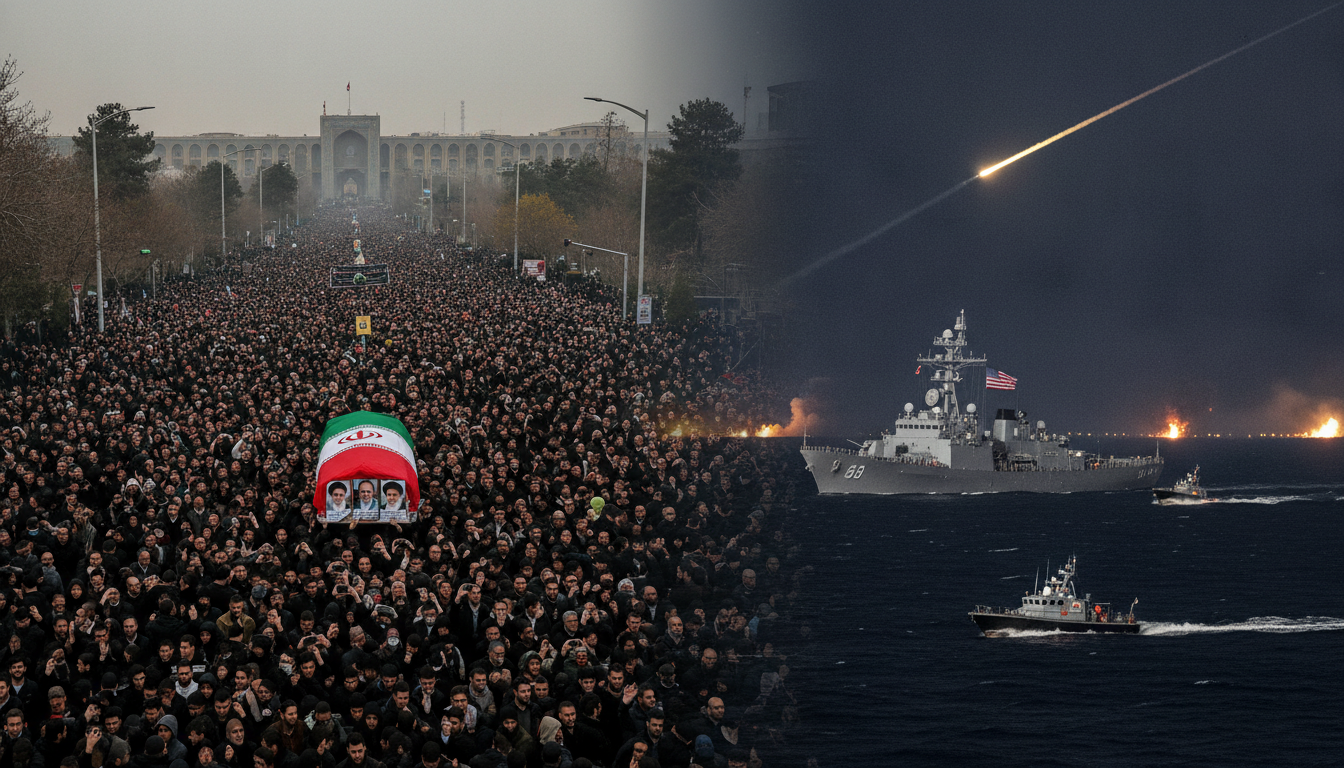
US strikes Iran again as Tehran retaliates against Gulf bases during Khamenei funeral week
US strikes Iran: fresh U.S. air attacks struck scores of military sites early Wednesday, drawing Iranian reprisals on Gulf bases and sending oil markets higher. (ksat.com)
U.S. forces strike roughly 90 Iranian military targets
The U.S. military said it launched a new round of airstrikes against Iran intended to degrade Tehran’s ability to threaten shipping in the Strait of Hormuz. CENTCOM released footage and said the operations struck coastal surveillance sites, air-defence systems and missile and drone storage facilities. (ksat.com)
Iranian state media reported explosions in several southern coastal cities including Bandar Abbas and Bushehr, and local officials described damage to infrastructure near key ports. Independent military sources and U.S. officials said the strikes followed a series of incidents in which commercial vessels were attacked in and around the strait. (abc7news.com)
Tehran attacks Gulf allied bases and commercial shipping
In response to the U.S. strikes, Iran’s Islamic Revolutionary Guard Corps and parts of Iran’s regular armed forces said they launched missiles and drones at military installations in Bahrain and Kuwait, and issued warnings affecting Qatar. Regional authorities reported intercepts and air-raid sirens, though early reports indicated limited, if any, damage to large facilities. (ksat.com)
Kuwaiti and Bahraini officials said they had taken defensive measures and that air-defence forces were active, while some commercial shipping reported heightened risk and temporary route disruptions in the Gulf. The exchanges underscore how quickly localized strikes can ripple across a congested maritime chokepoint vital to global energy flows. (brecorder.com)
Funeral of Ayatollah Ali Khamenei proceeds amid strikes and mass mourning
Funeral processions for Iran’s late supreme leader continued this week, drawing large crowds to Tehran, Mashhad and to pilgrimage sites in Iraq as state and religious authorities held multi-day ceremonies. Authorities had planned the burial events after a series of public commemorations, even as security officials warned of possible disruptions amid the renewed fighting. (aljazeera.com)
State broadcasters and witnesses described long lines of mourners and heavy symbolic displays at shrines and procession routes, and Iranian officials said some transport links were temporarily suspended for security reasons. Iranian authorities have framed the funerals as both a religious duty and a demonstration of national unity during the conflict. (aljazeera.com)
Ceasefire agreement put under strain after new exchanges
Diplomats had reported an interim protocol signed in mid-June intended to limit hostilities and open a path to broader negotiations, but U.S. officials and the White House signalled that the pause was fragile. President Donald Trump publicly declared the interim deal “over” after what he described as renewed Iranian attacks on shipping and U.S. sites, and he warned of further U.S. action. (brecorder.com)
Both sides continue to claim their steps are defensive and proportionate, with Iranian negotiators saying Tehran will control passage through the Strait of Hormuz on its own terms. Analysts warn that a pattern of tit-for-tat strikes risks wider escalation unless third-party mediators regain traction in talks. (brecorder.com)
Regional and economic fallout: oil prices and shipping disruptions
Markets reacted swiftly to the renewed hostilities, with crude benchmarks rising on fears of supply disruption through the Hormuz bottleneck. Traders and energy analysts pointed to an uptick in Brent futures as the exchanges intensified concerns about safe passage for tankers and LNG shipments through the Gulf. (the-independent.com)
Shipping insurers and maritime agencies issued advisories and re-routed some commercial traffic; at the same time, energy firms and national producers signalled contingency plans to mitigate short-term supply risks. Economists said sustained instability would lift freight and insurance costs and could push fuel prices higher for consumers if the situation persists. (invezz.com)
International responses and calls for restraint grow
Governments and international organisations urged restraint while some Western capitals reiterated support for navigational freedom in the Gulf. Diplomatic sources said back-channel efforts were underway to calm tensions and restore the interim arrangements that had briefly reduced the intensity of attacks. (brecorder.com)
Regional mediators and neighbouring states pressed for de-escalation even as they scrambled to assess damage and reassure domestic populations. Analysts cautioned that public anger and calls for vengeance inside Iran, fuelled by the funerals of the late leader, complicate the political environment for negotiators. (aljazeera.com)
The renewed U.S. strikes and Iranian reprisals have again exposed how fragile the ceasefire has become and how quickly the conflict can affect commercial passage and global markets. Continued diplomatic engagement will be critical to prevent further escalation while governments work to protect civilians, maintain critical maritime routes and stabilise regional economies.
