
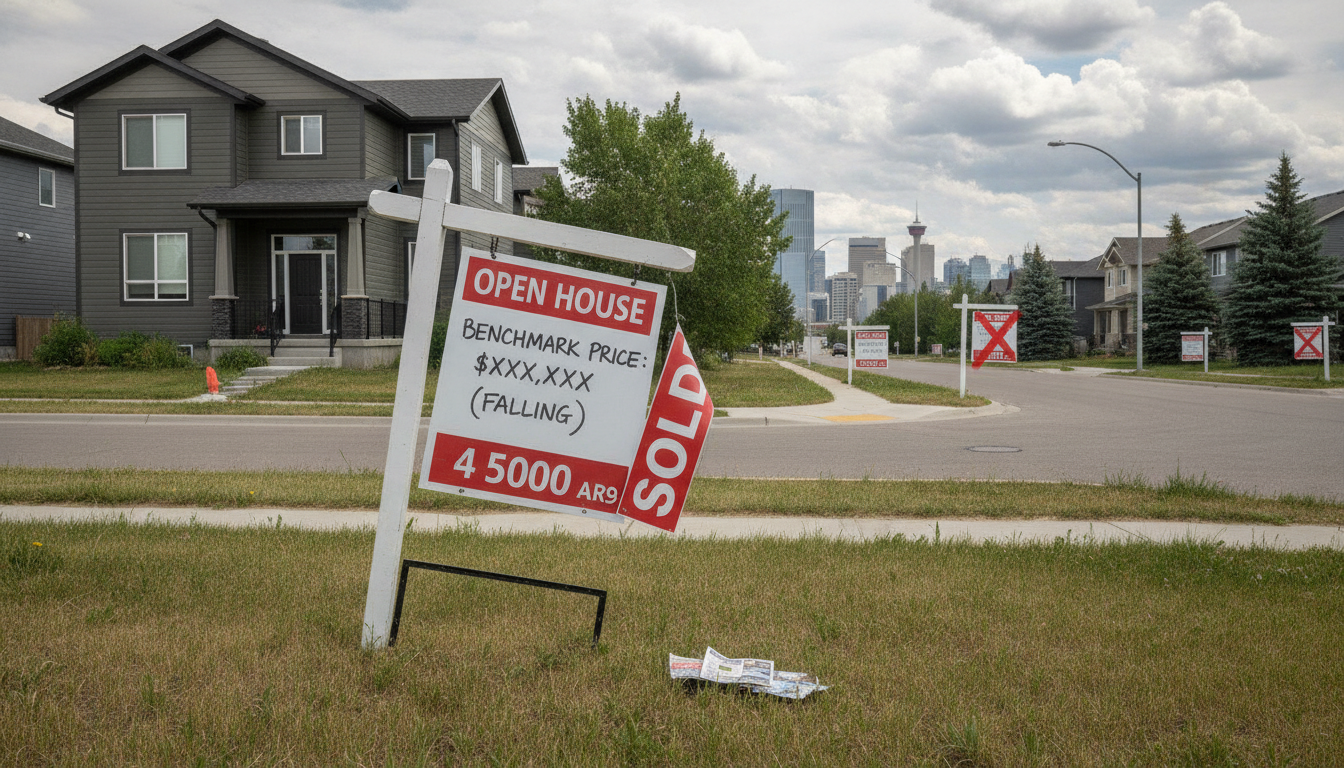
Calgary real estate posts June decline as benchmark price drops to $572,500
Calgary real estate saw June sales fall 3.8% and the residential benchmark price decline 2.1% to $572,500, with apartments and row homes hardest hit amid lower migration.
The Calgary housing market eased in June, with 2,197 homes sold and the residential benchmark price slipping to $572,500, according to the Calgary Real Estate Board.
That represents a 3.8 per cent drop in transactions compared with June 2025 and a 2.1 per cent decrease in the benchmark price over the same period.
Market officials said the changes reflect subdued demand as population inflows slow, cutting into interest for both high-density ownership and rental options.
The board’s chief economist, Ann‑Marie Lurie, pointed to lower migration as a primary factor behind the softer sales and particular weakness in apartment-style and row-style segments.
June sales decline 3.8% while benchmark price falls to $572,500
The Calgary Real Estate Board recorded 2,197 residential sales in June, down from the same month last year.
That decline in activity coincided with a benchmark price reduction of 2.1 per cent, placing the citywide benchmark at $572,500.
Officials said those citywide figures mask sharper moves in some housing segments, even as overall supply has not surged.
The board’s report frames June as a modest cooling phase rather than a market collapse, with price changes concentrated in higher-density product types.
Apartment and row prices lead year‑over‑year declines
Apartment-style homes experienced the steepest year‑over‑year drop, with a benchmark price down approximately nine per cent to $299,000.
Row-style properties also posted notable declines, falling 5.5 per cent to $424,100.
CREB economists highlighted that both apartment and row housing are more sensitive to shifts in migration and rental demand, making them vulnerable when population growth softens.
Buyers who target lower-priced and higher-density units have become fewer, which has translated into downward pressure on these sub-sectors.
Detached and semi‑detached segments show mixed outcomes
Detached homes were less affected by the June slowdown, with the benchmark price down 1.4 per cent to $750,500.
Semi‑detached homes bucked the trend with a slight increase, edging up 0.2 per cent to $694,600 compared with June 2025.
Analysts say these variations reflect differing buyer pools and supply dynamics across property types.
Detached homes continue to draw purchasers seeking yard space and single-family characteristics, while semis can attract buyers seeking a middle ground between detached and multi-family living.
New listings fall 7.7% while total inventory narrows to 6,799 homes
Despite weaker sales, new listings on the market in June totaled 3,899, which is 7.7 per cent fewer than the same month last year.
Total inventory declined modestly to 6,799 homes for sale, down 2.1 per cent year‑over‑year.
The dual movement of falling sales and falling listings has helped prevent a large build-up of unsold stock.
Market watchers said the tighter flow of new supply may have limited downward price momentum even as demand softened.
CREB attributes softness to lower migration and reduced rental market activity
The Calgary Real Estate Board and its chief economist, Ann‑Marie Lurie, directly connected the June moderation to lower migration levels.
Lurie said the drop in newcomers has dampened demand for both ownership of high-density homes and rental units, slowing turnover and price growth.
Lower migration affects a range of market participants, from first‑time buyers to investors, and can reduce the pool of prospective tenants supporting purpose‑built rentals.
CREB’s assessment underscores how demographic trends can have immediate effects on housing segments that depend on population inflows for demand.
What the June numbers mean for buyers, sellers and investors
For prospective buyers, the June data signal more negotiating room in specific segments, particularly apartments and row-style homes that led price declines.
Buyers with flexibility on timing may find opportunities in those product types as sellers adjust expectations to the current demand environment.
Sellers should be aware that list prices may need to be aligned with localized market conditions, especially for condominiums and stacked‑townhouse inventory.
Investors focused on rental income should monitor tenant demand and vacancy trends closely, since a weaker migration backdrop can pressure rents and occupancy in higher-density buildings.
Local economic context and short‑term outlook for Calgary housing
While CREB pointed to lower migration as a central factor, the market’s near‑term course will also depend on employment trends, wage growth and broader regional economic performance.
Municipal development patterns and new construction activity will play a role in how supply and demand rebalance over coming months.
Market participants and analysts expect continued segmentation: some neighbourhoods and housing types will remain resilient, while others may see longer price adjustments.
Monitoring monthly CREB releases will be essential to track whether June’s cooling is a short pause or the start of a more sustained shift.
How the shifts affect neighbourhoods and affordability concerns
Sharper declines in apartment and row prices could yield more entry points for first‑time buyers seeking affordable ownership alternatives within the city.
However, falling values in those segments may also complicate choices for owners who had relied on rapid appreciation to build down‑payment capacity.
Neighbourhoods dominated by multi‑unit buildings could experience more active marketing and incentive programs from sellers and developers attempting to move inventory.
Policymakers and housing advocates will likely watch how changes in migration and supply interact with affordability pressures for renters and lower‑income households.
Calgary’s residential market showed a measurable cooling in June, with officials pointing to lower migration as a key driver behind softer sales and price declines in specific segments.
The Calgary Real Estate Board reported 2,197 transactions, a 3.8 per cent drop from June 2025, and a citywide benchmark price of $572,500, down 2.1 per cent year‑over‑year.
Apartment and row-style properties exhibited the largest declines, while detached homes were only modestly lower and semi‑detached prices saw a small gain.
New listings fell by 7.7 per cent to 3,899 and total inventory narrowed to 6,799, tempering some downward price pressures by keeping unsold stock from swelling.
For buyers, sellers and investors the key message is segmentation: where you buy and what you sell will matter more than ever in determining outcomes.
Close attention to neighbourhood‑level data and the Calgary Real Estate Board’s monthly reports will be necessary to understand evolving risks and opportunities in the months ahead.
