
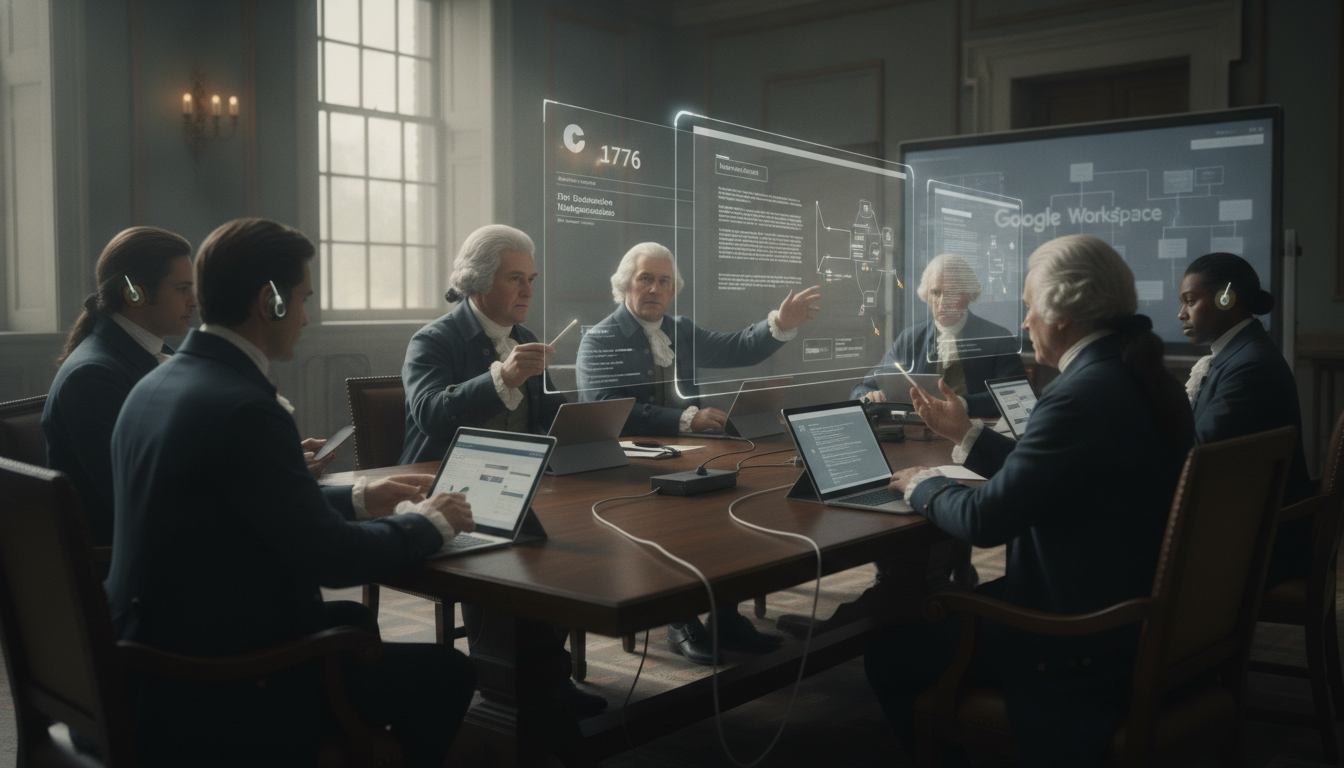
Google Workspace ad imagines Founding Fathers drafting Declaration with AI tools
A new Google Workspace ad reimagines the drafting of the Declaration of Independence and asks what would have happened if the Founding Fathers had modern productivity tools. The spot — promoted under the tagline “Group project, but make it 1776” — places Google Docs, Calendar, Meet and Google’s Gemini assistant at the center of a tongue‑in‑cheek collaboration. The commercial also weaves in a handful of AI features, from imagery prompts to automated meeting notes, while stopping short of suggesting the technology rewrote the historic text.
Founding Fathers meet Google Workspace
The ad opens on a fictionalized Thomas Jefferson mid‑draft when a persistent message from Benjamin Franklin nudges the process into a collaborative workflow. Edits appear in Google Docs, a meeting is scheduled in Calendar and participants join remotely via Google Meet, creating a modern backchannel for the eighteenth‑century delegates. The sequence ends with e‑signatures and celebratory fireworks, positioning the product suite as the organizational backbone of a seminal political moment.
AI features presented in modest roles
Rather than centering AI as the star, the commercial treats generative tools as assistants to human decisions. The spot shows a “help me visualize” feature used to test animals for the proposed national seal, and Google’s Gemini is depicted taking notes during the meeting. Delegates consult a chatbot for counsel and then reject a fictional request from King George III for access to the document, signaling limits to automation in matters of sovereignty and trust.
Production choices spark debate about authenticity
Viewers and critics have pointed to an uncanny visual quality in portions of the ad, prompting speculation that some footage was AI‑generated or heavily processed. The marketing team’s choice to keep many Meet cameras dark and to deploy light, comedic touches — including a line where Sam Adams asks, “Can we settle this over beers?” — underscores the ad’s intention to be playful rather than reverent. Still, choices about visual style and the portrayal of AI have become focal points for commentary.
Public reaction splits by platform
Responses on video and social platforms have been mixed. Comments on YouTube and Instagram skew positive, with many users praising the creativity and humor of the premise. By contrast, conversations on Bluesky and similar forums skewed critical, using terms such as “cringey” and “tone deaf” while interrogating the role of AI in historical storytelling. Prominent online voices and historians weighed in, amplifying the split between amusement and unease.
Historians and critics question AI’s civic role
Several scholars cautioned that a commercial framing of AI as a civic collaborator risks overstating its value for political organizing and public deliberation. Historian Angus Johnston, quoted in public commentary, argued that even in a lighthearted scenario it is “impossible to make the case that AI is a useful tool for political organizing, writing, or human collaboration.” That critique reflects broader concerns about transparency, accountability and the appropriateness of machine assistance in tasks that shape civic memory.
Marketing context and strategic aims
The ad arrives amid an advertising climate in 2026 in which major tech brands increasingly reference AI in high‑profile campaigns. Observers noted that Google’s approach here is comparatively restrained: AI elements are present but not positioned as creators of the Declaration’s content. The creative decision appears calibrated to promote Google Workspace as an enabler of teamwork while avoiding the kind of controversies that accompanied previous, more provocative AI ads.
Google’s campaign also operates as product positioning for Workspace in competitive enterprise markets, emphasizing collaborative features such as live document editing, calendar coordination and integrated communications. By placing those capabilities in a historic, culturally resonant narrative, the company leverages a familiar founding moment to illustrate how modern tools can streamline collective work — even if the scenario is deliberately anachronistic.
The commercial highlights a growing tension between technological demonstration and historical sensitivity. While the ad succeeds at generating conversation about product utility and advertising craft, it also raises questions about the limits of using national‑founding imagery to advertise contemporary tools. The debate underscores how AI and marketing intersect with civic memory, inviting scrutiny from historians, technologists and everyday viewers alike.
