
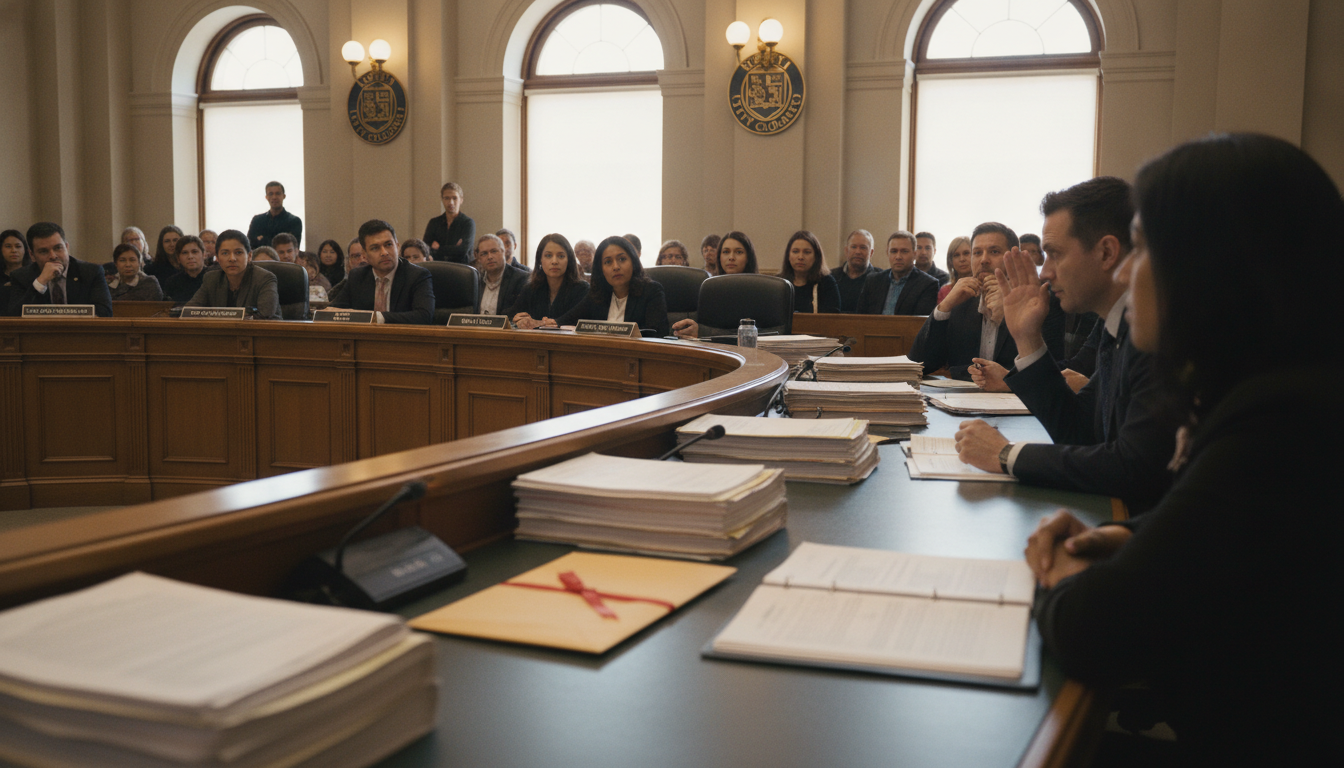
Calgary council approves annual in-camera summary to disclose closed sessions
Calgary city council votes 8-6 to require an annual in-camera summary in the CAO’s first quarterly report, listing closed sessions and legal reasons now.
Calgary city council narrowly approved a notice of motion Tuesday that will require an annual in-camera summary to be included in the chief administrative officer’s first quarterly report each year. The summary will catalogue closed sessions from the previous calendar year and state the legal exemption used for each meeting. Supporters framed the change as an effort to increase transparency about why council meets behind closed doors, while opponents warned it could produce perverse incentives.
Council approves notice of motion
The motion, introduced by Mayor Jeromy Farkas with co-sponsorship from Ward 14 Coun. Landon Johnston, passed on an 8-6 vote. Coun. Johnston was listed as a co-sponsor but was absent when the council took its decision. Those voting against the proposal included Couns. Rob Ward, DJ Kelly, Raj Dhaliwal, Myke Atkinson, Harrison Clark and Jennifer Wyness.
The approved text requires the CAO’s first quarterly report of each year to include an itemized summary of all in-camera meetings held during the previous calendar year. The summary must note the date, the meeting body and the specific legal basis for excluding the public.
Details of the annual summary
City officials say the new summary will not record discussion content or duration but will explain why councillors went into closed session. Municipal staff will list the statutory exemption relied on for each occurrence — for example, personal privacy, land transactions or labour negotiations — consistent with provincial access-to-information rules.
The intent is to centralize information that is otherwise scattered across meeting minutes and committee records, creating a single, searchable reference in the CAO’s quarterly reporting package. Proponents argue this will help the public and media understand patterns in closed-door decision-making without disclosing sensitive material.
Debate over a potential “scorecard” effect
Opponents of the motion raised concerns that publishing a regular tally could pressure councillors to shorten or rush sensitive conversations to reduce the appearance of in-camera time. Coun. Wyness warned this might lead to hasty choices or unfinished work if officials feel a clock is running on private deliberations.
Critics also noted that motions to move in-camera are already recorded in meeting minutes, which are public records posted by the city. They argued the new summary risks duplicating existing records without delivering meaningful additional oversight. Several councillors urged caution in adopting any mechanism that could alter how council conducts necessary confidential business.
Arguments from mayor and supporters
Mayor Farkas said the measure is aimed at public education rather than policing councillors’ schedules. He emphasized that the summary will be agnostic about how long closed sessions last and will instead make clear the legal grounds for them, reinforcing why some deliberations must remain private.
Supporters contend the consolidated report will make it easier for residents to see trends and for the city to demonstrate compliance with legislative requirements. They also suggested the summary could reduce speculation about why council met behind closed doors, by providing straightforward explanations in one place.
Technical questions and the role of clerks
During debate, some councillors questioned whether clerks should compile the summary manually when automated tools could extract the data quickly. Coun. Rob Ward noted an artificial intelligence tool had already been used to calculate time spent in-camera by the current council, though the mayor and others said the proposed summary is focused on reasons rather than minutes.
City clerks will be tasked with assembling the annual list for the CAO report, and officials will need to ensure the summaries align with obligations under the Municipal Government Act and the municipality’s procedure bylaw. Those statutes require a formal statement on the legal exemption used whenever a council or committee goes into closed session.
Next steps and implementation timeline
Council directed administration to include the in-camera summary beginning with the CAO’s first quarterly report next year, covering the previous calendar year’s closed meetings. Staff will develop a consistent format and work with legal services to confirm the phrasing of exemptions is compliant with provincial access rules.
Council members said they expect administration to provide clarity on how the summaries will be compiled and to report back if the new practice produces unintended consequences. The matter will return to routine reporting cycles once the initial format and process are established.
The decision marks a narrow shift toward greater centralized disclosure of the city’s closed-door activity, balancing an appetite for transparency with statutory protections for sensitive information. Future council sessions and the first CAO quarterly report under the new rule will show whether the summary eases public concerns or fuels further debate about the proper scope of in-camera deliberation.
