
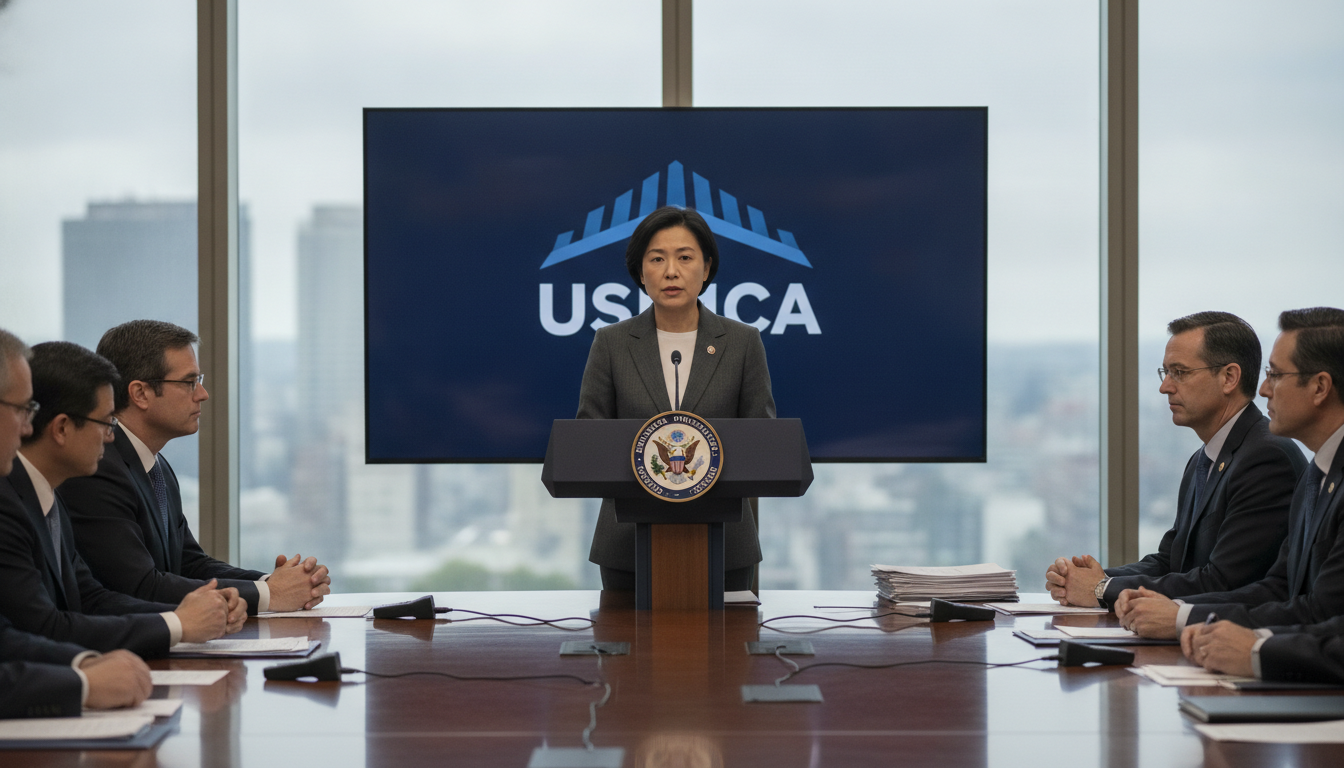
U.S. Declines CUSMA Renewal, Triggers Annual Review Process
U.S. declines to renew CUSMA, triggering annual reviews for the next decade as Washington seeks to fix trade ‘gaps’ and reduce deficits with Canada and Mexico.
The United States announced it will not proceed with a full CUSMA renewal, instead invoking the agreement’s built‑in option that initiates an annual review process for the remaining decade of the pact. The decision was disclosed by U.S. Trade Representative Jamieson Greer after a first trilateral virtual meeting with Canadian and Mexican officials on the trade accord’s sixth anniversary. The move means talks will continue year‑by‑year unless the three partners later agree to a full 16‑year renewal.
U.S. official frames move as effort to correct ‘gaps’
The U.S. representative said Washington intends to use the annual review mechanism to press for changes it describes as remedies for the agreement’s shortcomings and to tackle trade imbalances. Greer framed the step as the start of sustained dialogue with Ottawa and Mexico City to reduce the U.S. deficit with its neighbours. U.S. officials signalled they will formally list specific provisions they wish to amend as part of the review process.
Procedure and choices under the agreement
Under the terms of the Canada–United States–Mexico Agreement, the parties had three paths: a joint 16‑year renewal, mutual withdrawal with six months’ notice, or doing nothing, which automatically initiates yearly reviews for the remaining ten years. Canada and Mexico had indicated in early June a preference to extend the agreement for another 16 years. Instead, the parties opted for the status‑quo procedural trigger, ensuring the review requirement recurs on the agreement’s anniversary each year.
Canada signals focus on sectoral tariffs
Canadian ministers said they would use bilateral meetings with the United States to press longstanding tariff disputes, identifying steel, aluminium, automobiles and softwood lumber as priority issues. Senior Canadian officials and the minister responsible for the file, Dominic LeBlanc, stressed that renewal talks must address sectoral duties that have been imposed since the current U.S. administration took office. Ottawa also warned that the prospect of annual reviews could increase economic uncertainty for investors across all three countries.
Mexico pursues parallel negotiations with U.S.
Mexico has opened a formal negotiation channel with Washington and is preparing a series of bilateral talks, with a U.S.–Mexico meeting announced for the week of July 20. Mexican Economy Minister Marcelo Ebrard said Mexico is not looking to rush an outcome but wants to avoid prolonged uncertainty. Mexican officials will continue to press for stable terms that protect exporters while exploring possible fixes to contentious clauses.
Industry outlook and investor concerns
Business groups in Canada and across the region reacted with caution, noting that while CUSMA safeguarded many industries from new tariffs, some sectors remain exposed and could face ongoing disruption. Market participants will be watching whether annual reviews produce substantive legal changes or merely episodic bargaining that prolongs instability. Observers also warned that extended uncertainty could create openings for competitors, notably China, to win business at the expense of North American suppliers.
Negotiators on all sides stress that a full renewal for 16 years remains possible if the three governments can agree on text changes, meaning the annual review path is not an irreversible step away from long‑term stability. For now, the immediate consequence is a timetable of repeated, formal opportunities for each party to table grievances and seek amendments.
Political signals from Washington have been mixed in recent months, with senior U.S. officials privately acknowledging parts of the pact function effectively while publicly emphasizing deficits and the need for corrections. Canadian and Mexican representatives say they will continue bilateral engagements with U.S. counterparts over the coming weeks to narrow differences and explore pathways that could ultimately support a comprehensive renewal.
