
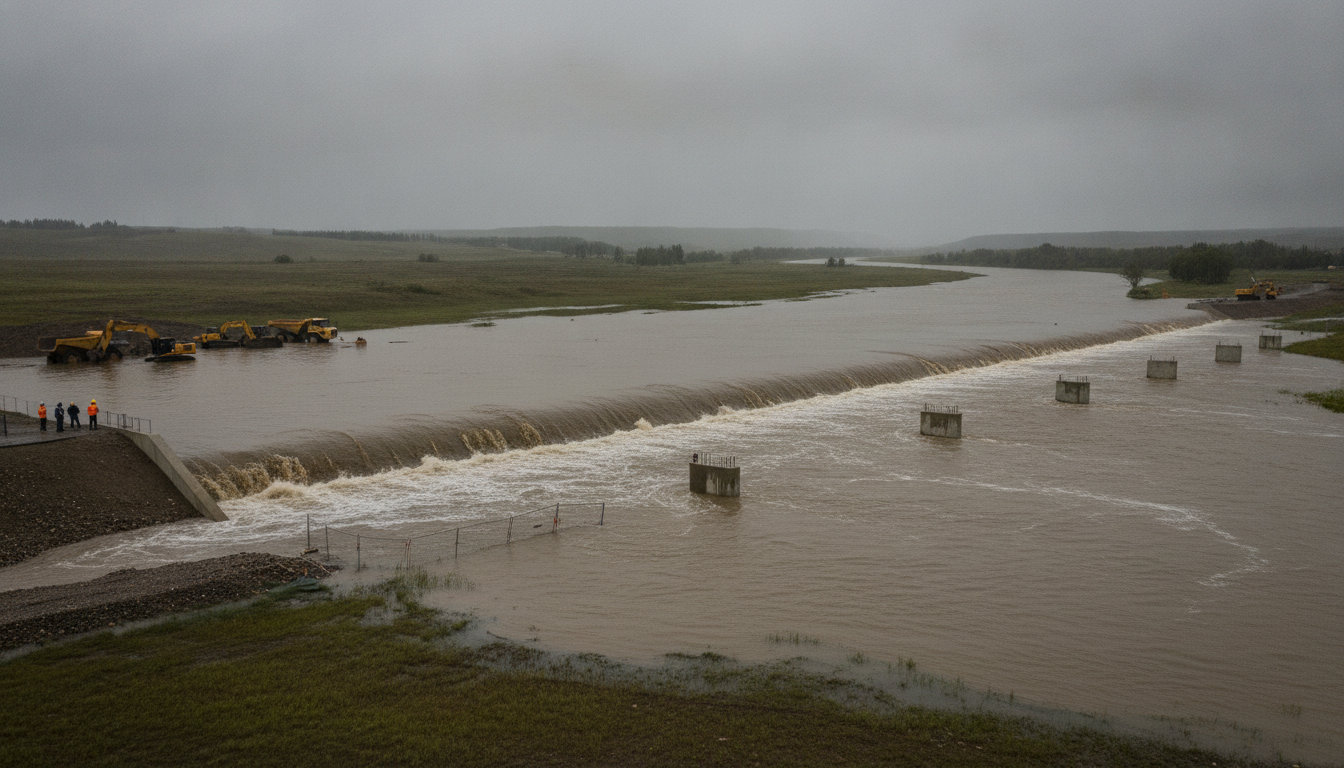
Springbank off-stream reservoir opened for first time as heavy rains trigger flood watches and washouts across Alberta
Calgary diverted water into the Springbank off-stream reservoir after intense rainfall dumped as much as 150 mm in parts of southern Alberta, sparking flood watches, road washouts and emergency alerts across the region.
The city of Calgary and provincial authorities moved quickly on the weekend to route excess runoff into the Springbank off-stream reservoir, using the facility for the first time since it was built to reduce flood risk to downstream communities. High-intensity rain over a short period caused rivers and creeks to rise rapidly, prompting high streamflow advisories and flood watches along the Bow and Elbow rivers. Municipal crews, emergency responders and rural residents reported damaged roads and bridges, and officials urged people to avoid riverbanks and non-essential travel while water levels peak. Authorities emphasized ongoing monitoring as runoff continues and the risk of localized flooding remains in several counties.
Springbank reservoir opened to protect Calgary
For the first operational deployment since its construction, water was intentionally directed into the Springbank off-stream reservoir west of Calgary to hold surplus runoff away from the Elbow River. The reservoir, built after the 2013 floods at a construction cost exceeding $800 million, is normally dry and designed to operate as temporary storage to reduce downstream flood peaks. Officials described the move as a precautionary measure to protect urban neighborhoods and key infrastructure located along the Elbow River corridor. Municipal emergency managers and engineers coordinated the diversion to balance reservoir capacity while keeping downstream flows at safer levels.
Municipal data showed intense precipitation concentrated over a narrow time window in the Bow and Elbow river basins, which sharply increased streamflow rates. City monitoring indicated that rainfall totals in parts of the drainage basins reached the order of 150 millimetres over less than 24 hours, dramatically accelerating runoff into tributaries and main stems. That volume of water, combined with saturated soils and strong winds that accompanied the storms, contributed to elevated water levels and increased debris loading in rivers. City officials maintained that the Springbank diversion was a mitigation action intended to dampen peak flows and reduce risk to Calgary residents.
Engineers and reservoir operators remained vigilant as water entered the off-stream facility, conducting frequent inspections and flow measurements throughout the activation period. The reservoir’s gates and control structures were managed to ensure controlled impoundment and gradual release when downstream conditions permitted. Officials emphasized that using the reservoir changes localized flow patterns and that downstream communities would be kept informed of any adjustments to releases. The activation also served as a real-world test of emergency procedures developed since the reservoir’s completion.
Calgary issues streamflow advisory and Elbow River flood watch
Calgary authorities placed the Bow River under a high streamflow advisory and issued a flood watch for the Elbow River as runoff moved through the system. The advisories were driven by rapidly rising river stages and projections that peak flows could stress low-lying areas and infrastructure along riverbanks. City water management teams worked with provincial hydrometric services to track river gauge readings and refine forecasts over the weekend. Residents near both rivers were asked to take precautions, including moving vehicles and valuables from low areas and monitoring official channels for updates.
The combination of intense precipitation and strong winds elevated the risk of localized flooding and shoreline erosion, conditions that prompted emergency planners to prepare for potential evacuations if river levels exceeded critical thresholds. The City of Calgary and Alberta Emergency Management used real-time telemetry and field observations to determine advisory levels and to decide on measures such as the Springbank diversion. Forecast uncertainty meant that authorities repeatedly cautioned residents to expect changing conditions and to follow guidance from local emergency services.
Municipal teams also focused on protecting essential infrastructure, including water treatment facilities, transportation corridors and utility lines susceptible to flood impacts. Sandbagging and temporary barricades were deployed in some vulnerable locations as short-term protective measures. City crews coordinated with provincial road maintenance crews to identify and respond to emerging washouts or debris-blocked culverts that could impair drainage and public safety.
River safety warnings from Calgary Fire Department and emergency officials
Calgary Fire Department public information officers warned the public to stay away from riverbanks and fast-moving water, highlighting both hypothermia risk and hidden hazards beneath the surface. Officials noted that water temperatures in swollen rivers were low — roughly around 12 C in some areas — and currents were stronger than normal. Debris such as tree branches and other material carried by the flow can create “sweepers” and “strainers” that entrap people or pets against submerged obstacles. Emergency personnel stressed that even shallow-looking water near a bank can carry enough force to overturn a person or vehicle.
Rescue teams also pointed out that wind-driven debris increases the danger to swimmers, boaters and anyone working near the water’s edge. With visibility reduced by murky runoff and floating material, the chance of entanglement and sudden immersion rises significantly. Officials reiterated standard safety advice: avoid recreational river use during high flows, keep children and pets well back from banks, and report observed hazards such as floating debris or emergent erosion to municipal lines. The fire service said it remained ready to respond but urged prevention as a priority because swift-water rescues are inherently risky.
First responders coordinated public messaging with municipal communications teams to ensure consistent warnings across social media, local radio and community alerting systems. The messaging emphasized the dual risks of hypothermia from cold water contact and mechanical injury from submerged objects. In addition to immediate safety guidance, authorities encouraged residents to document property damage and reach out to municipal hotlines for advice about sandbagging and temporary flood protection measures.
Rural washouts and bridge failures in Strathcona County
Outside the Calgary region, heavy rain and obstructed drainage caused significant infrastructure failures in rural areas, particularly in Strathcona County east of Edmonton. In the rural community of Akenside, runoff overwhelmed a creek crossing and left a bridge and roadway collapsed into a gaping breach. Local residents reported that debris and beaver dams had impeded culvert flow in the days leading up to the collapse, and the sudden influx of water caused the culvert to fail and the approach to wash away. The incident disrupted local traffic and prompted immediate response from county road crews.
Homeowners in the area described watching water levels climb to heights well above normal banks, and several reported moving belongings out of basements and lower floors as a precaution. Neighbours and county crews worked together to clear blocked channels once it was safe, and heavy equipment was brought in to restore flow and make temporary repairs. Officials said assessments would determine whether a permanent bridge replacement or a revised drainage design would be necessary to prevent similar future failures.
County engineers cited a combination of localized factors — beaver activity, undersized or obstructed culverts, and concentrated rainfall — as contributors to the erosion and infrastructure damage. Those same factors, they noted, are increasingly relevant as communities adapt to more frequent extreme precipitation events. Strathcona County confirmed that emergency road repairs were underway and that residents would be kept informed about detours and timelines for restoration.
Emergency alerts and road restrictions in Beaver and Lac Ste. Anne counties
Provincial and municipal emergency alerts remained active in several counties, including Beaver County and Lac Ste. Anne County, where overland flooding continued to block rural roads and isolate some properties. County officials implemented damage assessments and began prioritizing road repairs based on the extent of erosion and public-safety implications. Several routes were closed to through traffic pending safety inspections, and motorists were advised to consult Alberta 511 for the most current road-condition information before travelling.
Local emergency management teams coordinated with provincial agencies to ensure relief and recovery resources were directed to the most affected areas. That included dispatching heavy equipment to clear debris, reopening critical access routes for emergency services, and arranging contingency support for residents who might be cut off by flooding. County authorities emphasized that conditions could change rapidly and urged drivers to respect posted road closures and detour signage to avoid creating additional hazards.
In some locations, overland flooding left agricultural lands waterlogged and caused localized damage to fences and farm access roads. Agricultural producers were advised to document losses and to contact their local municipalities regarding assistance programs and timelines for infrastructure repairs. County representatives committed to sharing updated advisories and recovery plans with residents as assessments progressed.
Forecast, runoff monitoring and outlook for rivers
While the most intense rainfall had tapered at the time of the event, river and creek levels continued to rise as runoff reached main channels, meaning that peak river stages were still being reached in the days after the storms. Hydrologists and municipal water managers emphasized that rainfall is only the first stage of a flood cycle; the timing of peak flows depends on basin slopes, soil saturation, and the network of tributaries that route water toward main rivers. As a result, communities downstream could see elevated water levels even after skies clear.
Environment Canada forecast models indicated the possibility of additional showers or isolated thunderstorms in the days following the initial event, which could hamper recovery efforts and complicate forecast confidence. Municipalities continued to monitor gauge readings and run short-term hydrologic forecasts to refine actions such as controlled reservoir impoundments and temporary road restrictions. Authorities reiterated that residents should remain prepared for shifting conditions and check official sources for updated advisories rather than relying on social media alone.
The Springbank activation will remain under review as the reservoir transitions from active storage back to standby operations, and engineers will use data collected during the event to evaluate performance. The event provided municipal planners and provincial staff with operational experience that will inform future emergency-response plans and infrastructure maintenance priorities. In the medium term, officials noted that detailed damage assessments and an inventory of at-risk culverts and bridges will guide repair schedules and investment decisions.
Community response and immediate recovery actions
Across affected communities, emergency crews, municipal staff, and volunteers mobilized to address urgent needs, from clearing blocked culverts to providing temporary shelter and sandbag assistance. Local contractors with excavators and dump trucks worked with county road departments to reopen access where it was safe to do so, and municipal crews concentrated on debris removal and stabilizing washed-out embankments. Residents advised to document damage with photographs and to keep records of expenses related to emergency measures for possible reimbursement or insurance claims.
Neighbourhood and rural associations played an active role in disseminating local information, coordinating neighbour check-ins and sharing contact points for municipal support. In areas with limited cell coverage, door-to-door checks by local volunteers ensured that isolated households had information on road closures, sandbag availability and where to seek help. The provincial emergency-management framework provided for inter-jurisdictional support should counties require additional resources for recovery and repair.
Utility companies and transportation authorities inspected equipment and corridors for flood-related impacts, including potential erosion near poles and substations, and scoured underpasses and roadbeds for undermining. Where infrastructure stability was in question, service teams isolated affected equipment and posted warnings until safe remediation could be completed.
Final preparations and continued caution
As runoff continues to move downstream and crews work to repair damage, authorities asked residents to remain vigilant and to follow official updates from municipal and provincial emergency-management channels. Avoiding riverbanks, respecting road closures, and taking practical household precautions remain the immediate priorities for public safety. The activation of the Springbank off-stream reservoir demonstrated one layer of flood-risk mitigation now in action, while field assessments and repairs will shape recovery efforts in the coming days and weeks.
